Key Takeaways
- A black wire is the primary hot conductor in U.S. residential and commercial electrical systems
- The black wire carries live electricity from the electrical panel to outlets, switches, fixtures, and equipment
- A black wire should always be treated as live until proper testing confirms otherwise
- Turning off a switch does not always de-energize a black wire
- Black wire is not neutral and is not a ground wire
- In U.S. AC electrical systems, black wire is neither positive nor negative
- Color alone never confirms whether a wire is safe to touch, testing is always required
- When in doubt about any black wire, stop and call a licensed electrician
Important Safety Notice: The information in this article is provided for educational purposes only. Electrical work involves serious risk of shock, fire, and injury. Descriptions of wiring configurations and testing methods in this article are intended to help you understand how electrical systems work, not to guide you through performing electrical work yourself. Always turn off power at the panel and verify with a voltage tester before approaching any wiring. When in doubt, stop and contact a licensed electrician.
If you have ever opened an outlet box, a light fixture, or a switch and seen a black wire staring back at you, you already know that uneasy feeling. Is it safe to touch? Is it live right now? What is it even connected to?
Those are exactly the right questions to ask.
Black wire is one of the most common wires in any U.S. electrical system, and it is also one of the most misunderstood. Homeowners and business owners run into it constantly, whether they are replacing an outlet, installing a ceiling fan, or troubleshooting a tripped breaker. The problem is that black wire does not always behave the way people expect it to.
At Palmer Electric, our certified electricians work with black wire every single day, in homes, in commercial buildings, in new construction, and in older properties where the wiring has been modified over the years. We have seen what happens when black wire is misidentified, connected to the wrong terminal, or assumed to be safe because a switch was flipped off. It is never a good outcome.
This guide covers everything you need to know about black electrical wire: what it does, when it is hot, where it goes, what it connects to, and when you should stop what you are doing and call a professional.
Black Electrical Wire Summary Table
| Category | Details |
|---|---|
Wire Color | Black |
Primary Role | Hot conductor: carries live electricity from panel to devices |
Safety Status | Hot: treat as live at all times until tested |
Standard System | 120V and 240V AC residential and commercial (U.S.) |
NEC Classification | Ungrounded conductor: the NEC term for a hot wire |
Common Uses | Outlets, switches, light fixtures, ceiling fans, appliances, panels, commercial equipment |
Standard Pairing (Wires in the Same Cable or Circuit) | White (neutral) and green or bare copper (ground). These wires travel together but are never connected to each other. Each connects to its own separate terminal. |
Where Black Wire Connects | Hot terminal only: brass screw on outlets, common terminal on switches, hot bus bar in panels |
Voltage Tester Required | Yes, always before handling |
Can It Be Neutral | No, per NEC conventions. However, in older or non-code-compliant wiring, a black wire may have been used as a neutral. Always verify by testing, never by color alone |
Can It Be a Ground | No |
Positive or Negative | Neither: In standard U.S. residential & commercial electrical systems, which run on alternating current (AC), do not use positive or negative labels |
When to Call a Pro | Multiple black wires in one box, unknown connections, burning smell, tripped breaker, post-renovation wiring |
What Is a Black Wire in Electrical?
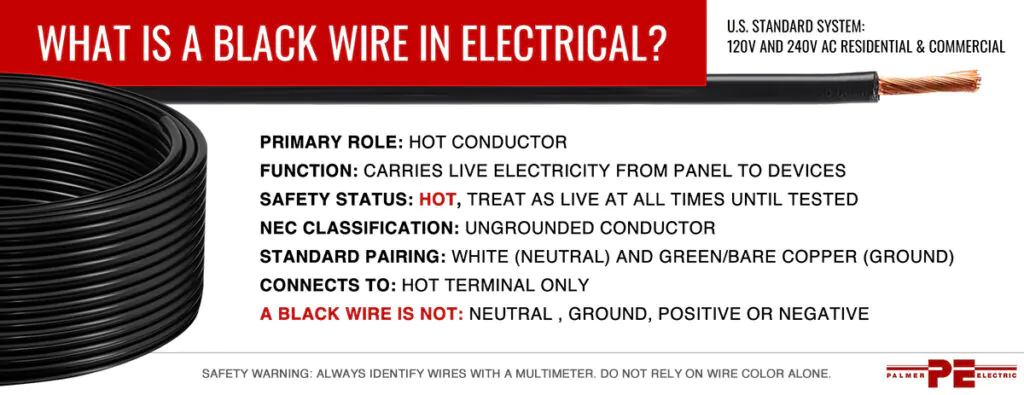
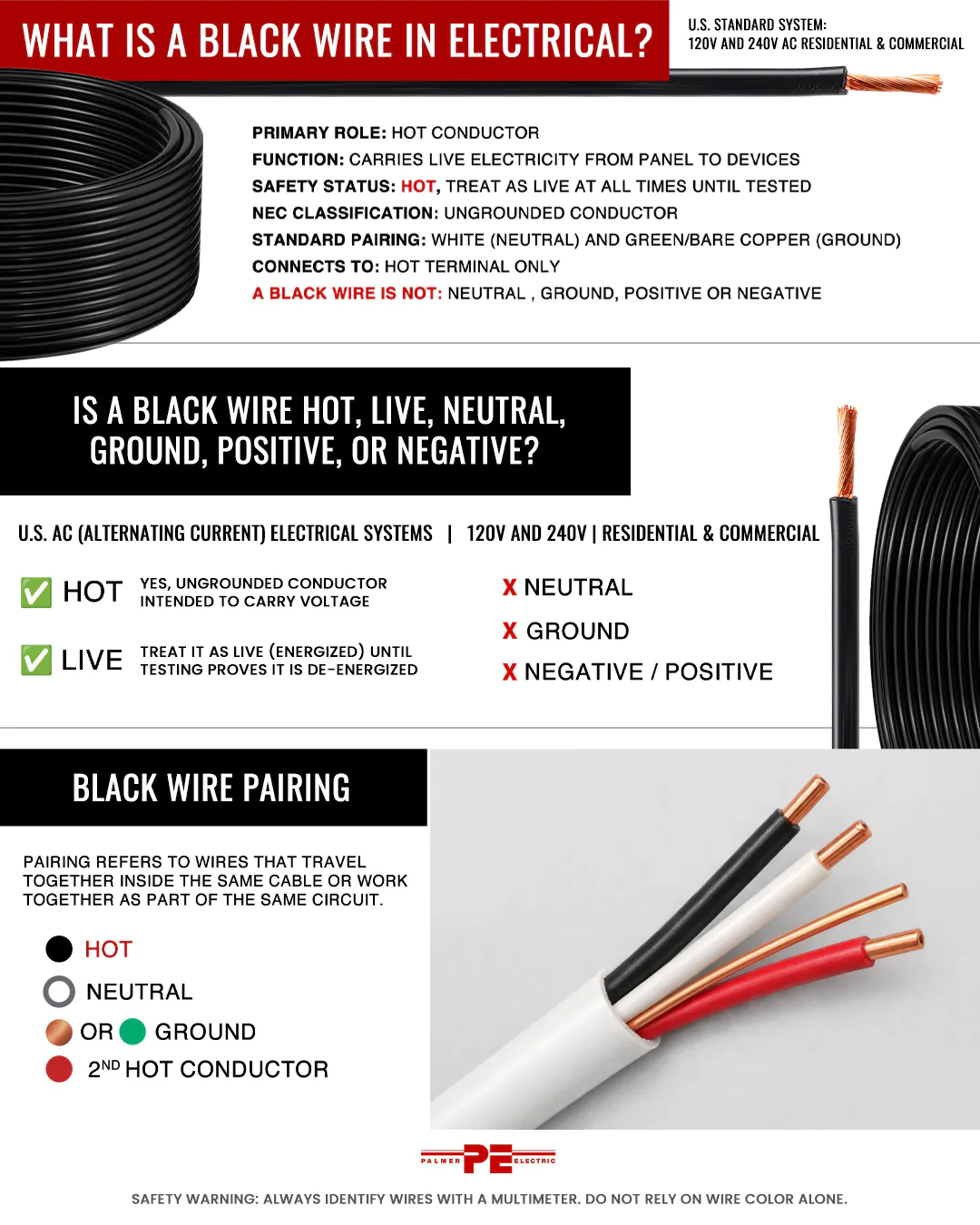
A black wire is the primary hot conductor in U.S. electrical systems. Its job is to carry live electricity from the electrical panel to the devices connected to the circuit, including outlets, switches, light fixtures, and appliances. Because it delivers power, a black wire is typically energized whenever the circuit is on.
Black wire is what most electricians refer to when they talk about the “hot” wire in a standard circuit. It is one of the first wires identified when opening any electrical box, and it is always treated with caution because of the role it plays.
Black Wire Synonyms: Live, Hot, and Energized
When electricians talk about black wire, they use several terms that can sound interchangeable but have slightly different meanings.
- A hot wire is a conductor that carries voltage above ground as part of the normal circuit design.
- A live wire means the wire is actively carrying electrical current at that moment.
- An energized wire is the broader term, meaning voltage is present whether or not current is actively flowing. A wire can be energized even when no device is drawing power from it.
In summary, a black wire can be hot, live, and energized all at once. That combination is exactly why it demands respect every time you encounter it.
Black Electrical Wire Voltage Rating in the US
Black wire is used in both 120V and 240V alternating current (AC) circuits in U.S. residential and commercial wiring. In a standard 120V circuit, one black wire carries power from the panel to the device. In a 240V circuit, such as those used for dryers, ovens, and air conditioning units, two hot wires are present and one or both may be black.
The voltage rating of a wire depends on its type, not its color. Common wiring types found in U.S. homes and commercial buildings, such as NM-B cable, the standard white or gray jacketed cable you see running through walls, and THHN conductors, used in conduit in commercial settings, are typically rated for 600 volts. Per NEC requirements and OSHA electrical standards, that rating applies to every conductor inside the cable regardless of color, and it provides a significant safety margin above the 120V and 240V used in standard branch circuits. Per code-based product marking requirements, the cable or conductor type is identified by markings on the cable jacket and/or conductor insulation, not by color alone.
Black Electrical Wire Function in Residential and Commercial Wiring
The core function of black wire is power delivery. It is the conductor that completes the first half of the circuit, bringing electricity from the panel to whatever device is at the end of the run. Without the black wire doing its job, nothing turns on.
In residential wiring, black wire is the wire that feeds power to outlets, connects to switches, and supplies ceiling fixtures and fans. In commercial wiring, black wire is one of the standard hot conductors in 120/208V three-phase systems, where it represents one of the three phase conductors.
The function stays the same in both settings: carry power to where it is needed. The difference is in how the system is built around it.
Is Black Wire Hot, Neutral, or Ground?
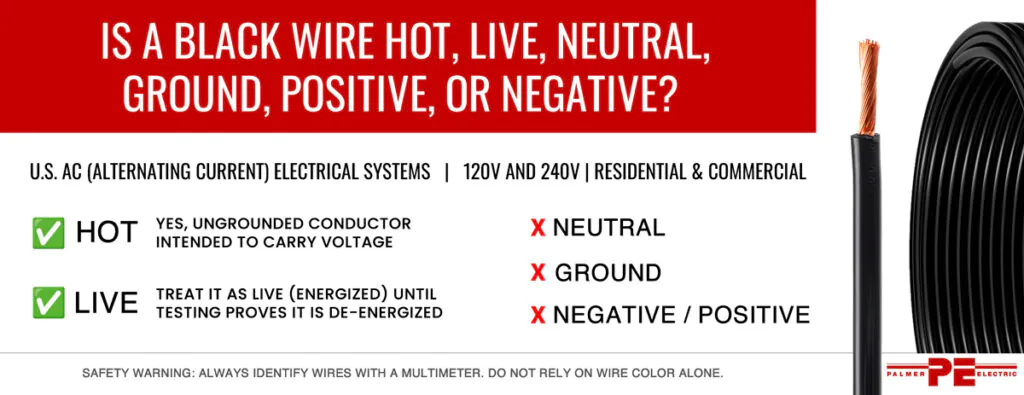
In U.S. electrical systems, a black wire is hot, and not neutral or ground. But understanding what that means in practice is not quite that simple, which is what this section covers.
Is Black Wire Hot?
Yes, a black wire is hot. In U.S. electrical systems, black is the standard color for the primary hot conductor. It carries live electricity from the electrical panel to outlets, switches, fixtures, and equipment. Any time you see a black wire, your default assumption should be that it is energized.
This applies whether the circuit appears to be off, whether a switch has been flipped, or whether a breaker was recently reset. A black wire is hot until a voltage tester proves otherwise.
Is a Black Wire Always Hot?
Not always, but treat it as if it is. In standard U.S. wiring, a black wire is almost always a hot conductor. However, there are real-world exceptions that can catch people off guard.
In older wiring systems, a black wire may have been re-identified or repurposed. In 3-way switch wiring, a black wire can sometimes serve as a traveler wire, meaning it is only energized under specific switch positions. In modified or DIY-wired systems, color conventions may not have been followed at all.
This is exactly why testing is non-negotiable. A black wire that appears inactive may still become live the moment a switch is toggled or a connected device is activated. Our electricians at Palmer Electric always verify with a non-contact voltage tester before touching any wire, regardless of color.
Is Black Wire Hot or Neutral?
Black wire is hot, not neutral. In standard U.S. residential wiring, the neutral conductor is white or gray. The black wire and the neutral wire have opposite roles: the black wire delivers electricity to the device, and the neutral wire returns it to the panel.
Mixing up black and white wires is one of the most common and dangerous mistakes in DIY electrical work. Connecting a black wire where a neutral wire belongs, or vice versa, can damage equipment, trip breakers, or create a serious shock hazard.
Is Black the Ground Wire?
No. Black wire is not a ground wire. In U.S. electrical systems, ground wires are green, green with a yellow stripe, or bare copper. The ground wire is a safety conductor, it is not part of the normal current path. Black wire is the opposite: it is always part of the current path and carries live electricity under normal operating conditions.
If you are ever unsure which wire is the ground in a box, look for green or bare copper. If no wire matches that description and you cannot identify the ground with confidence, that is a situation for a licensed electrician who can do testing with professional tools.
Is a Black Wire Live or Neutral?
A black wire is usually live, not neutral. In standard U.S. wiring, black usually identifies the hot wire, while neutral is usually white or gray. Because wiring can be altered, damaged, or misidentified, always test any wire before touching it. Do not rely on color alone to identify if it is live or not.
In common language, people use “live” to mean the wire has electricity on it right now and can shock you if touched. A neutral wire is the wire that normally carries electricity back to the panel after a light, outlet, or appliance uses it, and it is usually white or gray. OSHA says ungrounded, or “hot,” wires are often black or red, while grounded conductors are generally white or gray.
One important detail: a black wire is usually a hot wire, meaning it is intended to carry voltage in normal operation, but it is not always live at that exact moment. The breaker could be off, or the power could be out. That is why electricians use hot to describe the wire’s normal job, and live to describe whether voltage is present right now. OSHA defines live parts as energized conductive components.
If you find a black wire being used as a neutral, that usually points to older work, altered wiring, or improper identification, and it should be evaluated carefully before any work continues. Color alone is never a reliable identifier, so any wire should be tested before touching.
Is the Black Wire Positive or Negative?
In standard U.S. residential and commercial electrical systems, which run on alternating current (AC), a black wire is neither positive nor negative. Those terms apply to direct current (DC), systems such as batteries, automotive wiring, and solar panels. In AC systems, the correct term for the black wire is “hot”.
In most DC systems, black is commonly used as the negative conductor, but this varies by application. if you are working on a DC system and you see a black wire, do not assume it is negative based on color alone. Always confirm polarity through system documentation or testing before making any connections.
| System Type | Black Wire Role | Positive / Negative | AC Terminology |
|---|---|---|---|
U.S. Residential AC (120V) | Hot conductor | N/A, does not apply | Hot |
U.S. Commercial AC (120/208V) | Phase A hot conductor | N/A, does not apply | Hot |
U.S. High-Voltage AC (277/480V) | Not standard for black | N/A, does not apply | Hot (brown typically used) |
DC (solar, battery, automotive) | Typically negative conductor | Negative | N/A |
DC (RV, marine, specialty) | Varies by manufacturer | Verify by documentation | N/A |
For a full guide on positive and negative wire color identification in DC and low-voltage systems, read our article: Positive and Negative Wire Color Identification.
What Does the Black Wire Connect To?
Black wire always connects to the hot side of a device, never to the neutral or ground terminal. Knowing exactly where it belongs before you touch anything is the difference between a safe connection and a dangerous one.
Black Wire Terminal Connections: What to Know Before You Touch Anything
Before touching any black wire, turn off the correct breaker and confirm the circuit is dead with a non-contact voltage tester. Black wire connects to hot terminals, brass-colored screws, or labeled hot ports on devices. It never connects to neutral terminals, silver screws, or ground bars.
That single rule, black wire goes to the hot side, covers the vast majority of connections you will encounter in residential and commercial wiring. The challenge is that not every device labels its terminals clearly, and not every electrical box you open will be wired correctly to begin with. Knowing where the black wire is supposed to go is the first step. Verifying where it actually goes before you touch anything is the second.
Can I Connect a Black Wire to a Red Wire?
Yes, but only in specific and proper configurations. This is done when both wires are hot conductors in the same circuit and the connection is intentional and code-compliant. Common examples include certain 240V appliance circuits, such as dryers and ovens, and some multiwire branch circuit configurations where both the black and red wires carry power on separate phases.
Do not connect a black wire to a red wire unless you know the circuit is designed for it. In U.S. wiring, black and red wires are both usually hot wires, and they should only be connected when the circuit is specifically designed for that connection. You should never connect a black wire to a red wire simply because both are present in the box without understanding the circuit first. Connecting them incorrectly can create a short circuit, damage equipment, or create a serious shock hazard.
If you are not certain why a black and red wire are both present in a box, stop and have a licensed electrician evaluate the circuit before proceeding.
What Does "Pairing" Mean in Electrical Wiring?
In electrical wiring, pairing refers to the wires that travel together inside the same cable and work together as part of the same circuit. Each wire in a pair has its own separate job and connects to its own specific terminal. They are never connected to each other.
Think of it like a team. Black wire, white wire, and ground wire travel together inside the same cable, but each one has a different position to play. Black delivers power, white returns it, and ground provides a safety path. Same cable, separate roles, separate connections.
| Category | Details |
|---|---|
| Wires in the Same Cable | Black (hot) travels with white (neutral) and green or bare copper (ground) |
| What Each Wire Connects To | Black to hot terminal only, white to neutral terminal, ground to ground terminal |
| Are They Ever Connected to Each Other | No, each wire connects to its own separate terminal only |
Black Wire Pairing Overview
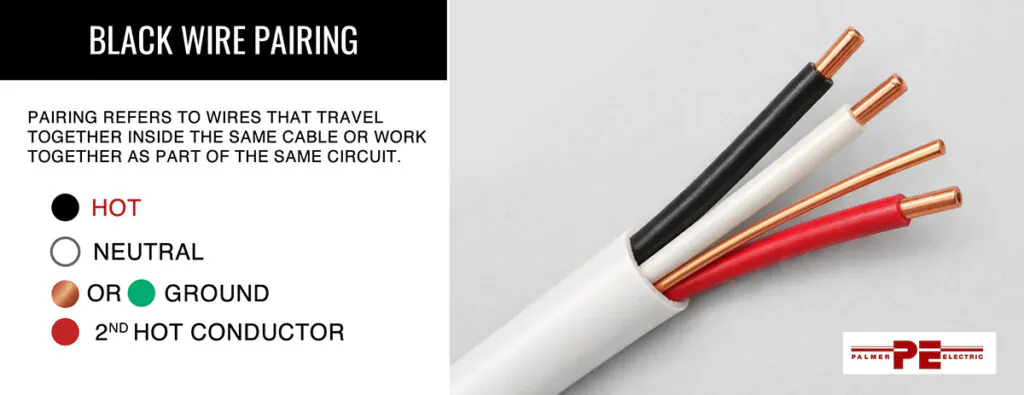
In standard U.S. residential wiring, black wire is always paired (travels) with a neutral and a ground. Here is how the standard pairing works in a basic circuit:
| Wire | Role | What It Does | Connects To |
|---|---|---|---|
| Black | Hot conductor | Carries electricity from the panel to the device | Hot terminal: brass screw on outlets, common terminal on switches, hot bus bar in panel |
| White | Neutral conductor | Returns electricity from the device back to the panel | Neutral terminal: silver screw on outlets, neutral bar in panel |
| Green or Bare Copper | Ground conductor | Provides a safety path for fault current, does not carry current during normal operation | Ground terminal: green screw on outlets, ground bar in panel |
| Red (when present) | Second hot conductor | Carries electricity as a second hot leg in 240V circuits or as a switch leg in multi-wire setups | Hot terminal: second brass screw on 240V outlets, traveler terminals on 3-way switches |
These wires travel together in the same cable but are never connected to each other. Each connects to its own separate terminal only.
Warning: A black wire must never be connected to a ground terminal, green screw, or bare copper ground wire. The ground conductor travels alongside black wire in every circuit but never carries load current.
This three-wire combination is the foundation of almost every 120V circuit in a U.S. home or commercial building. When all three are present and connected correctly, the circuit operates safely. When one is missing or misidentified, the risk of shock, damage, or fire increases significantly.
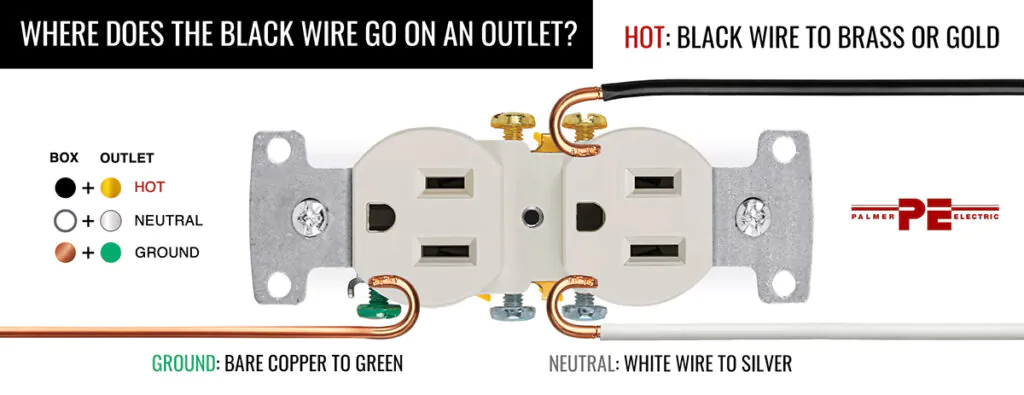
Where Does the Black Wire Go on an Outlet?
The black wire connects to the brass-colored (or gold) screw terminal on an outlet. This is the hot side of the receptacle. The brass terminal is identified by its color and may also be labeled HOT or H on the outlet body. Always identify the terminal by its color and marking, not by its position on the device.
This is one of the most common questions we hear from homeowners attempting a DIY outlet replacement. Getting it right matters because reversing the hot and neutral connections creates a condition called a reverse-polarity outlet. The outlet may still work, but it becomes significantly more dangerous because the device plugged into it is energized in a way it was not designed for.
Black Wire to Gold or Silver Screw?
Yes, the black wire goes to the gold or brass screw. The white wire goes to the silver screw. This is the standard terminal identification for 120V receptacles in the United States.
Here is a simple way to remember it: black to brass, white to silver.
Keep in mind that manufacturer instructions identify outlet terminals by screw color and device marking, not by room orientation or which side appears left or right after installation.
Black Wire to Gold or Silver Screw: Correct Terminal Wiring
| Terminal | Screw Color | Wire Color | How to Identify |
|---|---|---|---|
| Hot | Brass / Gold | Black | Connect to the brass or gold terminal, often marked HOT or H |
| Neutral | Silver | White | Connect to the silver terminal, often marked neutral or identified by silver-colored screws |
| Ground | Green | Green or Bare Copper | Connect to the green grounding screw |
| Hot, second if applicable | Brass / Gold | Red | On certain receptacles, a second hot may also connect to a brass terminal, depending on the device and circuit |
Does It Matter Which Side of the Outlet the Black Wire Goes On?
Yes, it matters. The black wire goes to the gold or brass screw. Connecting the black wire to the wrong side of the outlet is a safety hazard. Even if the outlet appears to function normally, a reverse-polarity connection means the hot side of the circuit is energized on the neutral terminal of any device plugged into it. This increases the risk of shock when handling plugs or servicing devices.
A simple and inexpensive plug-in outlet tester, available at any hardware store, will immediately tell you if an outlet has reversed polarity. If an outlet in your home or business fails that test, stop using it and have it corrected by a licensed electrician.
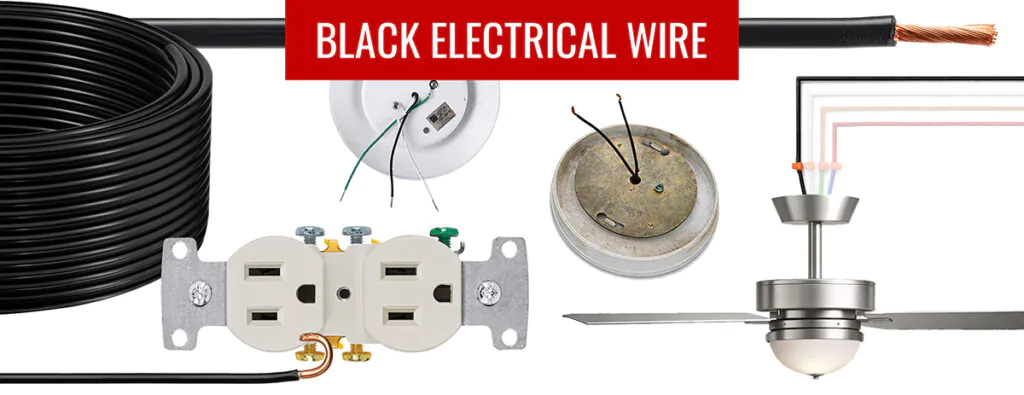
Black Wire in a Light Fixture
In a light fixture, the black wire is the hot conductor. Its job is to carry electricity from the ceiling box to the fixture itself, powering the bulb or LED module inside. It connects to the corresponding hot wire in the ceiling box, which is also typically black. Always treat it as live until testing confirms otherwise.
Light fixtures are where black wire questions get more complicated. Unlike a simple outlet, a fixture box can contain multiple black wires, and not all of them behave the same way.
Why Does the Ceiling Box Have 2 Black Wires?
Two black wires in a ceiling box usually mean one wire brings power in, and the other carries power to a switch, the light, or another device. The box is often acting as part of a larger circuit, not just feeding one fixture.
Common reasons:
- A feed-through box configuration: Power enters the ceiling box and then continues to another part of the circuit. The box not only feeds the light, but also passes power along to another switch, outlet, or fixture.
- The box is part of a switch loop. In some older-style switch-loop wiring, power reaches the ceiling box first and then travels down to the wall switch and back to the light.
- The wiring may be older or previously modified. In older homes, the wire colors and connections in a ceiling box may not follow the simple black-to-light, white-to-neutral pattern homeowners expect.
Safety warning: Do not assume both black wires do the same job. One may be always energized, one may be switched, and one may continue power to another part of the circuit. Test every wire before touching or reconnecting anything.
At Palmer Electric, this is a situation we see regularly during fixture replacements and ceiling fan upgrades. Our electricians always test every wire in the box before making any connections, regardless of how the wiring appears.
If you open a ceiling box and find more wires than you expected, stop and call a licensed electrician before proceeding.
Why Does a Ceiling Light Have 2 Black Wires?
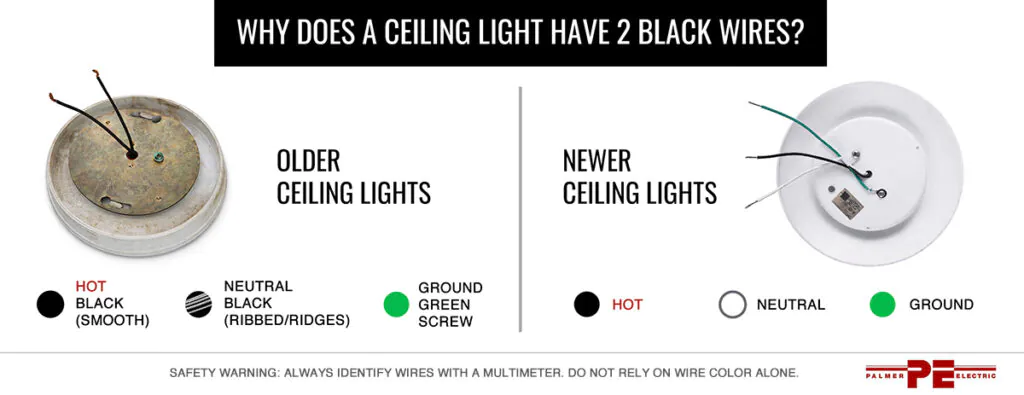
Most of the time, when a ceiling light has two black wires, it is because it is an older fixture and the wires are not color-coded the modern way (black for hot and white for neutral). In these fixtures, one black cable is typically hot (smooth), and the other is neutral (usually ribbed or marked).
Safety warning: Always identify cables with a multimeter; do not rely solely on the wire’s color or texture.
Why Does the Light Fixture Have 2 Black Wires?
Two black wires on a light fixture usually mean the fixture has its own internal wiring setup, such as multiple bulbs, or that it is an older fixture that is not color-coded the way newer fixtures usually are with black (hot) and white (neutral) wires. In that case, the fixture instructions or wire markings are the best guide.
Common reasons:
- The fixture has internal wiring for multiple bulbs or parts
- The fixture is older, and the wires are not color-coded the modern way. Previously, one black ribbed (with ridges) wire was used as a neutral cable, and the smooth black wire was used as the hot.
- The fixture instructions or markings are needed to identify which wire is hot and which is neutral.
Safety warning: If you need to identify which black wire is the neutral cable, do not rely on color or wire texture alone. Use a multimeter to test which black wire is the neutral and which is the hot.
Black Wire in a Ceiling Fan
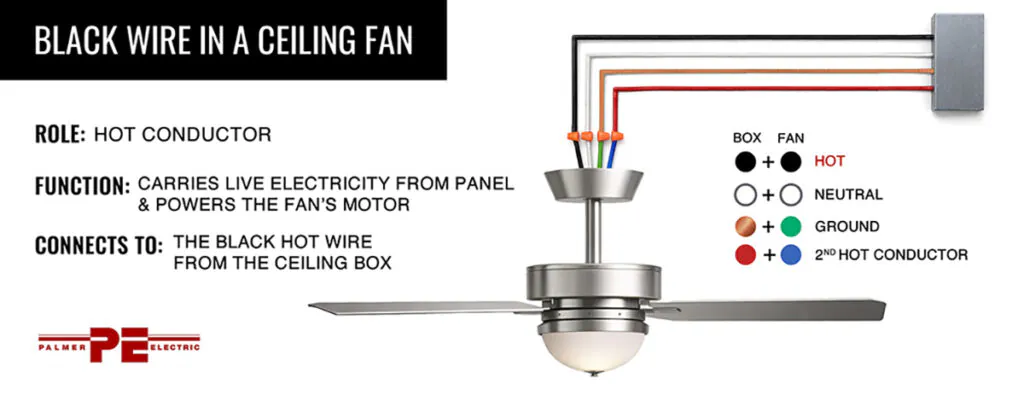
On a ceiling fan, the black wire is usually the “hot” wire that powers the fan motor. In many standard installations, the blue wire powers the light kit, but wiring can vary by model and control type, so always follow the manufacturer’s diagram.
A ceiling fan often has more conductors than a standard light fixture, and they do not all serve the same purpose. Unlike a simple light fixture where one hot wire controls the whole unit, a ceiling fan typically uses separate wires for the fan motor and the light kit. In most standard ceiling fan installations, the black wire typically controls the fan motor and a separate blue wire typically controls the light kit.
| Wire Color on Fan | Typical Function | Notes |
|---|---|---|
| Black | Fan motor control | Usually connects to the black hot wire from the ceiling box |
| Blue | Light kit control | Usually connects to the red wire, if you have separate wall-switch control |
| White | Neutral | Connects to the white neutral wire in the ceiling box |
| Green or Bare Copper | Ground | Connects to the bare copper or green grounding wire, and may also bond to the metal ceiling box |
Keep in mind that ceiling fan wiring can vary by manufacturer, fan model, and control type. Fans equipped with remote receivers or smart controls may have additional wires or require a different wiring configuration entirely. Because of this variation, the fan’s included wiring diagram is always the most reliable reference for that specific model.
When a ceiling fan is controlled by a single wall switch, the black and blue fan wires are often connected together to the single hot wire from the ceiling box, though this can vary by fan model and control type. When a dual switch is installed, one switch usually controls the black fan wire, and the other controls the blue light wire. Getting these connections mixed up is a common DIY mistake that results in the fan and light not operating as intended.
When Multiple Black Wires in a Ceiling Box May Still Be Live
Even after turning off the wall switch, multiple black wires in a ceiling box may still be energized. This happens because the switch only interrupts power to the fixture, not necessarily to every wire in the box. Depending on how the circuit is wired, the wire bringing power into the ceiling box may remain energized regardless of switch position.
This is often a normal part of switch-controlled lighting circuits, not necessarily a wiring defect. It is also one of the most important safety points in this entire article.
Before touching any wire in a ceiling box:
- Turn off the breaker for that circuit, not just the wall switch
- Use a non-contact voltage tester as an initial check on every wire in the box, including all black wires
- Confirm the circuit is de-energized before touching any conductors
- Do not assume any wire is safe based on switch position alone
Black Wire on a Light Switch
A black wire on a light switch is the “hot” wire, which usually carries power to or from the switch. In many standard switch setups, one black wire brings power into the switch, and another black wire carries power out to the light. Because one of those wires may still have power even when the switch is off, every wire in the box should be treated as potentially energized until tested.
Light switches are another common place where homeowners run into unexpected black wire configurations. What looks like a straightforward swap can quickly become confusing when the box contains more wires than expected. Below are some examples.
3 Black Wires on a Light Switch
The three black wires may include a hot wire, which brings power in from the panel, a switched wire, which sends power to the light, and a wire that continues power to another device or switch. In some homes, they may also be part of a more complex switching setup.
Common scenarios for 3 black wires on a light switch include:
- The switch box brings power in, sends power to the light, and continues power to another device. Example: one switch controls a kitchen light, while the same box also passes power to a nearby hallway outlet.
- The switch box is part of a multi-switch setup, where more than one switch controls the same light or fixture. Example: a stairway light can be turned on or off from both the top and bottom of the stairs.
- The box is being used as a pass-through point, so power continues on to another outlet, switch, or fixture. Example: the switch box for a bedroom light also sends power onward to the closet light.
In older or modified wiring, the wire colors may not follow a simple or predictable pattern. That is why electricians identify each wire by testing its function, not by assuming its role based on color alone.
If you open a switch box and find three black wires, it’s time to call a licensed electrician. Identifying which wire belongs on which terminal requires testing and experience, and getting it wrong can result in a switch that does not work properly, a light that does not respond correctly, or a wiring condition that creates a safety hazard.
What are the three black wires to a switch?
The three black wires may include a hot wire (which carries voltage from the panel), a switched wire (which carries power to the light), and a wire that continues to supply power to another device or switch. In some homes, they may also be part of a more complex switching setup.
Does It Matter Which Black Wire Goes on a Light Switch?
Yes, sometimes it does; it depends on the type of switch. On a standard single-pole mechanical light switch, the two switch terminals are usually interchangeable, so either black wire can typically go on either terminal.
On a 3-way switch, it matters a lot because the wire on the common terminal must be placed correctly for the switch to work as intended.
On most 3-way switches, the common terminal is identified by a darker or black-colored screw, and on some switches, it may also be labeled COM or COMMON.
The other two terminals, usually brass-colored screws, are the traveler terminals. If the common and traveler wires are mixed up, the light may work inconsistently or not work properly from both switch locations.
| Switch Type | Does Wire Placement Matter | Common Terminal Identifier | Common Error |
|---|---|---|---|
| Single-pole (standard, mechanical switch) | No, two brass terminals are interchangeable | Both terminals are brass colored | Leaving ground unconnected |
| 3-way switch | Yes, common terminal is specific | Darker screw color, may also be labeled COM or COMMON | Wrong wire on common terminal |
| 4-way switch | Yes, traveler pairs must be correct | No common terminal, four traveler terminals | Mismatched traveler pairs |
Black Wire in a Smart Switch
The black wire in a smart switch is usually the incoming “hot” wire that brings power from the panel into the switch, while another terminal or wire sends power to the light. Many smart switches also require a neutral wire, although some no-neutral models are designed to work without one.
Smart switches draw a small amount of continuous power to maintain their wireless connection and internal electronics. In many older homes, a neutral wire was not present in the switch box because older standard switching arrangements did not require one there. NEC requirements for switch box wiring have evolved over time, so whether a neutral is present depends largely on when and how the circuit was originally installed.
Some smart switch models are specifically designed to operate without a neutral wire, including certain no-neutral models from manufacturers such as Lutron and Leviton, but these have their own compatibility requirements and do not work correctly in every installation.
Before installing a smart switch, confirm the following:
- Whether the switch box has a neutral wire available
- Whether the smart switch model you selected requires a neutral wire or is specifically designed to work without one
- Whether the existing wiring configuration is compatible with that model
- Whether the circuit load type and wattage falls within that specific model’s rated capacity, which varies by manufacturer and product
At Palmer Electric, our electricians handle smart switch installations regularly and can confirm compatibility, identify whether a neutral is present, and recommend the right model for your specific wiring configuration before any work begins.
Where Black Wires Are Commonly Found
Black wire is present in virtually every part of a U.S. electrical system. The table below covers the most common locations and what the black wire is doing in each one.
| Location | Black Wire Role | Key Detail |
|---|---|---|
Standard outlets | Hot conductor to brass terminal | Connects to the brass or gold screw on a standard 120V receptacle. Identify the terminal by color and marking, not by device position |
GFCI outlets | Hot conductor on LINE, or on LOAD for downstream protection | Incoming power connects to the LINE terminals. LOAD terminals are only used when the GFCI is protecting other outlets downstream |
Light switches | Often the incoming hot or the switched hot | A black wire in a switch box is not always the always-live feed. It may also be the switched leg, depending on how the circuit is wired |
Dimmer switches | Hot conductor connected to the dimmer lead or terminal | Wire colors vary by dimmer model. Always follow the device wiring diagram, not a single color rule |
Ceiling light fixtures | Hot feed to the fixture, or pass-through hot conductor | A fixture box may have one black wire feeding the light, or multiple black wires if power continues to other parts of the circuit |
Ceiling fans | Commonly the fan motor hot conductor | On many fans, black is used for the fan motor and blue for the light kit, but always verify the manufacturer’s wiring diagram |
Smart switches | Usually line or load hot conductor | Many smart switches require a neutral, but not all do. Always follow the device instructions for correct black wire connection |
Electrical panels | Ungrounded conductor landed on a breaker | The black wire typically terminates on a single-pole breaker for 120V circuits or one pole of a 2-pole breaker for 240V circuits |
240V appliances | One of the hot conductors | Black is commonly one hot conductor, often paired with red. Each hot is about 120V to neutral, with 240V between the two hots |
Commercial 120/208V systems | Commonly a phase conductor | Black is often used for one phase conductor in 120/208V systems, but field identification should be verified because color conventions can vary by installation |
When to Call a Licensed Electrician
Some black wire situations may be manageable on your own or by a handyman, but it is important to know when to stop work and call a licensed electrician. The table below has some situations where the risk of getting it wrong is too high to take on without professional training and proper testing equipment.
| Situation | Call a Pro |
|---|---|
Standard single outlet replacement, confirmed wiring | If wiring does not match expected configuration |
Single-pole switch replacement, wiring matches expected | If 3 or more black wires present |
Multiple black wires of unknown origin | Yes, immediately |
Burning smell or repeated breaker trips | Yes, immediately |
Aluminum wiring present | Yes, specialized handling required |
Water or storm damage to wiring | Yes, before restoring power |
Post-renovation wiring confusion | Yes, trace and verify first |
Panel work of any kind | Yes, always |
Black Wire FAQ’s
Can a Black Wire Still Be Live If the Switch Is Off?
Turning off a switch does not always de-energize the black wire, it t only interrupts power to the load, meaning the light, fan, or fixture the switch controls. It does not cut power to the black wire that feeds the switch box itself. That wire comes directly from the panel and remains energized regardless of switch position.
The only reliable way to de-energize a black wire in a switch box is to turn off the breaker for that circuit at the panel, then verify the wire is de-energized by testing it with a non-contact voltage tester before touching it.
If the Breaker Is Off, Is the Black Wire Safe to Touch?
No, unless you test and confirm it is de-energized. This is the mistake that sends people to the emergency room. Turning off a breaker is the first step in making a circuit safe to work on. It is not the last step.
A breaker can be mislabeled, the wrong breaker can be switched off, a backfeed condition can exist, or a multi-wire branch circuit can leave a neutral wire still carrying current. None of these situations are obvious until you test.
Will I Get Shocked If I Touch the Black Wire?
Yes, touching an energized black wire can and will deliver an electric shock. Whether that shock is minor or life-threatening depends on the voltage, the current path through your body, and how long the contact lasts.
At 120V, contact with a live black wire can cause muscle contractions strong enough to prevent you from letting go, burns at the point of contact, and in worst-case scenarios, cardiac events. At 240V, the risk is significantly higher. Neither should be treated casually.
The shock risk is not limited to direct contact with the wire itself. Touching a metal box, a screw terminal, or a fixture component that is in contact with an energized black wire can deliver the same result.
The only safe approach to any black wire:
- Turn off the breaker at the panel, not just the wall switch. OSHA requires exposed live parts to be de-energized before work in normal circumstances.
- Before touching anything, use a non-contact voltage tester as an initial check on every wire in the box. Then, verify the absence of voltage with an appropriately rated tester or meter before touching conductors.
- If the tester indicates voltage on any wire, stop and identify why before proceeding.
- When in doubt, call a licensed electrician.
What Happens If You Mix Up Black and White Wires?
Mixing up black and white wires can cause a short circuit, an immediate breaker trip, sparks, electrical shock, fixture damage, or a fire hazard, depending on how the mix-up occurs. If the wires are connected directly to each other, the result is an immediate short circuit. If they are connected to the wrong terminals on a device, the result is a reverse-polarity condition that may not be immediately visible but creates a serious and ongoing shock hazard.
If you suspect a mix-up in your wiring, stop using the affected outlet, switch, or fixture and have it inspected by a licensed electrician before restoring power to that circuit.
Is Black Wire Neutral?
In standard U.S. wiring, a neutral wire should not be black. If you find a black wire being used as a neutral, that usually points to older work, altered wiring, or improper identification, and it should be evaluated carefully before any work continues.
This is why color alone is never a reliable identifier. A black wire serving as a neutral looks identical to one carrying 120V of live electricity. Only testing tells you which one you are dealing with.
Conclusion
Black wire is the primary power conductor in U.S. electrical systems. It shows up in every outlet, switch, fixture, and panel in virtually every building in the country. The most important things to carry away from this guide are simple: a black wire is hot until testing proves otherwise, turning off a switch is never enough, and when a situation involves wiring you cannot confidently identify, stopping and calling a professional is always the right move.
Electricity does not give second chances the way other home systems do.
Since 1951, Palmer Electric has helped homeowners and business owners across Central Florida with everything from simple circuit repairs to complete rewiring projects. Our licensed, bonded, and insured electricians bring the training, the tools, and the experience to handle black wire issues safely and correctly the first time.
References and Standards
This article reflects current U.S. electrical wiring conventions and safety practices based on professional field experience and widely adopted industry standards.
Electrical codes and standards are updated periodically. Always verify current requirements with your local authority having jurisdiction (AHJ) before performing or commissioning any electrical work.
- National Electrical Code (NEC), NFPA 70, current edition
- National Fire Protection Association (NFPA)
- U.S. Occupational Safety and Health Administration (OSHA) electrical safety standards
- National Electrical Code (NEC), NFPA 70, current edition. https://www.nfpa.org
- OSHA Subpart S, Electrical Standard eTool. U.S. Department of Labor. https://www.osha.gov/etools/subpart-s