Key Takeaways
- Electrical wire colors indicate a wire’s intended role, such as hot, neutral, ground, or control
- Some wires are always hot, while others are sometimes hot, depending on the system
- Neutral and ground wires are not the same and should never be assumed safe
- Wire color alone is never a guarantee; professional testing is always required
- Older buildings and modified systems may not follow modern color conventions
- When wire identification is unclear, working with a licensed electrician is the safest option
Electrical Color Code Wires And Electrical Wire Color Meanings Overview
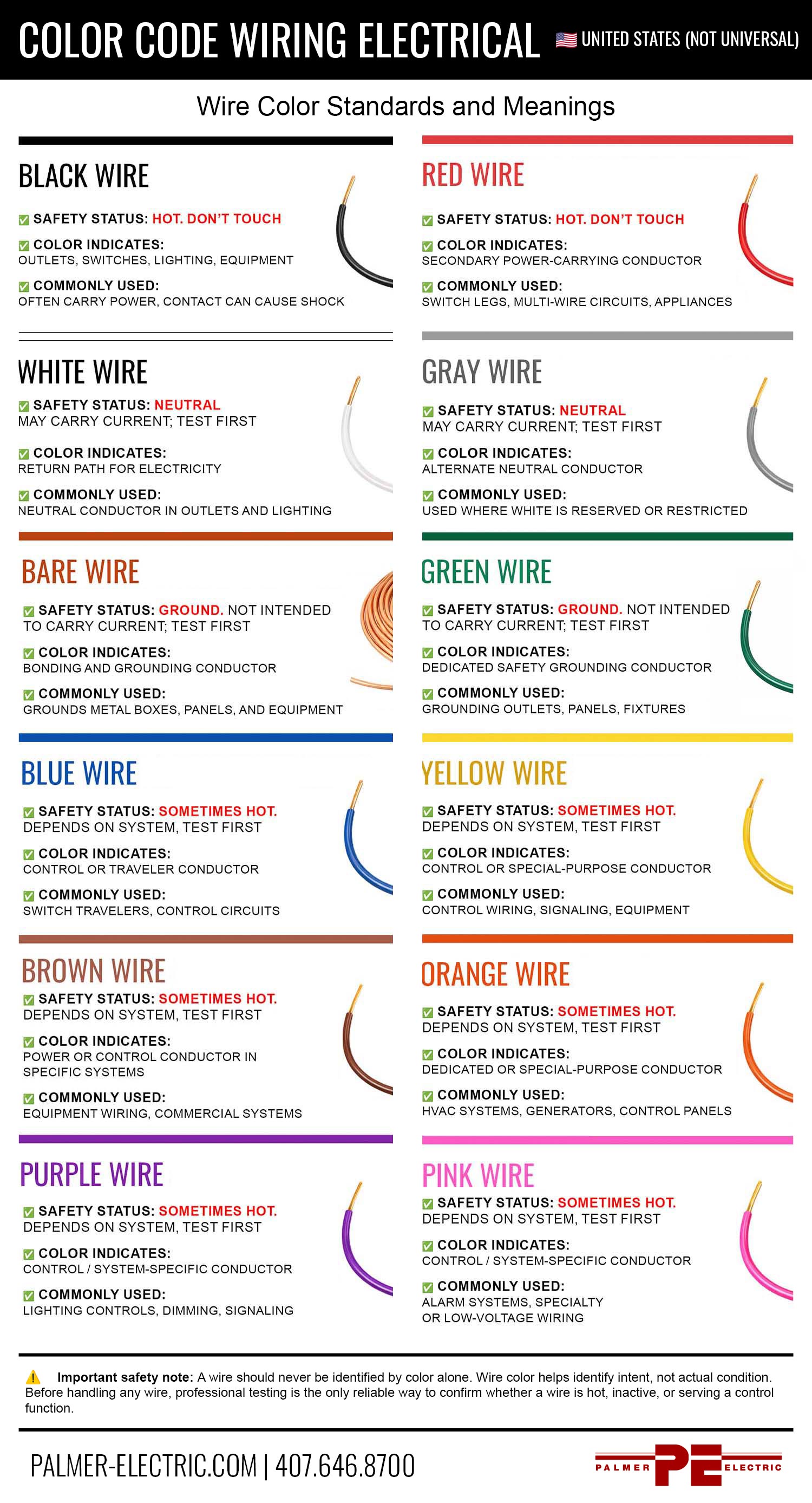
WARNING: Please be aware that the table below is a guide; a wire should never be identified by color alone. Wire color helps identify intent, not actual condition. Before handling any wire, always rely on testing with professional tools, not assumptions. Testing is the only reliable way to confirm whether a wire is hot, inactive, or serving a control function. When in doubt, call a licensed electrician; this is the only way to guarantee safety.
In the U.S., the National Electrical Code (NEC) defines required colors for neutral and grounding conductors, while hot wire colors often follow industry convention rather than strict rules.
The table below gives a quick snapshot of the most common electrical wire colors you can see at home. This is a general reference, not a substitute for proper testing. If you need more detailed information, continue reading this article.
| Wire Color | What the Color Indicates | Safety Status | Common Use | Pairing |
|---|---|---|---|---|
| Black | Primary power-carrying conductor |
Hot Don’t touch. | Outlets, switches, lighting, equipment | Paired with white (neutral) and ground |
| Red | Secondary power-carrying conductor |
Hot Don’t touch. | Switch legs, multi-wire circuits, appliances | Paired with black, white, and ground |
| White | Return path for electricity |
Neutral May carry current; don’t touch without testing. | Neutral conductor in outlets and lighting | Paired with black or red |
| Gray | Alternate neutral conductor |
Neutral May carry current; don’t touch without testing. | Used where white is reserved or restricted | Paired with hot conductors |
| Bare Copper | Bonding and grounding conductor |
Ground Not intended to carry current; don’t touch without testing. | Grounds metal boxes, panels, and equipment | Paired with green or grounding bars |
| Green | Dedicated safety grounding conductor |
Ground Not intended to carry current; don’t touch without testing. | Grounding outlets, fixtures, and panels | Paired with all circuits |
| Blue | Control or traveler conductor |
Sometimes Hot Depends on system; don’t touch without testing. | Switch travelers, control circuits | Paired with black, red, or ground |
| Yellow | Control or special-purpose conductor |
Sometimes Hot Depends on system; don’t touch without testing. | Control wiring, signaling, equipment | Paired with control or power circuits |
| Brown | Power or control conductor in specific systems |
Sometimes Hot Depends on system; don’t touch without testing. | Commercial systems, equipment wiring | Paired with blue, black, or ground |
| Orange | Dedicated or special-purpose conductor |
Sometimes Hot Depends on system; don’t touch without testing. | HVAC systems, generators, control panels | Paired with equipment-specific circuits |
| Purple | Control / system-specific conductor |
Sometimes Hot Depends on system; don’t touch without testing. | Lighting controls, dimming, signaling | Paired with control or low-voltage wiring |
| Pink | Control / system-specific conductor |
Sometimes Hot Depends on system; don’t touch without testing. | Alarm systems, specialty or custom wiring | Paired per system design |
IMPORTANT: Check for tape. Sometimes wires are marked with black or red tape to indicate they are “hot or “live”, meaning they carry electricity.
If you have ever opened an outlet box or light fixture and seen a bundle of different colored wires, you are not alone. Many customers ask us what those wire colors actually mean and whether they are safe to touch.
Electrical wire colors are designed to make electrical systems safer and easier to work on. By following electrical standards, it is easier to identify the wires’ general purpose, like carrying power, returning power, or protecting from electrical shock. The problem is that not every property follows the same rules, especially older homes or properties that have been remodeled over the years.
This guide includes a color code wiring chart that explains common electrical color code wires, how color coded wires are used in electrical wiring, and why color alone should never replace proper testing.
You do not need to be an electrician to learn what wire colors usually mean, but you do need to respect how dangerous electricity can be.
Important Safety Reminder
Electrical wire color does not guarantee a wire is safe. A wire can still carry power even if it does not look like a hot wire.
Before touching any electrical wiring:
- Turn off the correct breaker
- Use proper testing equipment
- Never assume based on color alone
If anything feels unclear, stopping and calling a licensed electrician is always the safest move.
What Do the Colors of Electrical Wires Mean
Electrical wire colors are used to signal what job a wire is intended to perform in a circuit. While the exact use can vary depending on the setup, most wiring follows common standards that electricians rely on every day.
It is important to remember that wire color indicates intent, not a guarantee. Wires must always be tested before being handled.
Black Wire Means
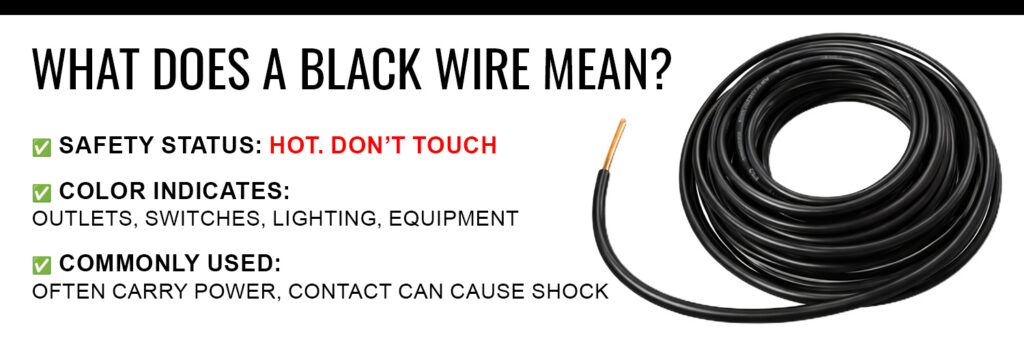
A black wire is one of the most common wires found in electrical systems. A black wire is typically used to carry electrical power to outlets, switches, lights, or equipment.
What Does Black Wire Mean?
In most cases, a black wire means the wire is intended to deliver electricity from the electrical panel to whatever device is connected to it. Because of this role, a black wire is often energized when the circuit is on.
Black Electrical Wire Color Code Overview
| Category | Description |
|---|---|
| Wire Color | Black |
| What the Color Indicates | Primary power-carrying conductor |
| Safety Status | Hot
Don’t touch. |
| Common Use | Outlets, switches, lighting, equipment |
| Pairing | Paired with white (neutral) and green or bare copper (ground) |
| Exceptions or Warnings | May remain energized even when a switch is off |
Is Black Wire Hot?
Yes, a black wire is generally hot (live or carries power). In US residential 120V AC household wiring, a black wire carries electricity from the panel to devices such as switches and outlets. It should always be treated as live.
When encountering more than one cable, a common question is whether is black or white wire hot. In standard wiring, the black wire is more likely to be the hot wire, while the white wire usually serves a different role. However, real-world wiring does not always follow expectations, especially in older or modified systems.
Relying on color alone can be dangerous. A wire’s actual role depends on how it is connected, not just how it looks. Testing is always required to confirm whether a wire is live or hot.
Pro rule of thumb: Any time a black wire is present, treat it as “live” or “hot” (carries electricity) until proper testing confirms otherwise.
To better understand how electricians identify live and hot wires safely, read our article “Live and Hot Wire Identification Guide”, which explains what hot wires are, how they differ from neutral wires, and why proper testing matters in every situation.
Want to learn more? Read our article “Guide to Black Electrical Wire: Function, Safety, Common Uses, Pairing, and Warnings” to learn when black wires are hot, how they behave in switch wiring, and why some fixtures contain multiple black wires.
Red Wire Means
A red wire is commonly seen in electrical systems where more than one power conductor is needed. While it may look similar to a black wire, a red wire often serves a specific purpose within a circuit. Understanding what a red wire is meant to do helps reduce confusion and improves electrical safety.
What Does the Red Wire Mean
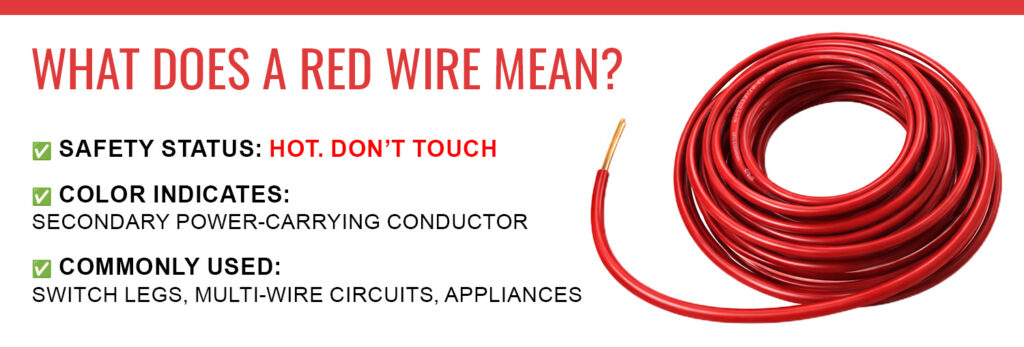
In most electrical systems in the US, a red wire means it is being used as a secondary power conductor. Like black wires, red wires can carry power and should be handled with caution. They are frequently used when a circuit needs more than one hot conductor.
Red wires are frequently used in switch wiring, multi-wire circuits, some appliances (240V circuits for ovens/dryers), and certain equipment connections. Their role depends on the system design, which is why red wires should always be identified through testing rather than assumptions.
Red Electrical Wire Color Code Overview
| Category | Description |
|---|---|
| Wire Color | Red |
| What the Color Indicates | Secondary power-carrying conductor |
| Safety Status | Hot
Don’t touch. |
| Common Use | Switch legs, multi-wire circuits, appliances |
| Pairing | Paired with black, white, and ground |
| Exceptions or Warnings | May be energized depending on switch position |
Is Red Wire Hot
Yes, a red wire is typically hot. A red wire commonly carries electrical power, just like a black wire. It may be energized whenever the circuit is on, or it may become energized depending on switch positions or system configuration.
Because red wires often appear in more complex wiring setups, they can be especially confusing. A red wire may be live even when a switch appears to be off, which makes testing critical before handling.
White Wire Means
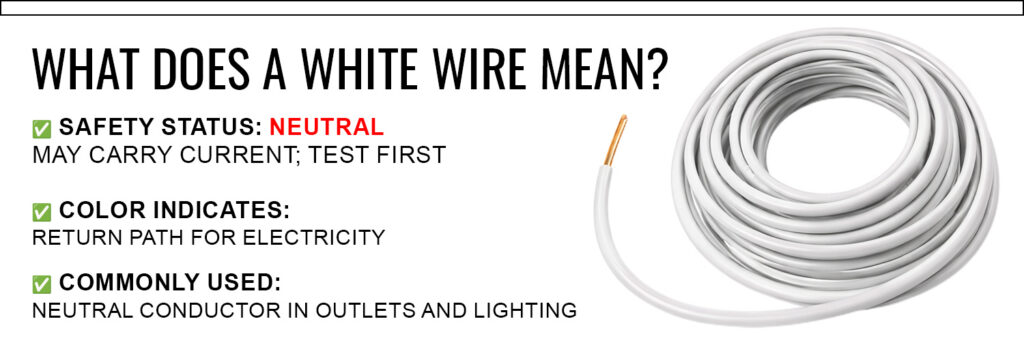
A white wire is one of the most recognizable wires in electrical systems, but it is also one of the most misunderstood. People often assume white wires are always safe, which can lead to dangerous mistakes. Understanding what a white wire is intended to do, and when it may behave differently, is critical for electrical safety.
What Does White Wire Mean?
In most electrical systems, a white wire means it is intended to serve as the neutral conductor. Its job is to provide a return path for electricity back to the electrical panel after power has been delivered to a device.
When someone asks what does white wire mean, the simple answer is that it usually completes the circuit rather than supplying power. That said, the function of a white wire depends on how it is connected. In some configurations, especially in older or modified wiring, a white wire may not be acting as a neutral at all.
Because of this, white wires should never be treated as harmless based on color alone.
White Electrical Wire Color Code Overview
| Category | Description |
|---|---|
| Wire Color | White |
| What the Color Indicates | Neutral return conductor |
| Safety Status | Neutral
May carry current; don’t touch without testing. |
| Common Use | Neutral connections in outlets and lighting |
| Pairing | Paired with black or red wires |
| Exceptions or Warnings | Can be reidentified and used as hot in older systems |
Is White Wire Hot?
In standard residential AC wiring, the white wire is neutral, not hot, and is meant to carry current back to the panel. However, in certain situations, yes, a white wire can carry electricity. White wires may be energized when they are repurposed in specific wiring setups, such as switch loops or modified circuits. In these cases, the wire may look like a neutral but behave like a hot wire.
This is why relying on color alone can be dangerous. A white wire should always be tested before being handled, even if it appears to be neutral.
Want to go learn more? Read our article “Guide to White Electrical Wire: Function, Safety, Common Uses, Pairing, and Warnings” to learn when white wires can be hot, how they are properly identified, and what mistakes to avoid.
Gray Wire
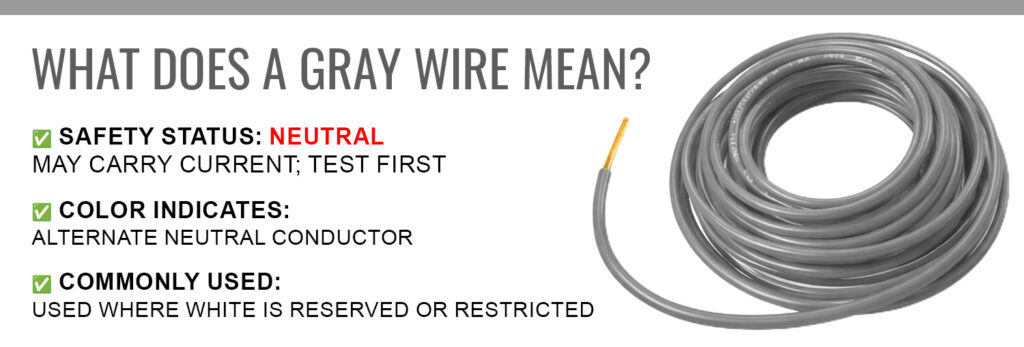
Gray wires are typically used in situations where standard color options are limited or restricted, especially in larger or more complex electrical systems. Understanding what a gray wire represents helps prevent dangerous assumptions.
Gray Electrical Wire Mean?
In electrical systems, a gray wire means it is being used as an alternate neutral conductor. It serves the same role as a white wire (completes a circuit by returning current back to the panel), but is used when white wiring is already present or reserved for another purpose.
Gray wires are most often found in commercial installations, multi-conductor cables, or systems that require clear separation between different neutral paths. While not as common in everyday residential wiring, they still follow established electrical standards.
Gray Electrical Wire Color Code Overview
| Category | Description |
|---|---|
| Wire Color | Gray |
| What the Color Indicates | Alternate neutral conductor |
| Safety Status | Neutral
May carry current; don’t touch without testing. |
| Common Use | Used where white is restricted or reserved |
| Pairing | Paired with hot conductors |
| Exceptions or Warnings | Often overlooked or mistaken for ground |
Is Gray Wire Hot?
No, a gray wire is not intended to be hot. In US electrical systems, it is intended to be a neutral conductor, and under normal conditions, it should not be “hot”.
A gray wire should not be used to deliver power the way black or red wires do. However, this does not mean it is safe to touch. Like all neutral wires, a gray wire can still carry electrical current during normal operation.
Because of this, a gray wire should always be treated with caution and tested before handling.
Is Gray Wire Neutral?
Yes, in US electrical systems, a gray wire is designated as a neutral wire.
Gray wires function the same way as white neutral wires. They provide a return path for electricity back to the electrical panel after power has been used by a device or fixture.
Even though gray wires are neutral, they should never be assumed to be inactive. Neutral wires may carry current and should only be handled after proper testing confirms it is safe to do so.
Is Gray Wire Positive Or Negative?
A gray wire is not positive or negative. Positive and negative labels apply to DC systems, not standard AC electrical wiring.
In U.S. AC electrical systems, gray wires are typically used as neutral conductors, serving as the return path for electricity.
Even though a gray wire is neutral, it may still carry current during normal operation and should never be assumed safe to touch. Always test before handling any wire.
Bare Copper Wire
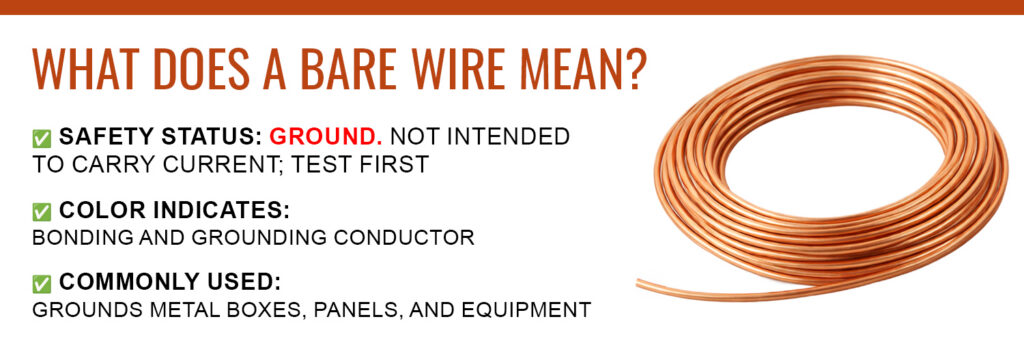
A bare wire, usually made of copper with no insulation (no protective coating), often stands out compared to other wires in an electrical system. Seeing an exposed wire naturally raises safety questions, especially about whether it carries power. Understanding what a bare wire is meant to do helps clear up that concern.
What Does Bare Wire Mean?
A bare wire means it is being used as a grounding (earthing) conductor.
Unlike insulated wires that deliver or return electricity, a bare wire’s job is safety. It provides a direct path for electricity to travel to ground if a fault occurs, such as a short circuit or damaged insulation. This helps reduce the risk of electrical shock and protects equipment.
Bare copper is commonly used for grounding because it conducts electricity well and allows for solid bonding to metal boxes, panels, and grounding bars.
Bare Copper Electrical Wire Color Code Overview
| Category | Description |
|---|---|
| Wire Color | Bare Copper |
| What the Color Indicates | Bonding and grounding conductor |
| Safety Status | Ground
Not intended to carry current; don’t touch without testing. |
| Common Use | Grounds metal boxes, panels, and equipment |
| Pairing | Paired with green or grounding bars |
| Exceptions or Warnings | Corrosion can reduce effectiveness |
Is Bare Wire Hot?
No, a bare wire is not intended to be hot. It is designed as a safety ground.
Under normal conditions, a bare wire should not carry electrical current. Its purpose is to remain inactive until a fault occurs. If a bare wire is energized during normal operation, it indicates a dangerous and serious wiring problem that needs immediate attention.
Because faults are not always visible, a bare wire should never be assumed safe without testing.
Is Bare Copper Wire Ground?
Yes. Bare copper wire is a ground wire.
In U.S. electrical systems, bare copper is used as the equipment grounding conductor. Its job is safety, not power delivery. A bare ground wire provides a direct path for electricity to travel safely to ground if a fault occurs, helping prevent electrical shock and equipment damage.
A bare copper ground wire is not intended to carry current during normal operation. If it is energized, that indicates a wiring fault that should be addressed immediately.
Even though bare copper is a ground wire, it should never be touched without testing, since faults can make it live unexpectedly.
Is It Safe to Touch a Bare Ground Wire?
No, it is not safe to touch a bare ground wire without proper testing, even though it is not supposed to carry power.
While a properly installed ground wire should not be energized, it can still become live if there is a wiring fault or damaged equipment. For this reason, bare ground wires should always be treated with caution and avoided unless proper testing confirms they are safe.
When in doubt, the safest choice is to leave bare ground wires alone and have them checked by a qualified electrician.
Green Wire Means
A green wire is one of the most important wires in an electrical system because it is directly tied to safety.
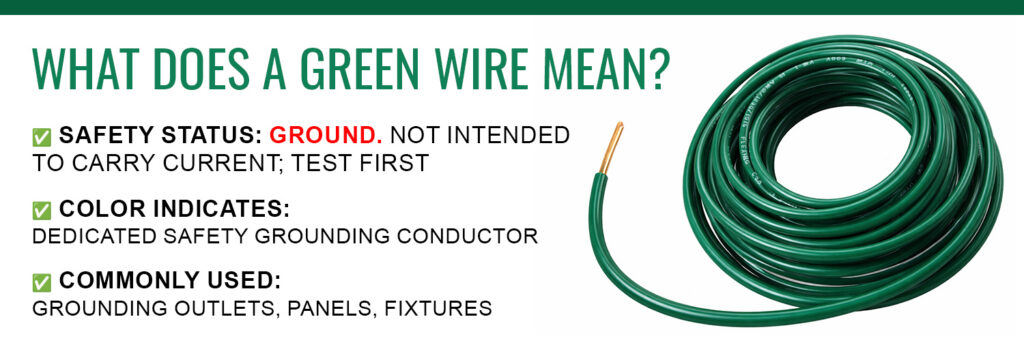
Green wires are grounding wires. Their job is safety, not power delivery. While green wires are easy to recognize, understanding the role of a green wire helps explain why it should never be ignored or altered.
What Does a Green Wire Mean?
In US electrical systems, a green wire means the wire is designated for grounding or earthing. The purpose of a green wire is not to deliver power or return power, but to provide a safe path for electricity to travel if there is a fault, helping reduce the risk of electrical shock or damage.
When a fault occurs, such as a loose connection or damaged wire, the green wire helps direct excess electricity away from people and toward the ground. This greatly reduces the risk of electrical shock and equipment damage.
A green wire should never be used for any purpose other than grounding. For example, they should never be used as hot or neutral wires.
Green Electrical Wire Color Code Overview
| Category | Description |
|---|---|
| Wire Color | Green |
| What the Color Indicates | Dedicated grounding conductor |
| Safety Status | Ground
Not intended to carry current; don’t touch without testing. |
| Common Use | Grounding outlets, panels, fixtures, equipment |
| Pairing | Paired with all circuits |
| Exceptions or Warnings | Should never be used as a power conductor |
Is Green Wire Hot?
No, a green wire is not intended to be hot in standard US electrical systems.
Under normal conditions, a green wire does not carry electricity. It only carries current during a fault or unsafe condition, which is exactly what makes it such an important safety feature.
If a green wire is carrying power during normal operation, that indicates a serious wiring problem that should be addressed immediately by a licensed electrician.
Is Green Wire Ground?
Yes, in US electrical systems, a green wire is ground.
Green wires are reserved specifically for grounding by electrical standards. They are used to connect metal parts of electrical systems, outlets, panels, and equipment to ground so that electricity has a controlled path during a fault.
Because grounding plays such a critical role in safety, green wires must always remain connected and intact.
Want to learn more? Read our article “Guide to Green Electrical Wire: Function, Safety, Common Uses, Pairing, and Warnings” to learn how grounding works, where green wires are found, and why proper grounding is essential for electrical safety.
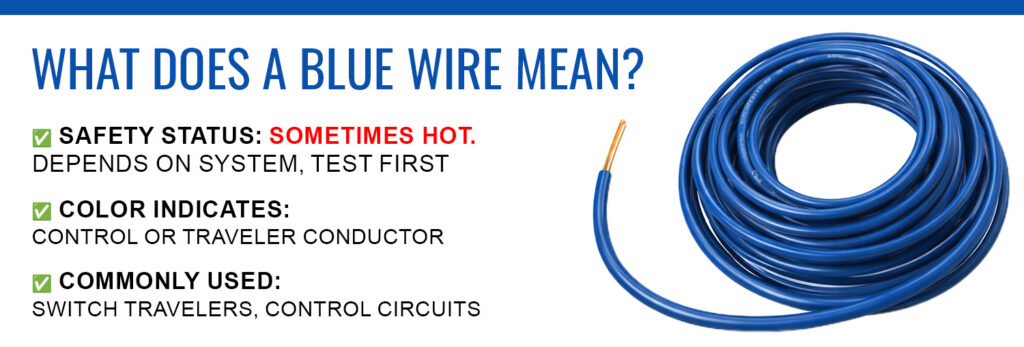
Blue Wire Means
Blue wires are typically used for specific functions rather than general power delivery, and their role depends heavily on the type of system they are part of.
A blue wire is less common than black, white, or green wires, which is why it often raises questions when someone encounters it. They are more common in commercial settings but do appear in residential wiring as well.
What Blue Wire Means
In electrical systems, a blue wire is most often used as a control or traveler wire. This means it helps control when electricity flows, rather than simply delivering power all the time.
Blue wires commonly appear in switch configurations, control circuits, and certain equipment wiring. Their purpose is defined by the system design, which is why blue wires should never be assumed to behave the same way as black or white wires.
Blue Electrical Wire Color Code Overview
| Category | Description |
|---|---|
| Wire Color | Blue |
| What the Color Indicates | Control or traveler conductor |
| Safety Status | Sometimes Hot
Depends on system; don’t touch without testing. |
| Common Use | Switch travelers, control circuits |
| Pairing | Paired with black, red, or ground |
| Exceptions or Warnings | Can appear inactive but become energized |
Is Blue Wire Hot or Neutral
A blue wire is not typically neutral, but it can be hot depending on the circuit.
In many setups, a blue wire carries electricity only when a switch is activated or when a control signal is sent. In other situations, it may act as a traveler wire that becomes energized under specific conditions.
Because a blue wire can switch between active and inactive states, it should always be treated with caution. Testing is the only reliable way to confirm whether a blue wire is carrying power at any given moment.
Important note: In some international and IEC-based electrical systems, blue wires are commonly used as neutral conductors. However, in U.S. residential and commercial 120V and 120/208V systems, blue wires are typically used as hot traveler or switched conductors. Always identify wiring based on the system in use and confirm with proper testing.
Want to learn more? Read our article “Guide to Blue Electrical Wire: Function, Safety, Common Uses, Pairing, and Warnings” to learn where blue wires are used, how they behave in control systems, and why proper identification is important.
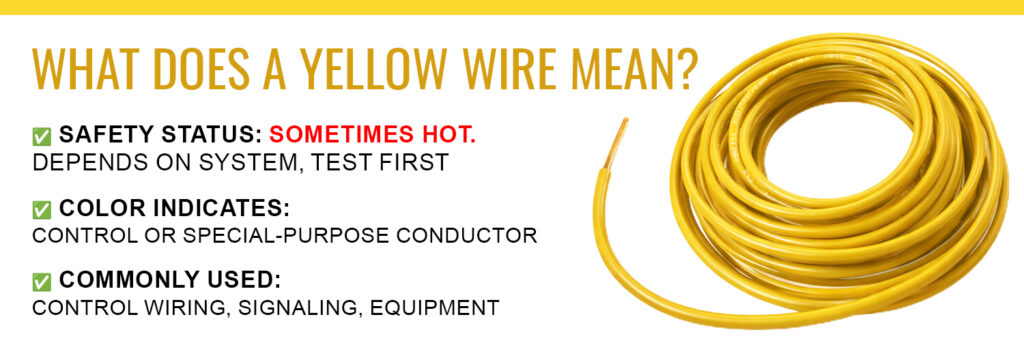
Yellow Wire Means
A yellow wire is often seen in electrical systems that use specialized wiring or control circuits. Because yellow wires are not used for basic power delivery in most standard setups, they tend to raise questions about what they do and whether they are safe to touch.
What Is Yellow Electrical Wire
A yellow electrical wire is commonly used for control, signaling, or special purpose circuits. Rather than supplying constant power like black or red wires, yellow wires are often part of systems that control how and when electricity flows.
Yellow wires may appear in control panels, HVAC equipment, interconnected systems, or other applications where communication between components is required. Their exact role depends on the system design, which is why yellow wires should always be identified before handling.
Yellow Electrical Wire Color Code Overview
| Category | Description |
|---|---|
| Wire Color | Yellow |
| What the Color Indicates | Control or special-purpose conductor |
| Safety Status | Sometimes Hot
Depends on system; don’t touch without testing. |
| Common Use | Control wiring, signaling, equipment |
| Pairing | Paired with control or power circuits |
| Exceptions or Warnings | Function varies widely by system |
Is A Yellow Wire Positive Or Negative
In U.S. AC electrical systems, a yellow wire is not positive or negative by default. Yellow wires are not labeled positive or negative. Their role depends on the system it’s part of. Yellow wires are often used for control, signaling, or special-purpose circuits, and in some cases, they can be hot, depending on the system. Color alone does not define polarity.
Positive and negative labels apply to DC systems, like batteries, solar setups, or certain low-voltage electronics. Even in DC systems, yellow does not have a universal polarity meaning. Polarity must be confirmed by documentation or testing.
Is Yellow a Neutral Wire
No. A yellow wire is not a neutral wire. In U.S. electrical systems, neutral wires are white or gray.
Yellow wires are typically used for control, signaling, or special-purpose circuits, and in some setups, they can be hot, depending on the system. Color alone isn’t a guarantee. If you’re unsure what a yellow wire is doing, testing is the only safe way to confirm its function.
Want to learn more? Read our article “Guide to Yellow Electrical Wire: Function, Safety, Common Uses, Pairing, and Warnings” to learn how yellow wires are used, when they carry power, and what to watch out for.
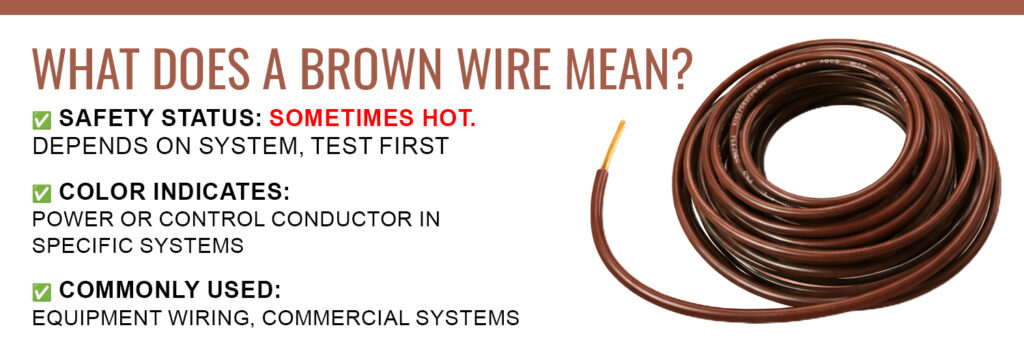
Brown Wire Means
In the US, a brown wire is not as common in standard 120V residential wiring, which is why it often causes confusion when it appears. Brown wires are typically associated with specific systems, equipment, or wiring standards, and their function depends on how and where they are used.
What Brown Wire Means
In electrical systems, a brown wire is most often used as a power or control conductor in certain applications. Brown wiring is commonly found in commercial environments, equipment wiring, and systems that follow international or manufacturer-specific standards.
In the United States, brown wires are occasionally seen in certain fixtures, imported equipment, or higher-voltage systems such as 277/480V installations.
In international and IEC-based systems, brown is commonly used as a live (hot) conductor. Because brown wires are not part of basic U.S. residential color conventions, their purpose should always be confirmed before handling.
Brown Electrical Wire Color Code Overview
| Category | Description |
|---|---|
| Wire Color | Brown |
| What the Color Indicates | Power or control conductor in specific systems |
| Safety Status | Sometimes Hot
Depends on system; don’t touch without testing. |
| Common Use | Commercial systems, equipment wiring |
| Pairing | Paired with blue, black, or ground |
| Exceptions or Warnings | Meaning varies by manufacturer or standard |
Is Brown Wire Hot or Neutral
A brown wire is not typically neutral. In most cases, a brown wire acts as a hot wire or a control wire.
Brown wires may carry electricity continuously or only under certain conditions, depending on the system design. This means a brown wire can be energized even when nearby components appear to be off. Due to this variability, brown wires should always be treated with caution and tested to confirm their status.
Important note: In international and IEC-based wiring systems, including the UK, brown wires are commonly used as hot (live) conductors. In U.S. electrical systems, brown wires are not part of standard residential color conventions and are typically seen in commercial, higher-voltage, or equipment-specific applications. Always identify wiring based on the system in use and confirm with proper testing.
Want to learn more? Read our article “Guide to Brown Electrical Wire: Function, Safety, Common Uses, Pairing, and Warnings” to learn where brown wires are used, how they behave in different systems, and what safety considerations apply.
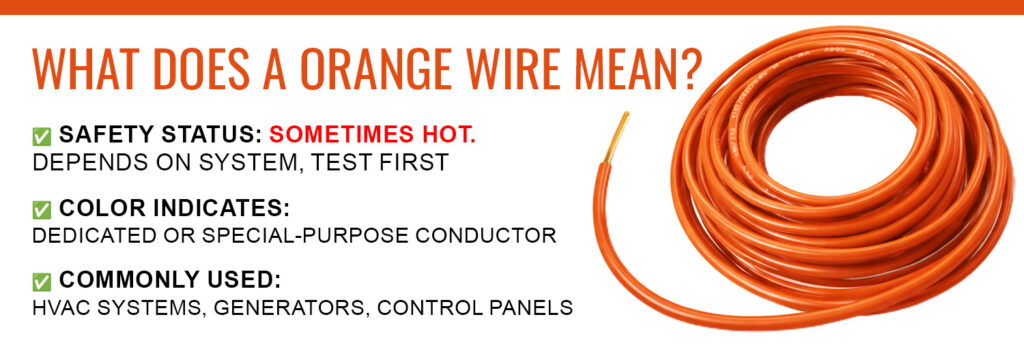
Orange Wire Meaning
In the US, an orange wire is not part of standard everyday wiring. Orange wires are usually tied to specific systems or dedicated circuits, and their role depends on how the system is designed. Because of this, orange wiring should always be identified carefully before being handled.
What Does Orange Wire Mean
In electrical systems, an orange wire is commonly used to identify a special purpose or dedicated circuit. Orange wiring is often associated with equipment that requires a specific power source, controlled operation, or separation from standard circuits.
Orange wires may be found in generator systems, HVAC equipment, control panels, or other installations where clear identification of a dedicated function is important. Their presence usually signals that the circuit should not be altered without proper knowledge.
Depending on the system, an orange wire may carry power, act as a control or trigger wire, or serve a specialized role in equipment such as HVAC systems, generators, or control panels. Because there is no universal standard for orange wiring, its function must always be confirmed through documentation or testing.
Orange Electrical Wire Color Code Overview
| Category | Description |
|---|---|
| Wire Color | Orange |
| What the Color Indicates | Dedicated or special-purpose conductor |
| Safety Status | Sometimes Hot
Depends on system; don’t touch without testing. |
| Common Use | HVAC systems, generators, control panels |
| Pairing | Paired with equipment-specific circuits |
| Exceptions or Warnings | Indicates a designated circuit, do not repurpose |
Is Orange Wire Hot
Yes, an orange wire in residential or commercial electrical systems is often hot, but not in the same way as a standard black or red wire. It is typically used for secondary power, 240-volt circuits (as a second hot wire), or as a “switch leg” for fans/lights.
In many systems, an orange wire carries electricity when a specific condition is met, such as when equipment is operating or a system is engaged. In other setups, it may be energized continuously to support dedicated equipment.
Because orange wires frequently serve specialized roles, they should always be treated as potentially live and tested before any work is performed.
Is Orange Wire Positive or Negative
An orange wire is not typically identified as positive or negative in standard US AC electrical systems.
Positive and negative labels are usually reserved for DC wiring. In most cases where orange wires are used, they are part of AC systems or control circuits rather than polarity based power systems. If an orange wire appears in a DC system, its polarity must be confirmed through system documentation or testing.
Assuming polarity based on color alone can lead to incorrect connections or equipment damage.
Clarification: In some specialized applications, orange wires may carry live power or be used as control or trigger wires for specific equipment. However, in U.S. AC electrical systems, orange wires are not classified as positive or negative. Polarity applies to DC systems only, and any orange wire used in a DC application must be identified through documentation or testing.
Want to learn more? Read our article “Guide to Orange Electrical Wire: Function, Safety, Common Uses, Pairing, and Warnings” to learn where orange wires are used, how they behave in dedicated systems, and what safety precautions matter most.
Purple Wire
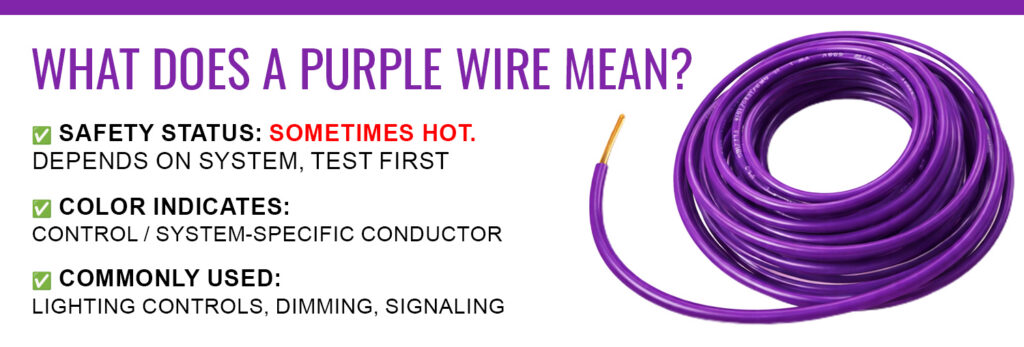
A purple wire is considered a specialty wire and is not part of standard power wiring. When purple wiring appears, it is usually tied to specific systems or equipment rather than general outlets or lighting. Because of this, purple wires often raise questions about their role and safety.
What Does Purple Wire Mean
In electrical systems, a purple wire is most commonly used for control, communication, or signaling purposes.
A purple wire typically indicates specific, non-standardized electrical, automotive, or lighting applications. Purple wiring is frequently found in commercial systems, lighting controls, dimming systems, and certain low voltage applications.
What Is Purple Wire In Electrical
Rather than delivering constant power, a purple wire is often used to control how and when electricity flows within a system. In many electrical applications, purple wiring is associated with lighting controls, such as dimmer switches, or with multi-way switching, where power is routed between switches rather than supplied continuously.
A purple wire may function as a switched hot conductor, a traveler wire in a 3-way or 4-way switch setup, or as part of a multi-conductor cable used for specialized control or equipment wiring. In some modern installations or manufacturer-specific designs, purple may be used in place of more traditional colors to clearly identify a controlled or designated circuit.
Because a purple wire can carry power depending on the circuit state, it is not a neutral or ground wire. Its exact role depends on the fixture, cable type, and system design, which is why proper identification is critical. Always use a voltage tester and follow equipment documentation before handling a purple wire to avoid electrical shock, equipment damage, or tripped breakers.
Purple Electrical Wire Color Code Overview
| Category | Description |
|---|---|
| Wire Color | Purple |
| What the Color Indicates | Control / system-specific conductor |
| Safety Status | Sometimes Hot
Depends on system; don’t touch without testing. |
| Common Use | Lighting controls, dimming, signaling |
| Pairing | Paired with control or low-voltage wiring |
| Exceptions or Warnings | No universal standard, verify function |
Is a Purple Wire Positive or Negative
A purple wire is not typically classified as positive or negative in standard AC electrical systems.
Positive and negative labels are usually associated with DC systems. In most cases where purple wiring is used, it serves as a control or signal conductor rather than a power supply wire. Because of this, its role cannot be determined by color alone.
If a purple wire appears in a system that uses DC power, its polarity must be verified through documentation or testing. Assumptions based on color can lead to incorrect connections or system damage.
Clarification: In some applications, purple wires may carry live power as part of switched lighting circuits or serve as control conductors in systems such as 0–10V dimming. In those cases, polarity may apply to the control circuit itself, but the purple wire is not universally defined as positive or negative. Its function depends entirely on the system design and must be confirmed through documentation or testing.
Pink Wire
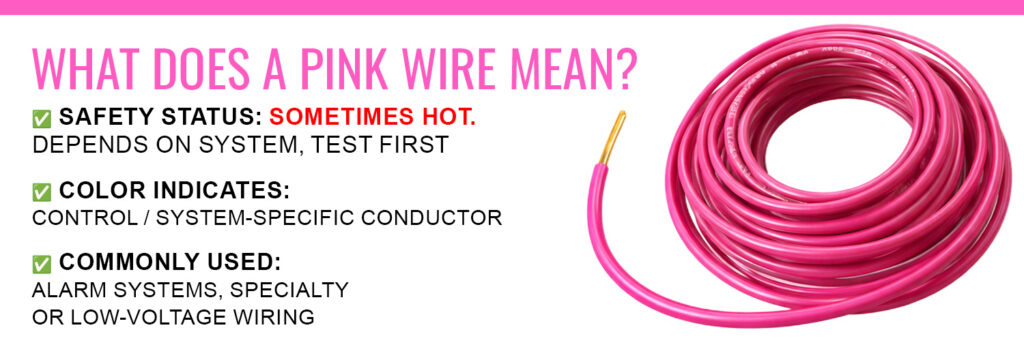
A pink wire is not part of standard electrical color coding, which often makes it one of the most confusing wires to encounter. When pink wiring appears, it is usually tied to specific systems, manufacturer requirements, or low voltage applications rather than general power wiring.
What Does a Pink Wire Mean
In electrical systems, a pink wire typically means it is being used for a system-specific or control-related purpose. Pink wiring may appear in low voltage circuits, communication wiring, alarm systems, or manufacturer defined applications.
Because there is no universal standard for pink wire usage, its function can vary widely. This makes identification and testing especially important before any work is performed.
In some specialized systems, pink wires may carry live power as part of a switched or controlled circuit, or serve as a low-voltage control wire in modern lighting and equipment systems. However, pink wiring does not follow a universal electrical standard, is not used as a normal hot, neutral, or ground wire in U.S. residential power circuits, and must always be identified through documentation or testing before handling.
Pink Electrical Wire Color Code Overview
| Category | Description |
|---|---|
| Wire Color | Pink |
| What the Color Indicates | Control / system-specific conductor |
| Safety Status | Sometimes Hot
Depends on system; don’t touch without testing. |
| Common Use | Alarm systems, specialty or custom wiring |
| Pairing | Paired per system or manufacturer design |
| Exceptions or Warnings | No standard meaning, testing required |
Is Pink Wire Live or Neutral
A pink wire is not typically neutral, and it is not intended to function as a standard live wire in household power circuits.
In most cases, pink wiring is used for control or low voltage purposes rather than delivering electrical power. However, that does not mean it is safe to touch without verification. Depending on the system, a pink wire may still carry voltage that can damage equipment or cause injury.
The only reliable way to determine whether a pink wire is live, neutral, or serving another role entirely is through proper testing and system documentation.
Clarification: In some specialized or manufacturer-defined systems, a pink wire may carry live voltage as part of a switched or controlled circuit, such as lighting controls or fan systems. However, pink wiring does not follow a universal standard in U.S. electrical systems and is not used as a normal hot, neutral, or ground wire. Because its function varies by application, a pink wire should always be tested and verified before handling.
Pink Wire Positive Or Negative
A pink wire is not positive or negative.
- Positive and negative labels apply to DC systems, such as batteries, solar equipment, or electronics.
- Standard U.S. AC electrical systems do not use positive and negative, they use hot, neutral, and ground.
- Pink wires do not have a universal polarity meaning in either AC or DC systems.
In most building wiring, a pink wire is used for control, signaling, or system-specific purposes, not as a defined positive or negative conductor. In rare cases where a pink wire appears in a DC control circuit, its polarity must be confirmed using documentation or testing, never by color alone.
Clarification: Some automotive and electronics systems use pink wires for ignition or control functions in DC circuits. These color conventions do not apply to U.S. residential or commercial electrical wiring, where pink wires have no standardized meaning and must always be identified through documentation or testing.
What Do Pink and Purple Wires Mean
Pink and purple wires are both considered non standard electrical wire colors, which means they are not used for general power delivery like black, white, or red wires. When these colors appear, they are usually tied to specific systems, controls, or manufacturer defined functions.
In many cases, pink and purple wires mean the wiring is part of a control circuit, communication system, lighting control setup, or low voltage application. Purple wires are commonly used in dimming systems, lighting controls, and signaling circuits. Pink wires are often seen in alarm systems, specialty controls, or custom equipment wiring.
Because neither pink nor purple follows a universal electrical color standard, their function cannot be determined by color alone. They may behave very differently depending on the system they belong to..
One common modern application for pink and purple wiring is 0–10V DC lighting control, especially in commercial LED systems. In these setups, purple is often used as the positive control conductor and pink (or sometimes gray) as the control common. While this usage is widespread in lighting controls, it does not apply to all systems, and pink or purple wires may serve entirely different roles in other installations.
When encountering pink or purple wiring, testing and system documentation are essential. These wires should never be assumed to be live, neutral, positive, or negative without verification
Common U.S. Electrical Wire Color Conventions by System
In the United States, electricians often follow industry color conventions to help distinguish different voltage systems. These color groupings are common in practice, especially in commercial buildings, but they are not guarantees and should never replace proper testing.
What color wires for 120/208V Systems (Residential and Commercial)
- Black, Red, Blue: Hot conductors (phases)
- White: Neutral
- Green or Bare Copper: Ground
These colors are commonly seen in homes, apartments, and light commercial buildings.
What color wires for 277/480V Systems (Commercial and Industrial)
- Brown, Orange, Yellow: Hot conductors (phases)
- Gray: Neutral
- Green or Bare Copper: Ground
These colors are most often found in commercial and industrial facilities, such as offices, warehouses, and large buildings.
Important: These color groupings reflect common practice, not a guarantee of function. Electrical systems can vary based on building age, modifications, and equipment. Always rely on proper testing before touching any wire.
Common U.S. Electrical Wire Color Conventions by System
| System Type | Typical Voltage Range | Hot (Phase) Wire Colors | Neutral Wire Color | Ground Wire Color | Where You’ll Commonly See It |
|---|---|---|---|---|---|
| 120/208V Systems | 120V single-phase and 120/208V three-phase | Black, Red, Blue | White | Green or Bare Copper | Homes, apartments, small commercial buildings |
| 277/480V Systems | 277V single-phase and 277/480V three-phase | Brown, Orange, Yellow | Gray | Green or Bare Copper | Offices, warehouses, industrial facilities |
Important safety note: These color groupings reflect common practice in the United States, not guaranteed wire function. Electrical systems can vary by building age, modifications, and equipment. Always rely on proper testing before touching any wire.
Conclusion
Electrical wire colors are designed to improve safety, but they are only one piece of the puzzle. Real world wiring can be complex, especially in older or modified buildings.
Knowing the basics help people recognize potential risks, but testing and professional experience are what truly keep electrical systems safe. When wire colors are confusing or safety is in question, working with a licensed electrician is always the right move.
Understanding wire colors is helpful, but real electrical safety comes from proper testing, training, and experience. Since 1951, Palmer Electric has been helping people across Central Florida identify wiring correctly, fix electrical issues safely, and bring systems up to code.
If you are in Orlando or anywhere in Central Florida and have questions about wiring, electrical safety, or need professional service, reach out to Palmer Electric. Call (407) 646-8700 to speak with a certified electrician or request a free estimate through our contact form.
References and Standards
This article reflects common U.S. electrical wiring conventions and safety practices based on industry experience and widely adopted standards, including guidance from the National Electrical Code (NEC).
- National Electrical Code (NEC), NFPA 70
- National Fire Protection Association (NFPA)