Commercial Electrician
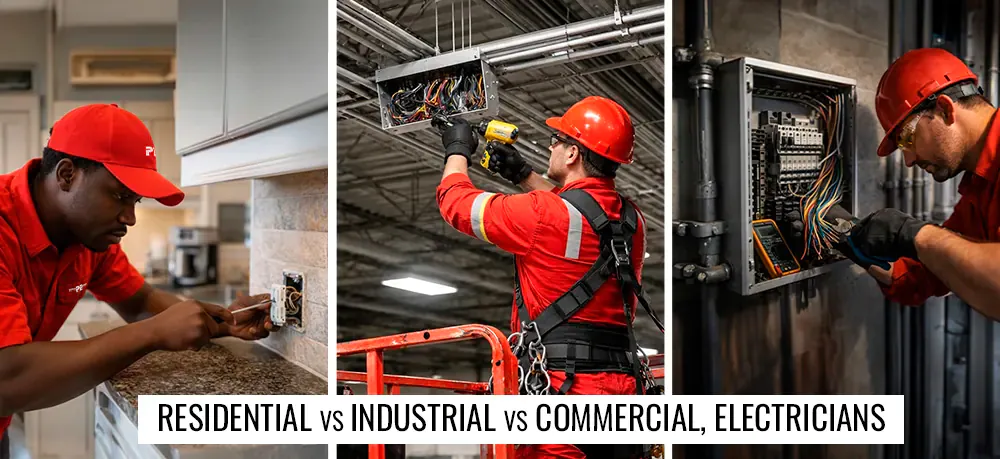
While the job descriptions seem similar, there are a few key differences between commercial, industrial, and residential electricians. Residential electricians provide electrical services and repairs in homes. Meanwhile, commercial electricians work primarily in stores, public buildings, and offices. Industrial electricians, on the other hand, provide electrical services in manufacturing and processing plants. Each type of electrical work has its own specialized skill set and requires separate training.
Why Understanding Electrician Types Matters
First of all, not all electrical work is created equal.
A home electrical system is very different from a retail store, and both are worlds apart from an industrial facility. Each environment has its own codes, voltage levels, safety risks, and inspection requirements.
Hiring the wrong type of electrician can lead to:
- Failed inspections
- Safety hazards
- System overloads
- Expensive redo
- Downtime for businesses
In Florida, where we deal with extreme heat, high humidity, heavy rain, and hurricanes, electrical systems take even more abuse. That’s why having an electrician who understands the particular requirements of your type of property matters.
Commercial, Residential, and Industrial Electricians at a Glance
Before we look more closely, here’s a simple side-by-side overview to help you quickly understand the core differences.
Electrician Types Comparison Table
| Category | Residential Electrician | Commercial Electrician | Industrial Electrician |
|---|---|---|---|
| Typical Worksites | Homes, apartments, condos, smaller buildings | Offices, retail, schools, restaurants, large complexes | Factories, plants, warehouses, power plants, manufacturing and processing facilities |
| Scope | Wiring, outlets, fixtures, smart home technology, appliance hookups, renovations | Large power distribution, extensive lighting networks, data and security systems, building automation | PLCs, heavy machinery, high-voltage systems, motors, generators, automation |
| Voltage Levels | Lower, 120V to 240V | Higher, 208V to 480V | Highest, 1,000V to 35,000V |
| Electrical Systems | Simple branch circuits | Larger distribution systems | Machinery-driven systems |
| Wiring | Smaller, sheathed cables installed in walls, attics, and crawlspaces | Larger wires installed in metal conduits, often requiring lifts or scaffolding | Heavy-duty wiring systems using robust conduits, armored cables, and specialized conductors |
| Code Requirements | Residential building codes including NEC, NFPA 70, ANSI, NECA | Commercial and local codes including NEC, NFPA 70, NFPA 70E, OSHA | Industrial standards and safety protocols including NEC, NFPA 70, NFPA 70E, OSHA |
| Focus | Homeowner needs, basic safety, functional lighting and power | Complex codes, project planning, high-power demands, efficiency | Complex troubleshooting, installation, and maintenance of large-scale systems |
| Skills | Problem-solving, communication, attention to detail, customer service | Strong knowledge of building codes, conduit systems, lighting, and power systems | Highly technical skills including electrical, mechanical, instrumentation, and controls knowledge |
| Tools & Access | Standard hand tools and testing devices, access through attics and crawlspaces | Heavier-duty tools designed for larger wiring and equipment, access using lifts and scaffolding | Specialized testing and control tools, access to confined spaces, elevated platforms, restricted-access areas |
| Customer Interaction | Homeowners | Business owners and property managers | Engineers and facility managers |
| Project Size & Complexity | Small to medium | Medium to large | Large and complex |
This table gives you the big picture. The details matter even more, especially when it comes to commercial electrical work.
Commercial vs Residential Electrician
Both commercial and residential electricians complete wiring on new construction, installation, general electrical services, and emergency electric repairs. However, commercial electricians focus on electric requirements and code specific to commercial buildings. Meanwhile, residential electricians have detailed knowledge of the electric code requirements for home owners, buyers and sellers.
Commercial Electricians
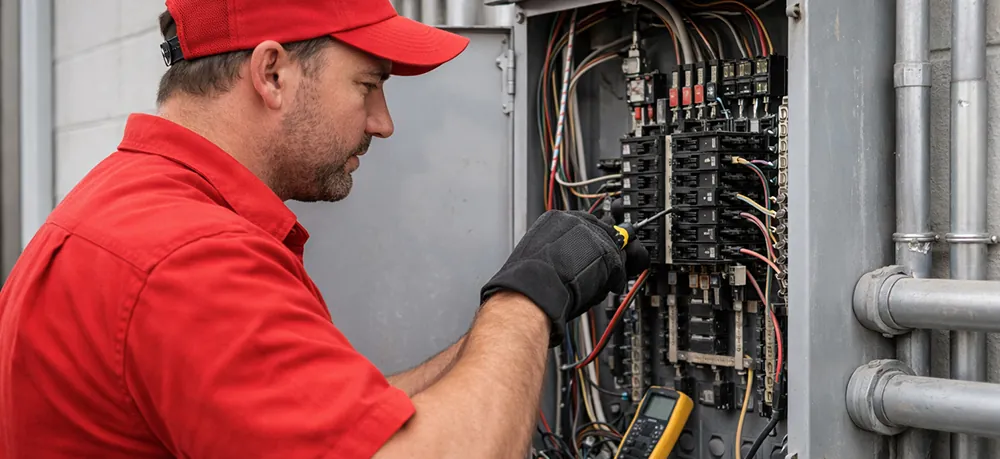
Commercial electricians specialize in electrical systems for businesses and public buildings. These systems are larger, more complex, and designed to support heavier electrical loads than a typical home.
At Palmer Electric, our commercial electricians work on everything from office buildings and retail spaces to medical facilities and schools throughout Central Florida.
Commercial Electrician Job Responsibilities
Commercial electrical work focuses on power distribution, reliability, and safety for occupied public spaces.
Typical responsibilities include:
- Installation of commercial electrical wiring, recessed lighting, and electrical components
- Electrical panel maintenance and repairs
- Lighting retrofits for more energy efficient lighting
- Emergency electrical services
- General electrical services
- Powering HVAC, elevators, and specialized equipment
- Troubleshooting outages in active businesses
- Ensuring systems meet local and state codes
Because commercial buildings stay occupied during 9 to 5, regular work hours, safety planning and coordination are a big part of the job.
Training
Commercial electricians go through formal apprenticeship programs and hands-on training focused on larger electrical systems.
To complete an apprenticeship, acquire 8-10,000 hours of experience, and pass an exam to become a licensed commercial electrician. Additional requirements differ between states.
Training typically includes:
- Commercial code requirements
- Load calculations
- Three-phase power systems
- Safety procedures for occupied buildings
Staying current with code updates is critical, especially as buildings become more energy-efficient and technology-driven.
Experience
Experience is where commercial electricians really separate themselves. With experience comes:
- Faster troubleshooting
- Better planning for minimal business disruption
- Knowledge of complex layouts and distribution systems
This is especially important in states like Florida, where many commercial buildings must also meet hurricane and emergency power requirements.
Worksites
Commercial electricians work for businesses and organizations in retail buildings, shopping centers, public buildings, offices, and more. They also install electrical wiring for commercial new construction.
Common worksites include:
- Office buildings
- Retail centers
- Restaurants
- Schools and universities
- Medical facilities
Each site comes with its own challenges, from working after hours to coordinating with inspectors and other trades.
For a full breakdown of what commercial electricians do, what tools they use, and what to look for before hiring one, see our complete guide: What Is a Commercial Electrician.
Residential Electricians

Residential electricians focus on electrical systems inside homes and small residential properties. This includes single-family houses, condos, townhomes, and small apartment buildings.
At Palmer Electric, our residential electricians work throughout Orlando and Central Florida, helping homeowners keep their electrical systems safe, reliable, and up to code in a climate that can be tough on wiring and equipment.
Residential Electrician Job Responsibilities
Residential electrical work is centered around everyday comfort and safety inside the home.
Residential electricians are experts in:
- Electrical repairs
- Residential wiring
- Electrical panel replacement
- Showcase lighting installation
- Recessed lighting installation
- Ceiling fan installation
- Troubleshooting power issues and breaker trips
- General electrical services
- Emergency electrical services
- Ensuring homes meet residential electrical codes
Because homeowners interact directly with the electrical system every day, residential work requires extra attention to detail and clear communication.
Training
Residential electricians complete apprenticeship programs and classroom training focused on home electrical systems. To complete an apprenticeship, acquire 8-10,000 hours of experience, and pass an exam to become a licensed industrial electrician. Additional requirements differ between states.
Training typically covers:
- Residential wiring methods
- Circuit protection and grounding
- Local and state residential codes
- Electrical safety for occupied homes
In Florida, residential training also emphasizes moisture control, surge protection, and storm-related risks.
Experience
Experience helps residential electricians quickly identify common household electrical problems.
With experience comes:
- Faster diagnosis of outages and flickering lights
- Safer panel upgrades
- Cleaner, less disruptive installations
- Better recommendations for future electrical needs
Homes today use far more electricity than they did years ago, so experience with modern loads is critical.
Worksites
Residential electricians work inside homes to complete repairs and new electrical projects.
Residential electricians typically work in:
- Single-family homes
- Condos and townhomes
- Small apartment complexes
- Home additions and renovations
These environments require respect for occupied living spaces and careful planning to keep families safe during work. As residential electricians, it’s important to have great communication and listening skills to ensure we understand what the client wants and can deliver. We put the client at ease with good customer service and professionalism.
Residential Vs Commercial Electrician Comparison
While residential and commercial electricians share core electrical knowledge, the scope, scale, and expectations of their work are very different.
Below is a breakdown of how these two electrician types compare.
Training, Licensing, and Certification
Residential electricians train primarily on home systems and residential codes.
Commercial electricians train on larger systems, higher loads, and commercial code requirements.
Both must be licensed, but commercial work typically requires deeper knowledge of inspections and compliance.
Project Scale And Complexity
Residential projects are usually smaller and completed quickly.
Commercial projects are larger, often phased, and require coordination with other trades and inspectors.
Types Of Electrical Systems
Residential systems are simpler and designed for everyday household use.
Commercial systems support lighting, HVAC, equipment, and emergency power systems.
Work Environments / Work Settings
Residential electricians work in lived-in homes.
Commercial electricians work in active businesses, public spaces, and large buildings.
Each environment presents different safety and scheduling challenges.
Education Requirements
Both paths require formal education and apprenticeships.
Commercial electricians typically receive additional training related to system design and load calculations.
Certification Requirements
Residential electricians focus on certifications related to home electrical systems.
Commercial electricians often hold certifications tied to commercial construction, safety, and inspections.
Job Responsibilities
Residential electricians handle service calls, upgrades, and repairs.
Commercial electricians manage installations, maintenance, and troubleshooting for large systems.
Tools & Specialized Equipment
Residential electricians use standard hand tools and testing devices.
Commercial electricians use heavier-duty tools designed for larger wiring and equipment.
Techniques & Wiring System
Residential wiring uses simpler layouts and materials.
Commercial wiring involves conduit systems, structured layouts, and advanced planning.
Customer Interaction
Residential electricians work directly with homeowners.
Commercial electricians work with business owners, property managers, and contractors.
Communication styles and expectations differ greatly.
Complexity & Voltage Capacity
Residential systems operate at lower voltage and simpler loads. Typically, between 120V – 240V .
Commercial systems handle higher voltage and larger power demands.
Typically between 208V – 480V.
Teamwork
Residential electricians often work independently or in small teams.
Commercial electricians frequently work as part of large crews.
Residential Vs Commercial Electrician Comparison Table
| Category | Residential Electrician | Commercial Electrician |
|---|---|---|
| Typical Worksites | Homes, apartments, condos, smaller buildings | Offices, retail spaces, schools, restaurants, large complexes |
| Scope of Work | Wiring, outlets, fixtures, smart home tech, appliance hookups, renovations | Large power distribution, extensive lighting networks, data and security systems, building automation |
| Voltage Levels | Lower, typically 120V to 240V | Higher, typically 208V to 480V |
| Electrical Systems | Simple branch circuits | Larger distribution systems |
| Wiring Methods | Smaller, sheathed cables in walls, attics, and crawlspaces | Larger wires in metal conduits for protection |
| Code Requirements | Residential building codes such as NEC, NFPA 70, ANSI, NECA | Commercial and local codes including NEC, NFPA 70, NFPA 70E, OSHA |
| Primary Focus | Homeowner needs, basic safety, functional lighting and power | Complex codes, project planning, high-power demands, and efficiency |
| Skills Emphasized | Problem-solving, communication, attention to detail, customer service | Strong knowledge of building codes, conduit systems, and public-space safety |
| Tools & Access | Standard hand tools and testing devices, access through attics and crawlspaces | Heavier-duty tools, access using lifts and scaffolding |
| Customer Interaction | Homeowners | Business owners and property managers |
| Project Size & Complexity | Small to medium | Medium to large |
Industrial vs Commercial Electrician
Industrial and commercial electricians are often grouped together, but the reality is that these are two very different specialties. The size of the systems, the type of equipment involved, and the safety risks all increase once you step into an industrial environment.
At Palmer Electric, we work with commercial facilities across Central Florida, and we understand when a project crosses the line into industrial electrical work and requires a different level of planning and expertise.
Why Industrial Electrical Work Is Different
Industrial electrical work focuses on keeping large-scale operations running safely and efficiently. These environments rely heavily on machinery, automation, and continuous power.
Unlike commercial buildings, industrial facilities often cannot afford downtime. Electrical systems must be designed for durability, redundancy, and constant use.
Industrial electricians also work around:
- Heavy machinery
- Moving equipment
- High-voltage systems
- Automated controls
- Strict safety procedures
Because of this, industrial electrical work requires specialized training and experience beyond standard commercial projects.
Industrial Electrician
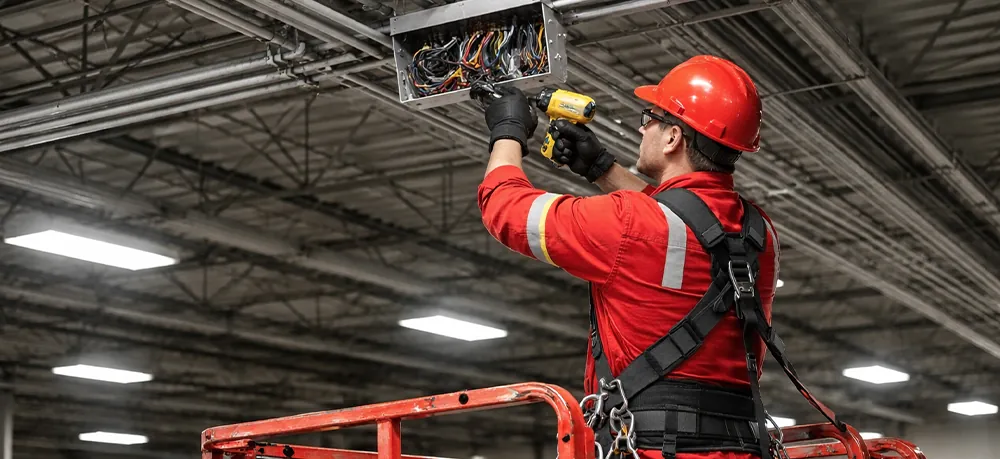
An industrial electrician specializes in installing, maintaining, and repairing electrical systems used in manufacturing plants, processing facilities, and large industrial sites.
Their role goes beyond lighting and power distribution. Industrial electricians focus on systems that keep machines, production lines, and automated processes running safely.
Industrial Electrician Jobs
Industrial electricians handle very complex electrical systems that are tied directly to operations.
Industrial electricians perform the following jobs in industrial settings:
- Industrial wiring specific to the industry
- Testing and repairs of electrical machinery used in production
- Grounding of machinery
- Electrical maintenance of machinery
- Troubleshooting machinery-related electrical issues
- Working with motors, controls, and automation equipment
For this type of electrician, precision and safety are critical. Especially in environments where equipment runs continuously.
Training
Industrial electricians receive advanced training focused on high-demand systems.
Industrial electricians complete an apprenticeship, acquire 8-10,000 hours of experience, and pass an exam to become a licensed industrial electrician. Additional requirements differ between states.
Training often includes:
- Industrial safety standards
- Electrical controls and automation
- Motor systems and control panels
- Lockout and tagout procedures
Because industrial systems are so specialized, ongoing training is essential.
Experience
Experience plays a major role in industrial electrical work.
Seasoned industrial electricians are better equipped to:
- Diagnose issues quickly
- Minimize production downtime
- Work safely around energized systems
- Coordinate with engineers and maintenance teams
Industrial environments leave little room for trial and error.
Worksites
Industrial electricians most often work in settings in which machinery is used for manufacturing or processing. These sites often operate around the clock, which affects scheduling and safety planning.
Industrial electricians typically work in:
- Manufacturing plants
- Processing facilities
- Distribution centers
- Large warehouses
- Industrial campuses
The electrical maintenance in these facilities requires specialized skills to ensure production is safe and efficient. Furthermore, electrical equipment used in manufacturing is highly sensitive and expensive. Knowledge of the wiring requirements for manufacturing facilities and expertise working on manufacturing machinery sets industrial electricians apart from other types of electricians.
What’s the Difference Between an Industrial Electrician and a Commercial Electrician?
While both work on large systems, industrial and commercial electricians operate in very different environments with different goals.
Below is a clear comparison to highlight those differences.
Training, Licensing, and Certification
Commercial electricians train for building systems and public spaces.
Industrial electricians receive additional training focused on machinery, automation, and safety procedures.
Project Scale And Complexity
Commercial projects are large but predictable.
Industrial projects are complex and often tied directly to production processes.
Types Of Electrical Systems
Commercial systems focus on power distribution, lighting, and equipment.
Industrial systems power machines, control processes, and automation.
Work Environments / Work Settings
Commercial electricians work in offices, stores, and institutions.
Industrial electricians work in high-risk, equipment-heavy environments.
Education Requirements
Both require formal education and apprenticeships.
Industrial electricians typically pursue more specialized technical training.
Certification Requirements
Commercial electricians hold certifications related to building systems.
Industrial electricians often carry additional safety and technical certifications.
Job Responsibilities
Commercial electricians install and maintain building systems.
Industrial electricians maintain operational systems critical to production.
Tools & Specialized Equipment
Commercial electricians use standard commercial-grade tools.
Industrial electricians use specialized testing equipment and control tools.
Techniques & Wiring System
Commercial wiring follows structured building layouts.
Industrial wiring supports machinery, controls, and automation systems.
Customer Interaction
Commercial electricians work with business owners and property managers.
Industrial electricians work closely with engineers and maintenance teams.
Complexity & Voltage Capacity
Commercial systems handle higher loads than homes. Typically, 208V – 480V.
Industrial systems operate at significantly higher voltage and complexity. Typically, 1,000V – 35,000V.
Teamwork
Commercial electricians often work in coordinated crews.
Industrial electricians frequently work as part of integrated maintenance teams.
Industrial vs Commercial Electrician Comparison Table
| Category | Commercial Electrician | Industrial Electrician |
|---|---|---|
| Typical Worksites | Offices, retail spaces, schools, restaurants, large complexes | Factories, plants, warehouses, power plants, manufacturing and processing facilities |
| Scope of Work | Power distribution, lighting systems, data and security systems, building automation | PLCs, heavy machinery, high-voltage systems, motors, generators, automation |
| Voltage Levels | Higher, typically 208V to 480V | Highest, ranging from 1,000V up to 35,000V |
| Electrical Systems | Building-wide distribution systems | Machinery-driven and process-critical systems |
| Wiring Methods | Large wires installed in metal conduit | Heavy-duty wiring systems, armored cables, specialized conductors |
| Code Requirements | NEC, NFPA 70, NFPA 70E, OSHA | NEC, NFPA 70, NFPA 70E, OSHA with stricter industrial safety protocols |
| Primary Focus | Powering and protecting commercial buildings and occupants | Keeping production, automation, and machinery running safely |
| Skills Emphasized | Code compliance, structured installations, public safety | Advanced technical skills, instrumentation, controls, and mechanical knowledge |
| Tools & Access | Commercial-grade tools, access via lifts and scaffolding | Specialized testing and control tools, access to confined spaces, elevated platforms, restricted-access areas |
| Customer Interaction | Business owners and property managers | Engineers and facility managers |
| Project Size & Complexity | Medium to large | Large and highly complex |
Choosing the Right Electrician for Your Project
Choosing the right electrician is about more than just availability. It’s about safety, code compliance, and making sure the electrical system is designed for how the space is actually used.
A home renovation, a new retail space, and an industrial facility all place very different demands on an electrical system. Using the right type of electrician from the start helps avoid failed inspections, unexpected downtime, and long-term electrical issues.
At Palmer Electric, we help homeowners and business owners across Orlando and Central Florida determine exactly what level of electrical expertise their project requires. From residential service upgrades to large commercial systems, choosing the electrician to the project is always the first step.
Commercial and Residential Electrician FAQ’s
The main difference comes down to system size and complexity. Residential electricians work on home electrical systems that handle everyday household loads. Commercial electricians work on larger systems designed for businesses, public buildings, and higher electrical demand.
In many cases, yes. Commercial electricians often have the training and licensing needed to work on residential systems. However, residential electricians typically focus more on homeowner-specific needs, local residential codes, and in-home safety considerations.
You typically need a commercial electrician when the work involves a business, public space, or multi-unit property. Offices, retail stores, restaurants, and schools all require commercial electrical expertise due to higher power loads and stricter code requirements.
Yes. Industrial electrical work generally involves higher voltage systems, heavy machinery, and active production environments. Because of this, industrial electricians follow stricter safety protocols and specialized procedures to reduce risk.
Yes. Commercial electrical work requires a properly licensed electrician to meet state and local code requirements. Licensed electricians ensure the work passes inspection and is safe for employees, customers, and the public.
If the electrical work is for a home or small residential property, it is typically considered residential. If the work involves a business, public building, or income-producing property, it usually falls under commercial electrical work. When in doubt, a licensed electrician can help classify the project correctly.
Commercial electricians provide electrical wiring installation, electrical maintenance, repairs, emergency services, and electrical upgrades to commercial properties. Some of the most common settings a commercial electrician works in include retail centers, office buildings, government buildings, schools, and hospitals.
An industrial electrician works in a factory or manufacturing setting on the power supply and electrical components of manufacturing equipment. Meanwhile, a commercial electrician provides electrical installation, maintenance and repair for commercial buildings such as offices and retail centers.
Residential and commercial electricians usually earn comparable salaries and benefits based on skill, experience, and years in the profession.
Commercial Licensed Electrician
Understanding the difference between residential, commercial, and industrial electricians helps you make smarter decisions about your electrical project. Each specialty exists for a reason, and using the right electrician helps ensure safe, reliable, and code-compliant electrical systems.
Palmer Electric has been continuously operating since 1951 for a reason. Our reputation for excellence and professionalism comes from getting every job done right. If you are looking for an expert commercial electrician or residential electrician team in the Orlando area, contact us today at (407) 646-8700.