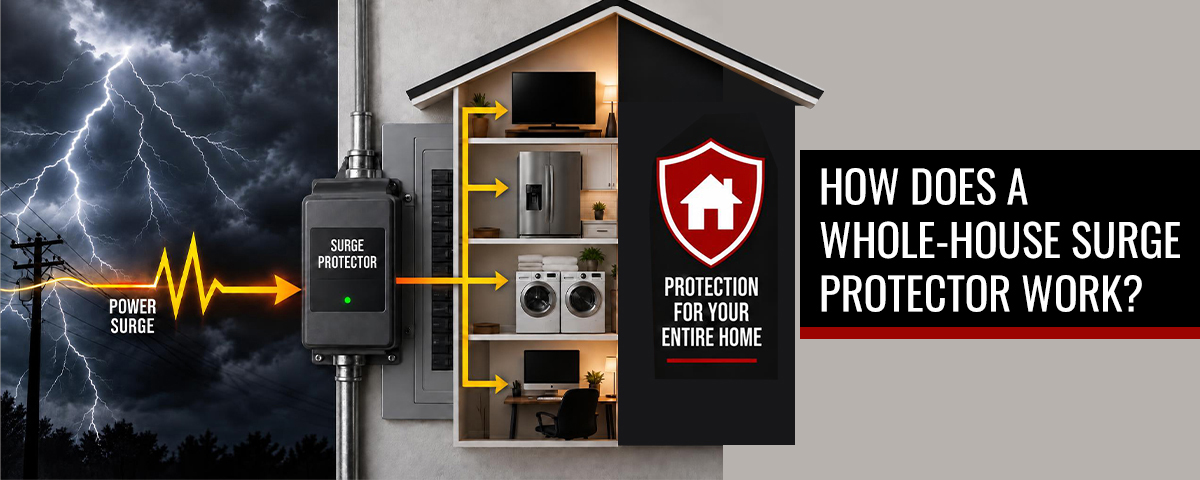
A whole-house surge protector connects at or near your home’s main electrical panel and reacts almost instantly when voltage suddenly rises above safe levels. It diverts the excess electrical energy away from your home’s circuits, helping keep the surge from damaging your outlets, appliances, and electronics.
Ever looked at that small device on or near your electrical panel and wondered what it actually does? We get that question a lot, especially here in Central Florida when storm season rolls around.
With all the lightning we deal with, plus the occasional surge that can come from the utility or equipment inside the home, it helps to know what that device is doing behind the scenes. Once you understand how surge protection works, it is a lot easier to decide what kind of protection makes sense for your home and electronics.
Key Takeaways
Here’s a quick summary of what the article covers.
- A whole-house surge protector installs at or near your main electrical panel and helps protect every circuit in your home, not just one outlet.
- It reacts almost instantly, far faster than a circuit breaker, and diverts voltage spikes away from your circuits.
- Some states, including Florida, have adopted the 2020 NEC or a later edition, which requires whole-home surge protection for new homes and when an existing home’s main electrical panel or service equipment is replaced
- It lowers your surge risk, but it can’t promise protection from a direct lightning strike.
- For the best protection, pair it with plug-in surge protectors.
How Does a Whole-House Surge Protector Work Overview
| Feature | Detail |
|---|---|
| Installation location | At or near the main electrical panel |
| Response speed | Nanoseconds (varies by device) |
| Voltage protection rating | Tested under UL 1449 |
| Code requirement | NEC Section 230.67 (2020 edition and later), adopted state by state |
| Grounding connection required | Yes |
| What it helps protect | All circuits and hardwired appliances |
| Direct lightning strike | Reduces risk, does not guarantee protection |
What Is a Whole-House Surge Protector?
A whole-house surge protector is a device installed at or near your home’s main electrical panel that diverts dangerous voltage spikes before they can damage your electrical system. Unlike a plug-in surge protector, it helps protect circuits, outlets, appliances, and electronics throughout your home, not just the devices plugged into one outlet.
At Palmer Electric, we install these year-round, and we think every home should have one. In states that have adopted the 2020 NEC or a later edition, Section 230.67 requires a surge protective device on dwelling services, including when an existing home’s main panel is replaced, not just in new construction. Florida, for example, enforces it through its state building code.
What Causes Power Surges?
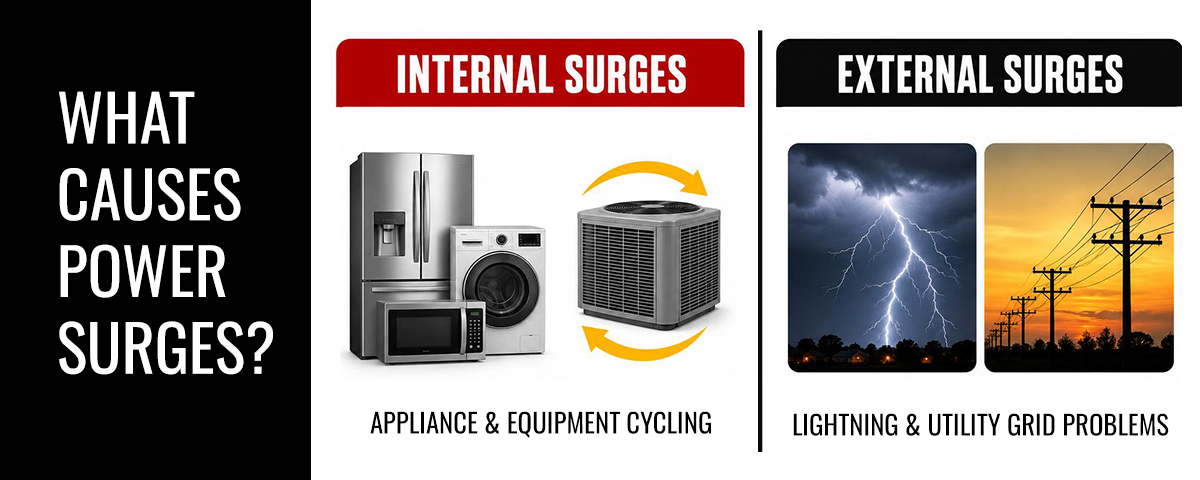
A power surge is a sudden, brief spike in voltage that can damage electronics and appliances. Surges come from two places: inside your home, like large appliances cycling on and off, and outside your home, like lightning strikes and utility grid problems.
- Internal surges: NEMA estimates, as cited by the Electrical Safety Foundation International (ESFI), that 60 to 80 percent of surges start inside the building, often from motors in AC units, refrigerators, and well pumps.
- External surges: Lightning and utility grid problems are less common, but lightning can cause the most powerful surges.
How Does a Whole Home Surge Protector Work?
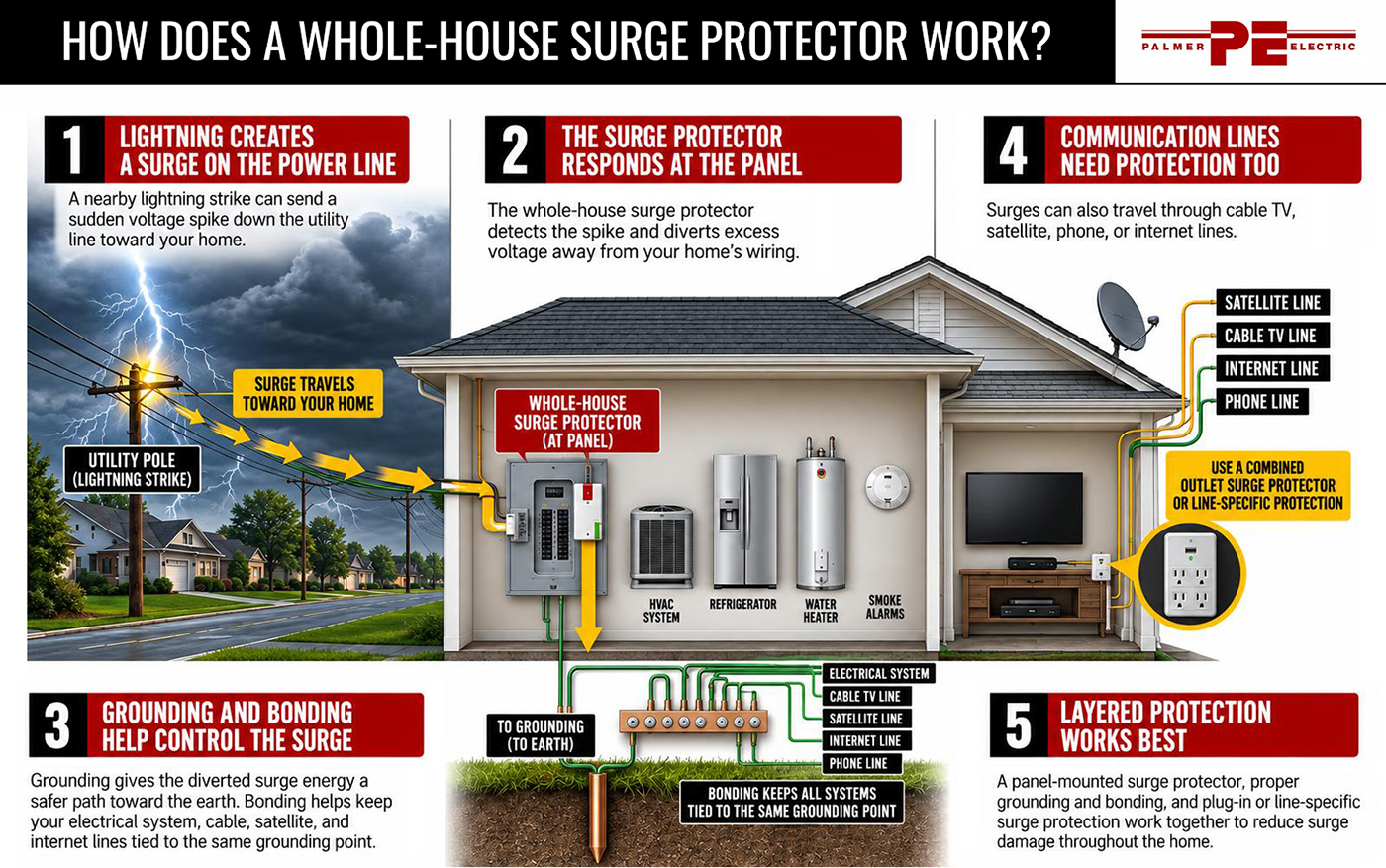
A whole-house surge protector works in four basic steps. It stays ready at or near your electrical panel, reacts the moment a voltage spike occurs, diverts the extra energy away from your home’s circuits, and lets normal power keep flowing the entire time.
Step 1: Constant Monitoring
The device sits at your electrical panel and is always ready to respond to sudden voltage spikes in your home’s electrical system. It works in the background all day, every day, whether a surge comes from outside the home or from equipment inside it.
Step 2: Quick Reaction
When a surge comes through, the protector responds in a split second. A lot of these devices use something called a Metal Oxide Varistor, or MOV.
Most of the time, the MOV just sits there while your electrical system runs at normal voltage. But if the voltage suddenly jumps too high, it reacts right away and gives that extra current another path to follow. Think of it like a gate that stays shut during normal operation, then opens when a surge needs to be redirected away from your home’s wiring and electronics.
UL 1449 doesn’t set a response time, but it does test how much voltage gets through, called the Voltage Protection Rating, or VPR. Circuit breakers can’t do this job because they’re built for overloads and short circuits, not brief voltage spikes.
Step 3: Safe Diversion (Shunting)
Once the surge protector senses that sudden spike, it gives the extra current a safer path to follow instead of letting it keep moving through your home’s circuits and appliances.
Depending on the device and where the surge is coming from, some of that current may be sent into the home’s grounding system. This is called shunting. In simple terms, the goal is to reduce how much of that surge reaches your outlets, electronics, and appliances in the first place.
Step 4: Uninterrupted Power (Parallel Wiring)
Here’s the part most people don’t expect. A whole-house surge protector is wired in parallel, meaning alongside your normal power flow, not in its path. Your lights, refrigerator, and AC keep running as usual, and the device only steps in when there’s a spike to catch.
No surge protector can stop every surge, so let’s look at where the limits are.
Whole House Surge Protector Limits
A whole-house surge protector helps reduce your surge risk, but it has limits. It can’t guarantee protection from every surge, especially a direct lightning strike, and it depends on proper grounding, plug-in backup for sensitive electronics, and replacement as it wears out.
It needs proper grounding
If your home’s grounding system is outdated, damaged, or poorly installed, the device has nowhere safe to send the surge.
It doesn’t replace plug-in protectors
Whole-house protection is your first line of defense, but computers, TVs, and other sensitive electronics still benefit from their own plug-in protector as a second layer.
It wears out
Many units last around 5 to 10 years, but that depends on how many surges they absorb, not just their age.
What Types of Surges Can a Whole-House Surge Protector Manage?
A whole-house surge protector can help manage two main types of voltage spikes: external surges from lightning-related events, utility grid switching, or power restoration, and internal surges that start inside the home when large equipment cycles on and off. It works by diverting excess voltage away from your home’s wiring and connected equipment.
1. External Surges
Lightning-related surges:
A whole-house surge protector device can help reduce damage from nearby lightning strikes that send surge energy through utility lines or connected electrical systems. However, there’s one thing to keep in mind: a standard whole-house surge protector device is not the same thing as a full lightning protection system, and it does not guarantee protection from a direct lightning strike to the home.
Utility grid issues:
From the utility side, power surges from grid switching, damaged transformers, downed lines, power restoration after an outage, and maintenance work can all create voltage spikes that travel into a home’s electrical system.
2. Internal Surges
Appliance and equipment cycling:
Many surges start inside the home or building. According to the National Electrical Manufacturers Association, or NEMA, up to 80% of surges are created within a facility. For example, in a Florida home, that can happen when equipment like air conditioners, refrigerators, pool pumps, washers, dryers, and other motor-driven appliances cycle on and off.
Even though internal surges are usually smaller than a major lightning-related surge, but they still matter. Why? Over time, repeated voltage spikes can place cumulative electrical stress and eventually damage circuit boards, smart controls, HVAC electronics, and connected devices.
The National Institute of Standards and Technology (NIST) treats surges separately from other power problems, because they need different fixes. Here’s how they compare.
| POWER PROBLEM | WHAT HAPPENS | DOES A WHOLE-HOUSE SURGE PROTECTOR HELP? |
|---|---|---|
| Surge | Voltage spike, typically a few millionths of a second | Yes |
| Sag or brownout | Voltage dips below normal and lights may dim | No |
| Outage | No voltage at all | No |
| Swell | Voltage stays above normal for longer than a surge | Not designed for it |
A battery backup (UPS) can help ride through sags and short outages, depending on the type, but a surge protector won’t. Swells matter too. NIST’s homeowner guide says specialists attribute most of the rare catastrophic surge protector failures to excessively high line voltage from a power system fault, not to exceptionally large surges.
What Does a Whole‑House Surge Protector Protect in Your Home?
A whole-house surge protector helps protect equipment connected through your electrical panel, including HVAC systems, major appliances, lighting circuits, outlets, pool equipment, EV chargers, and hardwired electronics. It reduces surge damage risk across the home, but it does not guarantee protection from every surge or direct lightning strike.
Also, keep in mind that devices connected to more than one source, like power plus cable, phone, satellite, or data lines, need extra point-of-use or line-specific surge protection. That includes TVs, modems, routers, computers, security systems, and home office equipment.
Big hardwired equipment or appliances
HVAC systems, water heaters, washers and dryers, ranges, and refrigerators. Appliances with electronic controls are more vulnerable to surge damage than ones with simple mechanical controls.
Life-safety devices
Smoke alarms, carbon monoxide alarms, fire alarm and security systems, and GFCI and AFCI outlets and breakers all run on sensitive electronics, and surge damage can be hard to spot. Protecting them is one reason the 2020 NEC added the requirement.
Everyday electronics
TVs, computers, chargers, and smart home devices plugged into any outlet get a first layer of protection.
Devices with a second connection
A TV with cable or satellite, a computer with a modem, and your internet equipment all plug into two systems: power and a communications line. A surge can arrive on that second line, so NIST recommends a combined plug-in protector for both connections. Your panel protector still handles the large surges on the power line.
Surges don’t always destroy equipment outright. ESFI describes three kinds of damage: destruction, disruptions, and degradation, which is gradual wear.
At Palmer Electric, we don’t stop at the panel. We look at the equipment you own and recommend point-of-use protection for sensitive electronics like home theaters and office equipment.
Why a Whole‑House Surge Protector Can’t Guarantee Protection From Every Lightning Strike
A whole-house surge protector can’t guarantee protection from every lightning strike because a direct or very close strike can exceed the surge current the device is rated to handle, and lightning can also reach your home through paths the device doesn’t cover, like phone, cable, and plumbing lines.
A strike can exceed the device’s rating
NOAA says a typical lightning flash carries about 30,000 amps, while some strokes can reach 300,000 amps. Every surge protector has a maximum surge current rating, and a powerful direct lightning strike can exceed what a whole-house surge protector is designed to handle.
Lightning has other entry points
Close or direct strikes can bypass the main electrical panel entirely. They can enter a home through unshielded telephone lines, cable lines, water pipes, or through the earth ground connection itself.
It’s not a lightning protection system
NIST explains that lightning rods protect the structure and help avoid fires, but they don’t prevent surges in the wiring. They do different jobs, and rod systems are installed by lightning protection professionals.
Proximity to lightning
The farther a device sits from your panel, like an outdoor AC unit or a detached garage, the less the panel protector can help it, so equipment like that often needs its own protector.
Here’s how the main paths line up with what a whole-house surge protector covers.
| HOW LIGHTNING GETS IN | DOES A WHOLE-HOUSE SURGE PROTECTOR COVER IT? |
|---|---|
| Power lines into your home | Yes, this is its main job |
| Phone, cable, or satellite lines | No, these need their own protection |
| Metal plumbing and metal in concrete | No |
| A direct strike to the house itself | Partly, but a strike can exceed its rating |
Here in central Florida, this isn’t theory: the stretch from Tampa Bay to Cape Canaveral has the highest lightning concentration in the country. The good news is that direct strikes are rare, but the bad news is that indirect strikes affect homes more, because they send surges along power, phone, and cable lines. A whole-house surge protector handles the power-line surges, and phone and cable lines need their own protection. If lightning does hit your home, the National Weather Service recommends checking that your smoke alarms are working and, if needed, having a licensed electrician check your wiring.
Not sure if your home actually needs whole-house surge protection? We cover the pros, cons, and whether it is worth the investment in our guide: Do I Need a Whole-House Surge Protector in Florida?
Whole-House Surge Protector vs. Plug-In Protection
A whole-house surge protector covers your electrical system from the panel, while a plug-in surge protector covers only what’s plugged into it. They work best together: the panel unit handles the big surges coming in, and plug-ins give your most sensitive devices a second layer.
| WHOLE-HOUSE | PLUG-IN | |
|---|---|---|
| Where it connects | At or near your main electrical panel | A wall outlet |
| What it covers | Every circuit, including hardwired appliances like HVAC | Only the devices plugged into it |
| Phone and cable protection | No | Yes, on combined models |
| Who installs it | Usually a licensed electrician, depending on local rules | You, by plugging it into an outlet |
| Label to look for | UL 1449 | UL 1449 (a strip marked only UL 1363 is not a surge protector) |
Think of it as layers. NIST notes that the panel protector’s main job is diverting large surges on the power line before they enter the house, which makes plug-in protection easier.
Why Grounding and Bonding Make Surge Protection Work
A surge protector needs a solid grounding and bonding system to work properly. Grounding ties your electrical system to the earth. Bonding connects metal parts and other systems, like cable, phone, satellite, and service equipment, back to the same grounding system so they stay at the same electrical potential.
Here’s the simple version: bonding helps everything “agree” on the same reference point. If your electrical system, cable line, and phone line are not properly bonded together, a surge can create a big voltage difference between them. That difference can travel through equipment connected to more than one system, like a TV, modem, router, computer, or security system.
Bonding Lowers the Risk, but It Doesn’t Remove It
When a surge hits a cable, phone, satellite, or data line, the voltage between that line and your power system can jump. Equipment connected to both systems can take the hit. Proper bonding helps keep that voltage difference smaller, which lowers the risk of damage.
But bonding is not the same as surge protection. It does not replace a combined plug-in surge protector or line-specific surge protection for devices connected to power plus cable, phone, cable TV, or data lines.
The code requires a common connection point
Since the 2008 edition, NEC Section 250.94 has required an intersystem bonding termination at new services, where cable, phone, and satellite grounds connect to your electrical grounding system. Older homes may not have one.
What to ask your electrician
Confirm that the grounding connections at your panel are solid and that your cable, phone, and satellite grounds connect to the same point at the service.
At Palmer Electric, if we spot a grounding or wiring concern during an installation, we’ll explain it and recommend the next step.
Common Mistakes & Misconceptions
Three mistakes can undo the protection you paid for, and all three are easy to avoid.
Waiting for something to break
Surge damage isn’t always dramatic. Smaller surges, like the ones from your AC compressor starting up, can wear down electronics over time, so the first sign may be a device that dies early.
Ignoring the status light
Indicator lights vary by brand, and the colors don’t always mean what you’d guess. Check your manual to learn what yours means, then look at it after major storms.
Treating panel work like a DIY job
Some units connect on the utility side of your main breaker, where you can’t shut the power off yourself. Hire a licensed electrician.
Real-World Example: How a whole-house surge protector Responds During a Storm?
Here’s how different types of surge protection can work together during a typical Central Florida summer storm.
1. Lightning strikes a utility pole a few streets away, and a surge travels down the power line toward your home.
2. At the panel, your whole-house surge protective device handles the power-line surge by diverting extra voltage away from your home’s wiring and toward the grounding system. That helps lower the risk of damage to equipment connected through the panel, including your HVAC system, refrigerator, water heater, and hardwired smoke alarms.
3. Grounding gives that diverted surge energy a safer path to follow. Bonding helps keep your electrical system, cable TV line, satellite line, internet line, and other connected systems tied to the same grounding point. That matters because big voltage differences between systems can damage equipment connected to more than one line.
4. But that same storm can also send a surge through a cable TV, satellite, or internet line. If your TV, modem, router, or cable box is connected to both power and a communication line, it needs protection on both paths. That is where a combined plug-in surge protector or properly protected coax/data line comes in.
5. No single device handled every possible surge path. The panel-mounted surge protective device helped protect the electrical wiring side, proper grounding and bonding helped control voltage differences between systems, and the plug-in or line-specific protector helped cover the cable, internet, or data side. That layered approach gives sensitive electronics a much better chance during storm season.
This kind of damage is very real, especially here in Florida. For example, in July 2026, lightning hit an apartment building in Altamonte Springs, and the Seminole County Fire Department said it believes the strike traveled through the electrical system and started a fire behind a dryer.
And that was not an isolated risk. According to the Insurance Information Institute, insurers paid about $1.65 billion for lightning-related homeowners claims across the country in 2025. Florida had more claims than any other state, which is one more reason we take lightning and surge protection seriously in Central Florida.
We see how close these storms get. During a recent panel replacement in Central Florida, lightning hit a transformer two streets from the house, which pulled the utility crew away and delayed turning the power back on until that evening. A strike doesn’t have to hit your house to affect your power.
Whole House Surge Protector FAQs
Here are a few more questions about how surge protection works.
Does a whole-house surge protector use electricity?
Only a tiny amount. It’s wired alongside your normal power flow and only conducts during a surge, so it doesn’t add anything noticeable to your electric bill. The status light draws a small amount of power too. For exact figures on a specific unit, check the manufacturer’s spec sheet.
Will a whole-house surge protector stop my lights from flickering?
Usually not. Flickering or dimming is typically a voltage sag, not a surge, and surge protectors don’t fix sags. Common causes include large appliances starting up, loose connections, and utility problems. If your lights flicker often, have an electrician check your wiring and panel.
Can a whole-house surge protector cause a fire?
Yes, but it is very rare when the device is properly listed and installed. Whole-house surge protectors listed to UL 1449 are tested for safe operation and failure under surge conditions, but fire risk can increase if the unit is defective, overloaded beyond its rating, damaged, or installed incorrectly.
To keep the risk low, choose a UL 1449-listed surge protector device and have it installed by a licensed electrician at or near the electrical panel. Because the device connects to service equipment and live wiring, this is not a DIY installation.
How do I know if my home already has a whole-house surge protector?
Look for a small device mounted on or next to your electrical panel, often with a status light, or a breaker-style unit labeled as a surge protective device. Homes with a service installed or replaced under the 2020 NEC or later may already have one. Don’t open the panel yourself; an electrician can confirm.
Can renters and condo owners get whole-house surge protection?
Usually only with permission. Whole-house protection is installed at the electrical service, which your landlord or building owner controls, so renters can’t add it themselves. Ask your landlord, and use plug-in surge protectors for your own electronics in the meantime. Condo owners should check with their association first.
Have a question we didn’t cover? Browse our surge and lightning protection FAQs.
Conclusion
A whole-house surge protector is a smart layer of defense for homes, especially with lightning, storms, outages, and heavy AC use. It works at the panel to divert damaging voltage spikes before they spread through your wiring and reach expensive equipment.
It can help protect HVAC systems, refrigerators, smart appliances, pool equipment, EV chargers, and hardwired electronics, but it is not a magic shield. For the best protection, pair a panel-mounted surge protection device with plug-in surge protection for sensitive electronics and make sure the installation is handled by a licensed electrician.
Ready to Protect Your Home?
At Palmer Electric, our licensed electricians install whole-house surge protection across Orlando and Central Florida. We look at your panel, your grounding, and the equipment you own, then recommend the right setup. Learn more about our full surge and lightning protection services, or go straight to scheduling your whole-house surge protector installation. Call 407-646-8700 for a free estimate.
References
- National Institute of Standards and Technology (NIST). “Surges Happen! How to Protect the Appliances in Your Home.” Special Publication 960-6, 2001. https://nvlpubs.nist.gov/nistpubs/Legacy/SP/nistspecialpublication960-6.pdf
- Electrical Safety Foundation International (ESFI). “Surge Protection Highlights.” https://www.esfi.org/surge-protection-highlights-video-short/
- ESFI. “Common Surge Internal Causes.” https://www.esfi.org/common-surge-internal-causes-video-short/
- ESFI. “Surge and Protect.” https://www.esfi.org/surge-and-protect/
- ESFI. “Benefits of Surge Protective Devices.” https://www.esfi.org/benefits-of-surge-protective-devices-video-short/
- NEMA Surge Protection Institute. “How surge protector devices work.” https://www.nemasurge.org/how-spd-s-work/
- NEMA Surge Protection Institute. “How Do Metal Oxide Varistors Work?” https://www.nemasurge.org/wp-content/uploads/2021/06/How-Do-Metal-Oxide-Varistors-Work.pdf
- NEMA Surge Protection Institute. “UL 1449: Surge Protective Devices (surge protector device).” https://www.nemasurge.org/ul-1449-transient-voltage-surge-suppressors/
- NEMA Surge Protection Institute. “What Are Surges.” https://www.nemasurge.org/history/
- Electrical Contractor Magazine. “Surge Protection Requirements: CQD Spotlight.” https://www.ecmag.com/magazine/articles/article-detail/surge-protection-requirements-cqd-spotlight
- International Code Council. “Florida Building Code, 8th Edition (2023): Preface.” https://codes.iccsafe.org/content/FLMC2023P1/preface
- NOAA. “The Lightning Process: Keeping in Step.” https://www.noaa.gov/jetstream/lightning/how-lightning-is-created/jetstream-max-lightning-process-keeping-in-step
- NOAA. “Lightning: Frequently Asked Questions.” https://www.noaa.gov/jetstream/lightning/frequently-asked-questions
- NASA. “Lightning Characteristics and Lightning Strike Peak Current Probabilities,” 1999. https://ntrs.nasa.gov/api/citations/19990009077/downloads/19990009077.pdf
- National Weather Service. “Lightning Safety Statements: Indoor Safety.” https://www.weather.gov/media/pub/pdf/Lightning/Ltg_Safety_Statements/05_thursday_indoor_safety.pdf
- National Weather Service, Gray, ME. “Lightning Safety Around the Home.” https://www.weather.gov/gyx/LightningAwarenessWeekFriday
- University of Nebraska Medical Center, Environmental Health & Safety. “Safety Guideline: Relocatable Power Taps or Strips.” https://www.unmc.edu/ehs/_documents/occ_health/relocatable_power_taps_safety_guideline.pdf
- WKMG ClickOrlando. “Florida leads nation in lightning damage claims,” July 23, 2026. https://www.clickorlando.com/news/local/2026/07/23/florida-leads-nation-in-lightning-damage-claims-hear-the-911-call-from-seminole-county-strike/
- Triple-I. “Lightning coverage and safety.” https://www.iii.org/article/lightning-coverage-and-safety