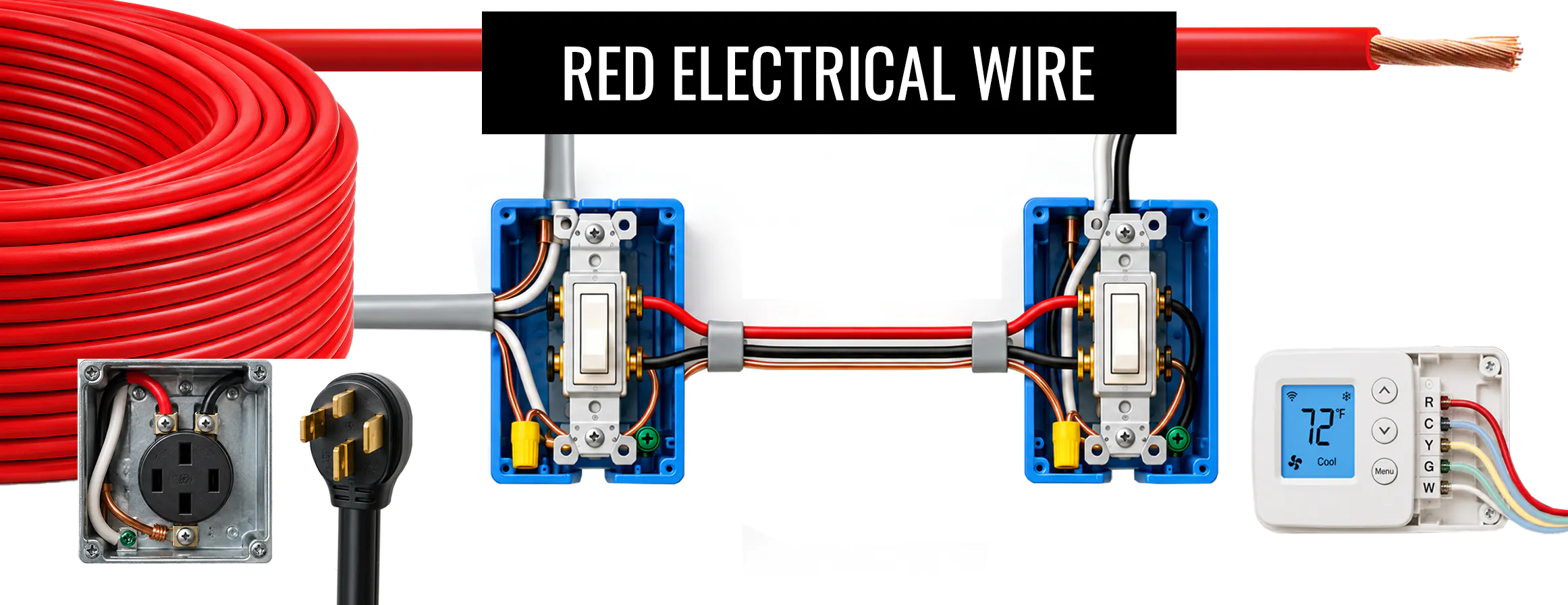
In U.S. home wiring, a red wire usually serves as a hot wire that carries electrical power. It may control a light or ceiling fan, serve as a traveler between two 3-way switches, or provide the second hot wire in a 240-volt circuit. However, red can also be a smoke alarm interconnect wire. Always treat it as live until properly tested.
Pull down an old ceiling light and you might find four wires in the box: black, white, bare copper, and red. You probably recognize black and white, but what about red? A red wire can do several different jobs. It might carry power from a wall switch to a light, connect two switches that control the same light, help power a 240-volt appliance like a dryer, or link hardwired smoke alarms together. Each job works differently, and knowing which one you’re looking at is key to staying safe.
At Palmer Electric, our licensed electricians have been answering questions like this for Central Florida homeowners since 1951. This guide walks through the jobs a red wire can perform, when it may be energized (meaning electricity is present), and what you need to know to stay safe. Wondering what other wire colors mean? Check out our electrical wire color code guide for a complete breakdown.
Key Takeaways
Start with these actions, then use the table below for a quick look at where red typically shows up.
- Never assume a red wire is safe to touch, even when the wall switch is off or the breaker appears to be off.
- Find out which wall switch controls the red wire at a ceiling fan or light before connecting or capping anything.
- Leave a black wire alone if it’s joined to other wires in the box, because it may supply power to other outlets or lights.
- Label the wire on the dark-colored screw (the common terminal) before replacing a 3-way switch, one of two switches that control the same light, because mixing it up with the other wires is a frequent wiring mistake.
- Never connect a smoke alarm’s red interconnect wire (the wire that links the alarms) to a hot wire (one that carries household power), because it may damage the alarms.
- Stop and call a licensed electrician if you find a red wire and can’t identify its purpose.
Important Safety Notice: The information in this article is provided for educational purposes only. Electrical work involves serious risk of shock, fire, and injury. Descriptions of wiring configurations and testing methods in this article are intended to help you understand how electrical systems work, not to guide you through performing electrical work yourself. Always turn off power at the panel and verify with a voltage tester before approaching any wiring. When in doubt, stop and contact a licensed electrician.
Red Wire Overview
| ROLE | WHERE YOU’LL FIND IT | VOLTAGE |
|---|---|---|
| Switched hot (controlled by a wall switch) | Ceiling fan and light boxes, half-switched outlets | Typically 120V when energized |
| Traveler (runs between two 3-way switches) | Between two switches that control one light (stairs, long hallways) | Typically 120V when energized |
| Second hot leg (240V circuits) | Electric dryer and range circuits | Typically 120V on each hot wire; 240V measured between red and black |
| Smoke alarm interconnect (links alarms so they sound together) | Hardwired smoke alarm boxes | Typically a low signal voltage that varies by manufacturer |
| Thermostat R wire (supplies thermostat power) | Thermostat and HVAC equipment | Typically 24V AC (alternating current) |
What Is Red Wire in Electrical?
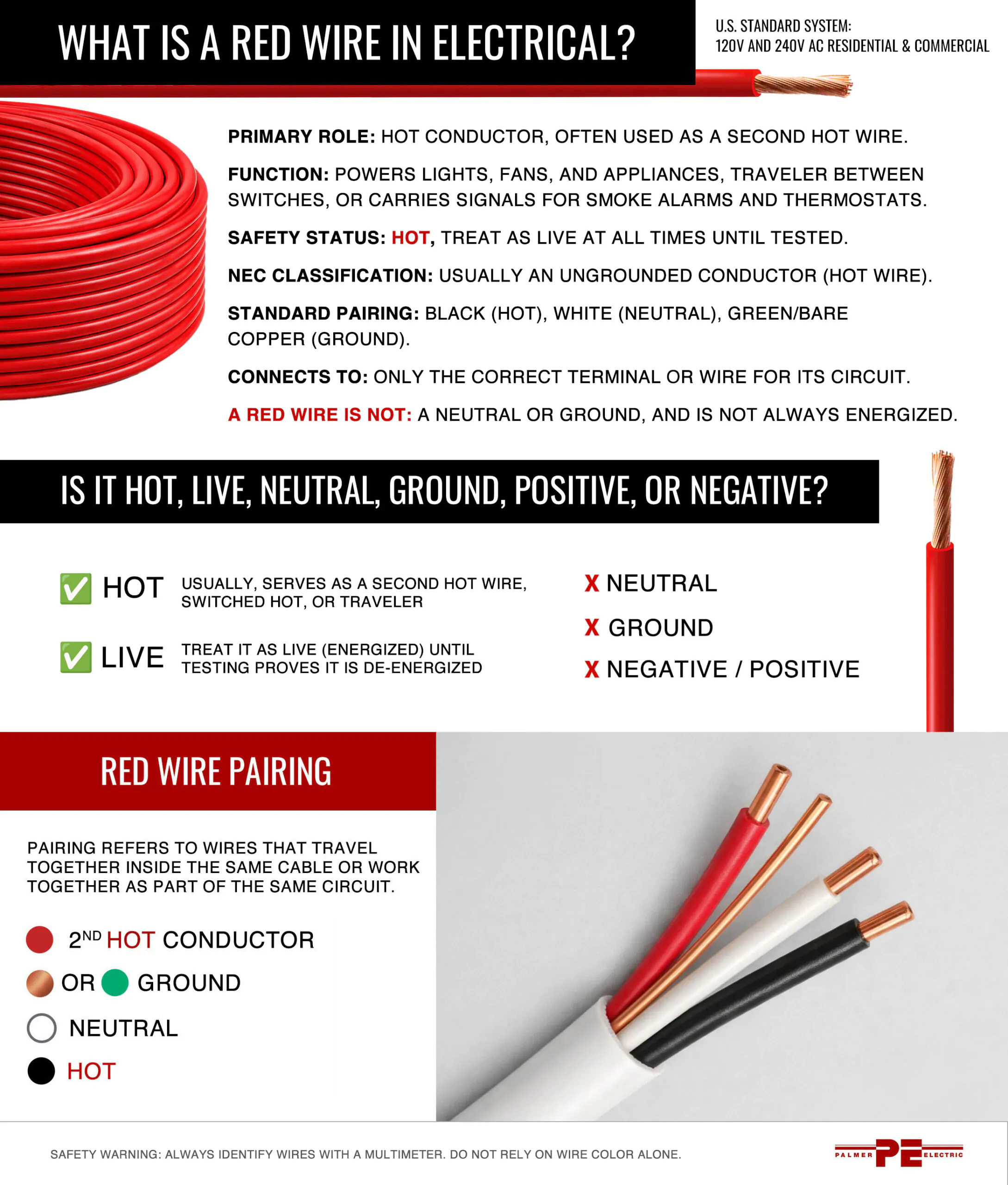
A red electrical wire is typically a hot wire, meaning it’s designed to carry power from your electrical panel to a light, switch, outlet, or appliance. It’s often used as a second hot wire alongside the black one, for example, to power a fan’s light separately or to help run a 240V appliance like a dryer.
Whether a box has that second hot wire usually comes down to the type of cable that runs to it.
Why Some Circuits Need a Second Hot Wire
Many household lights and outlets use cable labeled 14/2 or 12/2. The first number tells you the wire size, while the second tells you how many insulated wires are inside. These cables typically contain a black wire, a white wire, and a bare copper ground (safety) wire.
When a circuit needs an extra wire (electricians call each wire a conductor), they may use 14/3 or 12/3 cable, which typically adds a red wire. That extra wire may let two switches control the same light, or let separate switches control a ceiling fan and its light.
Ever spotted a red wire capped off inside a ceiling box? It’s often a spare left for a future fan or light.
Is a Red Wire Hot, Neutral, or Ground?
A red wire is typically a hot wire, not a neutral or a ground. Neutral and ground wires have their own required colors, and red isn’t one of them. The main household exception is the red wire that links hardwired smoke alarms, which typically carries a small signal instead of household power.
Here’s what each type of wire does:
- Hot wire: carries power from the panel to the light or appliance.
- Neutral wire: usually white, carries that power back to the panel to complete the circuit.
- Ground wire: usually bare copper or green, provides a safety path that only carries electricity if something goes wrong.
What surprises many homeowners is that the National Electrical Code (NEC), the national standard for safe electrical installations, doesn’t require hot wires in a typical home to be red or black. Its color rules focus on the other two: in most home wiring, neutral wires must be white or gray, and ground wires must be green, green with yellow stripes, or bare copper. Using red as the second hot wire is a common practice among electricians, not a code requirement, so color alone can’t tell you what a wire does.
Here in Florida, the 8th Edition (2023) Florida Building Code, the statewide construction code, currently adopts the 2020 NEC for electrical installations, according to Osceola County’s building office. The 9th Edition, which adopts the 2023 NEC, takes effect December 31, 2026.
Is a Red Wire Always Hot?
A red wire isn’t always hot in the everyday sense of the word. “Hot” describes the wire’s job, while “energized,” also called live, means electricity is present right now, which depends on what controls it: a wall switch, the position of two switches, or a breaker. Treat it as energized until testing confirms otherwise.
| RED WIRE’S JOB | WHEN IT’S TYPICALLY ENERGIZED | DOES TURNING OFF THE WALL SWITCH MAKE IT SAFE? |
|---|---|---|
| Switched hot: controls a fan light or switched outlet | Typically when the switch is on | No. It may lose power, but that alone doesn’t confirm it’s safe to touch |
| Traveler: connects two switches that control one light | May be energized depending on both switches’ positions | No. It may still be energized |
| Second hot leg: powers a 240V appliance (dryer, range) | Typically whenever its breaker is on | No. A wall switch generally doesn’t control this circuit |
| Smoke alarm interconnect: links compatible hardwired alarms | Typically when an alarm sounds | No. A wall switch doesn’t normally control it |
Notice the pattern in that last column? A wall switch is never proof that a wire is safe to touch.
Is the Red Wire Positive or Negative?
The red wire is typically positive (+) in DC (direct current) systems, such as car batteries. In your home’s AC (alternating current) wiring, a red wire is neither positive nor negative. Instead, it usually serves as a hot wire that carries power to lights, switches, or appliances.
Why the difference? DC power flows in one direction, so it has a fixed positive side and negative side. The AC power in your walls keeps switching direction, completing 60 cycles every second in the U.S., according to the U.S. Department of Energy, the federal energy agency, so neither side stays positive or negative.
What Is Red Wire on a Ceiling Fan?
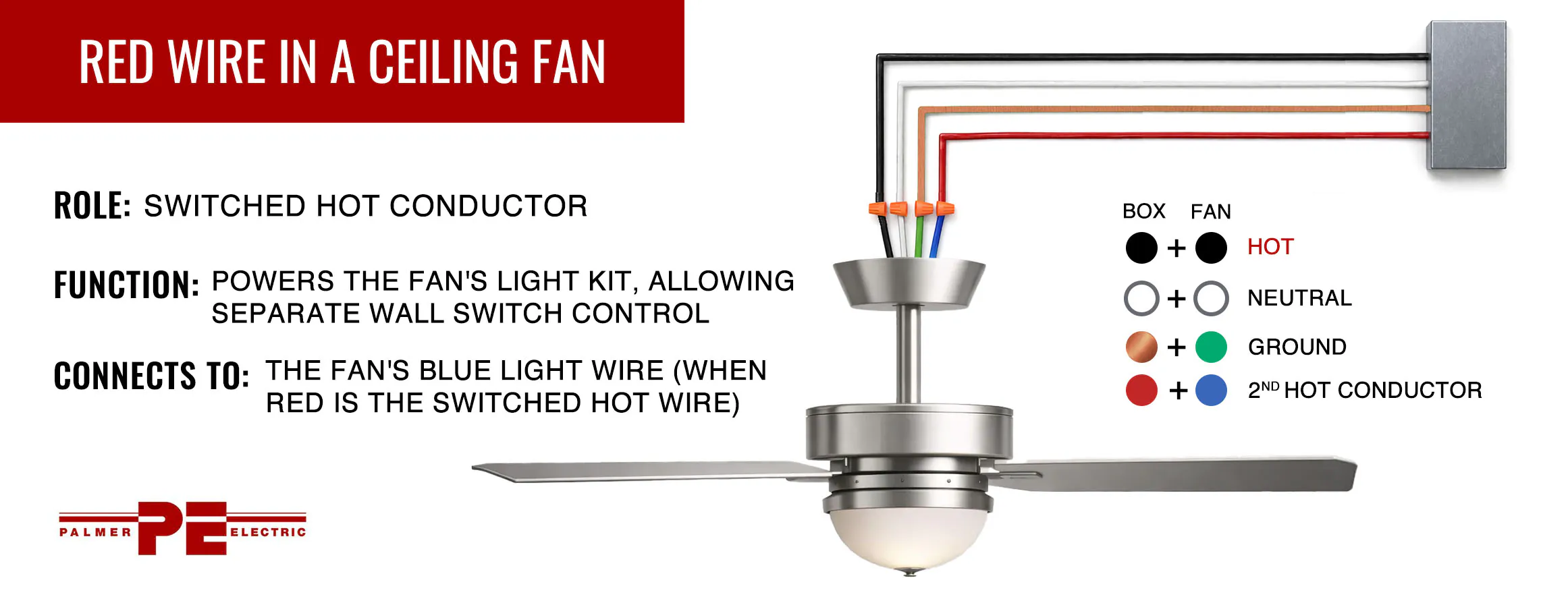
The red wire on a ceiling fan is typically a switched hot wire in the ceiling box, meaning a wall switch turns its power on and off. It’s usually there so one switch can control the fan’s light, and another can control the fan motor. Its exact job depends on how your home was wired.
Some homes have this red wire even when only one wall switch was installed, because the extra wire was run so a second switch could be added later.
Where Does the Red Wire Go on a Ceiling Fan?
On a ceiling fan, the red wire from the ceiling typically goes to the fan’s blue wire, which powers the light, when separate switches control the fan and light. The ceiling’s black wire usually connects to the fan’s black wire, which powers the motor. White wires typically connect as neutrals, and green or bare copper wires as grounds.
But what if you have only one wall switch?
You may see advice to connect both the fan’s black and blue wires to the ceiling’s black wire and cap the unused red wire with a wire connector (a small plastic cap that joins or seals wire ends). That setup only works when the black wire is the one the switch controls and the fan’s instructions allow it.
In some homes, it’s the other way around: the red wire is controlled by the wall switch while the black wire has constant power. If the wrong wire gets capped, the fan or light may ignore the wall switch or run nonstop.
For the full fan wire color chart, see our black electrical wire guide. If your ceiling box doesn’t match what the fan instructions show, our ceiling fan installation team can sort it out.
Where Does the Red Wire Go if You're Installing a Light Instead of a Fan?
When you’re installing a light instead of a fan, the ceiling’s red wire may connect to the fixture’s black wire, provided testing confirms that red is the switched hot wire. White typically connects to white, and the fixture’s ground connects to the circuit’s ground wire.
But what happens to the ceiling’s black wire?
First, check how it’s connected. If it’s joined with other black wires under a wire connector, it may be supplying power to other lights or outlets, and that connection needs to stay intact. If it’s a single wire on its own, it may be an unused wire that can be capped, but an electrician should first confirm it isn’t needed elsewhere in the circuit.
What Is a Red Wire for a Light Switch?
A red wire on a light switch is typically a hot wire with one of two jobs. On a single switch, it usually carries power from the switch to a light, fan, or switched outlet. Where two switches control the same light, it’s usually a traveler, one of the two wires connecting those switches.
You may read that the red wire on a switch always carries electricity. That’s not quite accurate. When it runs from a switch to a light, it typically loses power when the switch is off.
Here’s the tricky part: a voltage tester only tells you whether power is present, not which job the wire has. Figuring out its role means understanding how the whole circuit was built.
What Does the Red Wire Do on a 3-Way Switch?
The red wire on a 3-way switch is usually a traveler. A 3-way switch setup lets you control one light from two places, like the top and bottom of a staircase. Flipping either switch shifts power from one traveler to the other, so the red traveler may remain energized even when the light is off.
In a typical setup, the red and black wires in the cable between the switches act as travelers.
If you can control the same light from three or more locations, one or more 4-way switches are typically installed between the two 3-way switches to change the traveler connections.
However, not every home uses the same wiring arrangement. In some installations, the red wire serves a different purpose, such as carrying switched power to a light.
Does the Red Wire Go to the Black Screw?
The red wire usually doesn’t go to the black screw. On a standard 3-way switch, red is typically a traveler, so it connects to one of the brass-colored screws, while the black screw is the common terminal that connects to incoming power or the wire leading to the light. Some setups do use red as the common wire, though.
How does that work? A 3-way switch has one common screw and two traveler screws. When you flip the switch, the common connects to one traveler or the other, changing the path electricity takes.
What about a regular light switch? A basic single-pole switch, the kind that controls a light from one spot, usually has two brass-colored screws and no black common screw. On a standard mechanical switch, the two hot connections are generally interchangeable.
What about a smart switch? Smart switches are a little different. Some have connections labeled LINE (incoming power) and LOAD (power going to the light), while others use different wiring arrangements. Since wiring requirements vary by manufacturer and model, it’s important to follow the specific switch’s installation instructions.
When our electricians replace a 3-way switch, we identify and label the wire on the common screw before disconnecting anything, so the replacement goes back exactly the way the circuit needs it.
Other Common Uses for Red Wires
Beyond fans and switches, red wires typically show up in four other places around the house. Two of them usually carry household power, and two typically don’t.
Red Wire on an Outlet: Half-Switched Receptacles
A red wire on an electrical outlet often means it’s a half-switched receptacle, where a wall switch controls one half while the other stays powered. The red wire typically supplies switched power, while the black wire usually provides constant power. This setup is common when homeowners want to control a lamp from a wall switch.
In this arrangement, the small metal tab connecting the outlet’s two brass screws is typically removed. The red wire usually connects to one brass screw, and the black wire to the other, which lets the two halves operate independently.
In many half-switched outlets, both halves receive power from the same circuit breaker. However, some split receptacles use two separate circuits. When separate circuits supply the same receptacle, the National Electrical Code (NEC) requires a way to shut them off together, typically an approved handle tie (a clip joining two breaker handles) or a two-pole breaker (a single breaker that controls both).
At Palmer Electric, we know that outlet problems aren’t always easy to figure out, especially when you’re dealing with unfamiliar wiring.
As one of our customers shared, they called Palmer Electric to have a wall outlet checked. Our electrician, Will, arrived, explained that he could take care of the problem, and completed the work promptly. The homeowner appreciated his knowledge, professionalism, and reasonable pricing.
Whether you’re dealing with a faulty outlet or trying to understand why one half is controlled by a wall switch, our electricians can inspect the wiring, identify the problem, and recommend the right solution.
Red Wire on 240V Appliances
Electric dryers and ranges typically use four wires: black, red, white, and ground. Red and black are usually the two hot wires, each typically providing 120 volts relative to neutral. Together, they supply 240 volts to the heating elements, while the white neutral usually lets the appliance run 120-volt parts like timers and lights.
Here’s something many homeowners don’t realize: appliances that use only 240 volts, such as many traditional electric water heaters, AC condensers, and pool pumps, generally don’t need a neutral wire.
For example, a standard electric water heater may use a cable containing a black wire, a white wire, and a ground wire. In this setup, the white wire typically serves as the second hot wire, and the NEC requires it to be permanently re-marked, usually with colored tape or paint, wherever it’s visible in a box or at a connection.
That’s one reason you might not find a red wire connected to your water heater. The exact wiring depends on the appliance and installation.
You may also find red and black hot wires in a home’s 120/240V generator connection. These systems typically use two hot wires to supply power through approved transfer equipment (which switches the home between utility and generator power), although wire colors and connections may vary by generator model.
At Palmer Electric, we install generator connections and Generac standby generators throughout Central Florida, where hurricane season can bring extended outages.
One customer shared their experience having our electricians install a 50-amp generator inlet at their home. They appreciated how quickly the installation was scheduled after receiving a quote and described our technicians as knowledgeable and professional. The homeowner was so pleased with the work that they said they would choose Palmer Electric again for future projects.
Generator connections require careful planning and proper electrical installation, especially when connecting backup power to a home’s electrical system.
Red Wire in Hardwired Smoke Alarms
In a typical hardwired smoke alarm system, the red wire serves as the interconnect, sending a signal that makes all connected alarms sound when one detects smoke. It doesn’t normally carry the 120-volt household power that runs the alarms. Instead, the black wire typically supplies power, the white wire usually serves as neutral, and the red wire links the alarms together.
Connecting the interconnect wire to a hot wire may damage the alarms and keep the system from working properly. If an alarm isn’t interconnected, its unused interconnect lead is typically insulated as the manufacturer’s instructions direct.
Here’s something homeowners should know: the interconnect wire on the alarm itself isn’t always red. Some manufacturers, such as smoke alarm maker BRK, use orange instead. Replacement alarms also typically need to be compatible with the existing system, because different models may use different communication signals.
In Florida, smoke alarms in new homes generally must be interconnected so that when one sounds, the others do too. This may be done through wired interconnection or listed wireless alarms, depending on the installation.
Red Wire on a Thermostat (R, Rh, and Rc)
The red wire on a thermostat is usually the R wire, which supplies low-voltage power, typically 24 volts AC, from your home’s heating and cooling system, according to installation instructions from HVAC manufacturers Trane and Carrier. It’s different from the 120-volt wiring used for household outlets. Some thermostats also have Rh (heating) and Rc (cooling) terminals, which accommodate systems with shared or separate power supplies.
What if your thermostat has both Rh and Rc terminals but only one red wire? Some thermostats connect these terminals internally, while others use a small jumper or require a specific connection. The correct setup depends on the thermostat model, so the manufacturer’s wiring instructions are the best guide.
Here’s another thing to watch for: if the red R wire touches the C (common) wire while the HVAC system is powered, it may cause a short circuit and blow a small fuse on the control board. That’s why electricians typically turn off power to the HVAC equipment before working on thermostat wiring.
For a closer look at what the other thermostat wire colors mean, see our electrical wire color code guide.
Which Wires Go With a Red Wire?
The wires that go with a red wire are typically black, white, and ground, but red’s connection depends on the circuit. It may connect to a ceiling fan’s light wire, a 3-way switch’s traveler terminal, or one half of a switched outlet. In a 240V circuit, red and black are usually separate hot wires that aren’t meant to be joined.
You may read that a red wire typically connects to a black wire. That’s only correct in certain wiring arrangements.
Not sure how red and black wires work together? Our black electrical wire guide explains their different roles and common connections.
| WIRE COLOR | TYPICAL ROLE | CAN RED CONNECT TO IT? |
|---|---|---|
| Black | Hot wire | Only when the circuit design specifically calls for a connection |
| White | Neutral | No, not when white is serving as neutral |
| Green or bare copper | Ground | No, never connect a hot red wire to ground |
| Blue (ceiling fan) | Light kit wire | Typically yes, when red is the switched hot wire |
| Red (smoke alarm) | Interconnect signal wire | Typically connects to the compatible alarm’s designated interconnect lead |
Red Wire vs. Black Wire: What’s the Difference?
In home wiring, red and black wires are both typically hot wires that carry power from the breaker panel. The difference is their usual job: black is typically the main hot wire, while red is usually a second hot wire for 240V appliances, separate switch control, or 3-way switches. In DC systems, red typically means positive and black negative.
Here’s how the two compare in a typical home:
| BLACK WIRE | RED WIRE | |
|---|---|---|
| ROLE IN THE CIRCUIT | Typically the main hot wire | Usually a second hot wire |
| WHERE YOU’LL USUALLY FIND IT | Most outlet, switch, and light circuits | Only where three-wire cable was run: fan and light boxes, 3-way switches, switched outlets, dryer and range circuits |
| TYPICAL VOLTAGE | 120V | 120V; 240V measured between red and black on a 240V circuit |
| CONTROLLED BY A WALL SWITCH? | Often has constant power, but may be switched | Often switched, or used as a traveler between switches |
| MAY BE ENERGIZED WITH THE LIGHT OFF? | Yes, when it’s the constant power wire | Yes, when it’s a traveler on a 3-way switch |
| IN DC SYSTEMS | Typically negative (-) | Typically positive (+) |
So why do electricians use both colors? When two hot wires share a box, different colors make them easy to tell apart. Red is typically chosen whenever a circuit needs a second hot wire that must stay distinguishable from the first: a switched wire next to a constant one, a pair of travelers, or the two hot wires of a 240V circuit.
Want to learn more? Visit our black electrical wire guide to learn more about the black wire functions.
Can a Black Wire Be Used Instead of a Red Wire?
Yes, in many household AC circuits, a black wire can do the same job as a red wire. The catch is identification. When two hot wires in the same box look identical, it’s easy for the next person to mix them up, which is why electricians typically use different colors or mark one with colored tape.
Common Red Wire Mistakes and What Happens
Common red wire mistakes include connecting it to a neutral or ground wire, joining the wrong hot wires, confusing a traveler with the common wire on a 3-way switch, or connecting a smoke alarm’s interconnect wire to household power. Depending on the circuit, these mistakes may trip breakers, damage equipment, or create serious electrical hazards.
| MISTAKE | WHAT TYPICALLY HAPPENS |
|---|---|
| Red hot wire connected to a white neutral | Short circuit; the breaker typically trips, and the connection may spark or scorch |
| Red hot wire connected to a ground wire | The breaker typically trips; if the ground path is weak, metal boxes or fixtures may become energized |
| Red and black from different breakers joined together | May cause a short circuit or dangerous cross-feeding between circuits |
| Smoke alarm red interconnect connected to a hot wire | Alarms may be damaged, and the whole interconnected system may stop working |
| Red traveler swapped with the common wire on a 3-way switch | The light may only work with the switches in certain positions |
What about reversing red and black wires? That depends on the circuit. On a ceiling fan with separate switches, the controls might operate the opposite parts of the fan. On a standard dryer or range circuit, swapping the two hot wires typically makes no difference.
You may also hear this called “reverse polarity,” but that’s not quite the same thing. In household AC wiring, reverse polarity usually refers to swapping hot and neutral connections. Depending on the wiring, this may leave parts of a fixture energized even when the switch is off. In DC systems, such as car batteries, reversing positive and negative connections may damage equipment.
When a Red Wire May Still Be Live
A red wire may still be energized (live) when a wall switch or appliance is off, depending on how the circuit is wired. It may also stay energized after you turn off a breaker if the panel is mislabeled, the circuit shares a neutral wire with another circuit, or a generator is connected improperly.
Here’s why these situations may be dangerous:
Mislabeled electrical panels: Breaker labels may become outdated after years of repairs or remodeling. Turning off the breaker marked for a room doesn’t guarantee you’ve disconnected the correct circuit.
Shared neutral circuits: Some homes have a red wire and a black wire on separate breakers
that share one white neutral. This is called a multiwire branch circuit. Turning off only one breaker may leave the other circuit energized and the shared neutral carrying current. The NEC requires a way to disconnect both hot wires together, usually an approved handle tie or two-pole breaker.
Battery-backed smoke alarms: Some interconnected hardwired smoke alarms may continue sending signals through their interconnect wire during a power outage, so the red wire may carry a low-voltage signal even when household power is off, depending on the alarm model.
Improper generator connections: Connecting a generator to a household outlet with a homemade cord may send electricity back into your home’s wiring and onto utility lines. A properly installed generator inlet and transfer switch helps prevent dangerous backfeeding.
Red Wires in Older vs. Newer Florida Homes
The age of your home may change what you find behind a cover plate. Here’s how red wires tend to show up in older and newer Central Florida homes, and what to know before updating them.
How Wiring Practices Have Changed
The National Electrical Code is updated every three years, and a few of those changes affect the wires you’ll find in your home.
- Dryers and ranges: Since the 1996 NEC, new dryer and range circuits have typically used four wires: black, red, white, and a separate ground. Many older homes still have three-wire circuits without a separate ground, which the code generally allows to remain in existing installations.
- Switch boxes: Since the 2011 NEC, a neutral wire has generally been required at most new switch locations. Older switch boxes may have only hot wires, which matters if you’re planning a smart switch, since many models need a neutral.
Red Wires in Older Central Florida Homes
Older homes may have fewer red wires to begin with, because many were wired with simple two-wire cable for each light and outlet. When red does appear, it may be harder to recognize. Older cloth or rubber insulation can fade or darken over the decades, so a red wire may look brown or black.
Working with existing wiring can also be challenging, especially in Central Florida’s concrete-block homes. One of our customers shared how Palmer Electric electricians Gene and Jack completed a whole-home rewire, including an electrical service and panel upgrade. Despite the challenges of working in a block home, the homeowner was impressed by how little drywall repair was needed and how clean our team left everything.
That’s the kind of care we bring to electrical wiring projects. Whether we’re identifying an unfamiliar red wire or replacing outdated wiring, our electricians take the time to understand the existing electrical system before making changes.
Why Renovations May Add Red Wires
Renovations are a common reason a red wire shows up where a home’s original wiring didn’t have one. Adding a ceiling fan with separate light control, a second switch at the other end of a hallway, a switched outlet, or an electric vehicle charger may mean running three-wire cable, which brings a red wire with it. Work by previous owners may also leave red wires that don’t follow standard practice.
Code Compliance When Updating Wiring
In Florida, electrical renovation work typically requires a permit, an inspection by the local building department, and new work that meets the code currently in force. The Florida Building Code includes a separate volume, Existing Building, that covers repairs, alterations, and additions to existing homes, as Osceola County’s building department notes. Older wiring that isn’t being changed is generally allowed to remain, as long as it isn’t unsafe. A licensed electrical contractor typically pulls the permit and schedules the inspection.
What to Do With an Unused Red Wire
An unused red wire is typically capped individually with an approved wire connector and tucked inside the electrical box. Before that, an electrician usually identifies its purpose, verifies the circuit is de-energized, and checks whether the wire is connected elsewhere. The extra wire is usually left in place for possible future use.
Why not just cut it off? That extra red wire might come in handy if you decide to install a ceiling fan with separate light controls or add another wall switch later.
Electricians generally leave enough wire to make future connections easier. In fact, the NEC (Section 300.14) generally requires at least 6 inches of free wire at electrical boxes where wires are connected, though wires that only pass through a box are exempt.
The other end matters too. In some homes, an unused red wire in the ceiling box may still be connected to a wall switch. That could explain why you have a switch that doesn’t seem to control anything.
When to Call a Licensed Electrician
Some red wire situations are clear signs that the job needs a licensed professional, not a DIY fix:
| SITUATION | WHY IT TYPICALLY NEEDS A PRO |
|---|---|
| A red wire that no switch seems to control | It may be fed from another circuit or share a neutral |
| Red and black wires sharing one white wire, on two separate breakers | A missing handle tie may leave the neutral carrying current |
| Your tester shows voltage after the breaker is off | The panel may be mislabeled, or there may be a second power source |
| Hardwired smoke alarms that won’t sound together | The interconnect wiring may be faulty, or the models may be incompatible |
| Adding or changing a 240V circuit or generator connection | These typically require a permit, and errors may create a backfeed risk |
| Scorched, brittle, or melted insulation on a red wire | Possible signs of overheating and fire risk |
Seeing scorch marks or smelling something burning? Turn off the main breaker if it’s safe to do so, and call our 24/7 emergency electricians.
Red Wire FAQs
Here are a few more questions homeowners often ask about red wires.
Can I Use a Red Wire as a Neutral?
No, not in typical U.S. home wiring. Neutral wires are normally identified by white or gray insulation, and under the National Electrical Code (NEC), you can’t simply wrap white tape around a red wire to use it as a neutral. The NEC allows some exceptions for larger wires, but these generally don’t apply to standard household lighting and outlet circuits.
Can I Connect a Red Wire to a Brown Wire?
Yes, in certain installations. A brown wire on a fixture built to international wiring standards typically serves as the hot wire, so it may connect to your home’s red switched hot wire. However, the connection should match the fixture’s wiring instructions and voltage requirements, and the fixture should be UL or ETL listed for use in the U.S.
On these fixtures, blue typically identifies neutral, while green with yellow stripes usually identifies ground.
Should I Connect the Red or Black Wire First?
Whether you connect the red or black wire first generally doesn’t matter in household wiring. Electricians typically connect the ground wire first, then the neutral, and finally the hot wires, because grounding first establishes the safety connection before the other wires are attached.
When disconnecting a fixture, the ground is typically removed last.
Car batteries work differently. The usual order is to connect the red positive cable first, then the black negative cable, and to disconnect black first when removing a battery.
Conclusion
A red wire usually means someone planned your home’s wiring for more than a simple on-and-off circuit.
If you open a box and the red wire doesn’t match anything in this guide, that’s the moment to bring in a pro. Palmer Electric has served Central Florida homeowners since 1951 (Florida license EC0003096), and our licensed electricians can trace, test, and explain your wiring before anything changes. Call us 24/7 at 407.646.8700 or request a free estimate through our contact form.
References
- National Fire Protection Association, NFPA 70: National Electrical Code (2020 edition). https://www.nfpa.org/codes-and-standards/nfpa-70-standard-development/70 Free read-only access requires a free NFPA account.
- Florida Building Commission, 9th Edition (2026) Florida Building Code update workplan (lists the December 31, 2026 effective date and the 2023 NEC as the selected electrical code). https://www.floridabuilding.org/fbc/commission/FBC_0726/Commission/2026_FBC_Workplan_August_2026.pdf
- Osceola County, Builders and Contractors (Florida Building Code and NEC adoption). https://www.osceola.org/Doing-Business/Building-and-Permits/Permit-Information/Builders-Contractors
- U.S. Department of Energy, Office of Electricity, Learn More About Interconnections. https://www.energy.gov/oe/learn-more-about-interconnections
- Trane, Programmable Touch Screen Thermostat Installation/Configuration Instructions (BAS-SVN203B-EN, June 2020). https://elibrary.tranetechnologies.com/public/commercial-hvac/Literature/Installation/BAS-SVN203B-EN_06052020.pdf
- Carrier, Comfort Series AC/HP Thermostat Installation Instructions (TC-PACA-02SI, April 2017), hosted by distributor Sigler. https://siglers.com/mwdownloads/download/link/id/5595
- BRK Electronics (a Resideo company), How Do I Install Hardwired BRK Alarms? https://www.brkelectronics.com/blogs/installer-corner/how-do-i-install-hardwired-brk-alarms