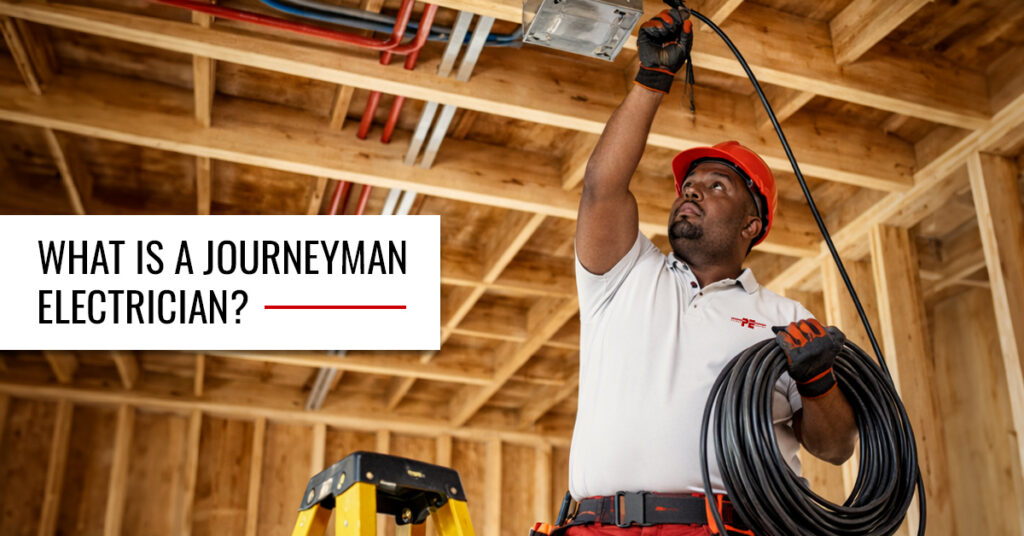
A journeyman electrician is a credentialed electrical professional who has completed the training and experience required by their state or local jurisdiction and passed the required licensing or competency exam, earning the legal authority to perform electrical work without direct, on-site supervision. Journeymen are the core of most electrical crews, working across residential, commercial, and industrial settings under the license of a licensed electrical contractor.
Every building you walk into, every outlet you plug into, and every light switch you flip was almost certainly installed or inspected by a journeyman electrician. They are not the entry point of the trade and they are not the top, but they are the engine. The journeyman level is where electricians spend the majority of their working careers, and for good reason. It is where the real work happens.
If you are a business owner trying to understand who is actually working in your building, or you are a mid-apprenticeship and wondering what comes next, or how the electrical trade is structured, this guide covers everything you need to know about the journeyman electrician role.
Key Takeaways for Journeyman Electrician
- A journeyman electrician is a credentialed electrical professional who has completed the required training and passed the licensing or competency exam required by their state or local jurisdiction.
- Training requirements vary. The most common path is four to five years through a registered apprenticeship.
- In most jurisdictions, journeymen can work without someone looking over their shoulder on every task, but they still work under a licensed electrical contractor, master electrician, or qualifying license holder.
- What a journeyman is authorized to do depends on their license type and local rules. Some licenses cover all settings, others are limited to specific types of work.
- In many jurisdictions, journeymen can oversee apprentices on the job site, though the rules on how many and in what capacity vary locally.
- The journeyman level is where most electricians spend the bulk of their careers.
- Journeyman experience is typically required before pursuing a master electrician license, but requirements vary by state and local authority.
- Journeyman licensing is handled at the state level in some places and at the local or county level in others. Requirements vary.
Journeyman Electrician Overview Table
| Category | Details |
|---|---|
| Role Level | Credentialed electrical professional, mid-level in the trade hierarchy |
| Also Known As | Journey-Level Electrician, Journeyperson Electrician, Journeyworker Electrician, Journeyman Electrician, Electrical Journeyman; title varies by jurisdiction |
| Works Under | Licensed electrical contractor or other licensed employer, as defined by state or local jurisdiction. Learn more about working with a licensed electrical contractor: Electrical Contractors |
| Supervises | May oversee apprentices where local rules allow; ratios and conditions vary |
| Credential Required | Varies by jurisdiction. Most states require a state-issued journeyman license. Some states license at the county or municipal level only. A small number of states, such as Pennsylvania, have no statewide requirement but may require a local license depending on the municipality where the work is performed. |
| Can Work Without Direct Supervision | Yes, in most jurisdictions, they can perform hands-on electrical work independently. However, in most states they must operate under a licensed electrical contractor who holds the permit and legal responsibility for the project. |
| Can Pull Permits | Varies by jurisdiction. In most states, permits are pulled by the licensed electrical contractor or master electrician. Some states allow licensed journeymen to pull permits for specific work types. |
| Typical Experience | Varies; four to five years through a registered apprenticeship is most common |
| Work Settings | Residential, commercial, industrial, and construction, within the scope of their license |
| Next Career Step | Master electrician license or licensed electrical contractor, depending on the jurisdiction |
For a full breakdown of the master electrician credential, see: What Is a Master Electrician
Journeyman Electrician Definition
A journeyman electrician is a fully credentialed electrical professional who has completed all required apprenticeship training, documented the necessary on-the-job hours, and passed the applicable state or local licensing examination. The term “journeyman” indicates that they have mastered the foundational skills of the trade and are qualified to work within the scope of their credential without direct, on-site supervision.
Journeyman Electrician Synonyms and Title Variations
You may also see this role listed under different titles depending on the state or employer. Common synonyms include:
- Journeyman Electrician: The most widely used title across job postings, contracts, and the electrical industry
- Journey-Level Electrician: The term used in many state licensing statutes and U.S. Department of Labor apprenticeship documentation
- Journeyperson Electrician: A gender-neutral alternative used in some state licensing language and union documentation
- Journeyworker Electrician: A gender-neutral alternative used in some state and federal workforce documentation
- Electrical Journeyman: A common reordering of the title, frequently used in contractor documentation and job postings
- Inside Wireman: An IBEW-specific classification for journeyman-level electricians working on interior commercial and industrial electrical systems. Not a universal synonym, but refers to the same credential level within union settings
One important thing to know: the title can change depending on the state or even the employer. But the credential behind it is basically the same, completed training and passing a licensing or competency exam. So if you see different titles on a contractor’s crew list or in a job posting, they are usually referring to the same level of qualification.
For a full breakdown of how the journeyman role fits within the broader structure of the electrical trade, including how it compares to apprentice and master electrician roles, see our guide on Electrician Levels Explained: Skill Levels, Roles, and Career Progression.
What Is a Journeyman Electrician
A journeyman electrician is a credentialed professional who has completed a formal apprenticeship, passed the required licensing or competency exam, and earned the legal authority to perform electrical work without being directly supervised on every task.
Did you know the difference between an apprentice and a journeyman is not just about experience? It also comes down to legal standing. An apprentice cannot legally do electrical work alone, they need a licensed electrician on site who is responsible for the work. A journeyman, on the other hand, can handle work on their own within the scope of their license, make real-time decisions in the field, and take direct responsibility for doing the job safely and up to code.
At Palmer Electric, our journeymen are the backbone of every crew we send out. Whether it is a panel upgrade in a Central Florida home, a commercial tenant improvement in an Orlando office building, or a new construction project, the journeyman on that crew keeps the work moving safely and correctly. For a full overview of the different types of electricians in the trade, see: Types of Electricians
Why Are They Called Journeyman Electricians?
The word “journeyman” comes from the French word “journée,” which means a day’s work. In medieval Europe, trade guilds used a three-level system: apprentice, journeyman, and master. A journeyman had finished their apprenticeship and could be hired for wages by different masters. They were skilled workers, but not yet at the level where they could run their own shop or take on apprentices.
According to the Britannica Encyclopedia, a journeyman could work for one master or another and earn wages, while a master craftsman was the one with the standing to operate independently.
That three-tier structure influenced how the modern skilled trades organized their training and licensing systems. You will still find that language across much of the U.S. electrical industry today, though not every state or jurisdiction uses all three titles or defines them the same way.
The title stayed after all these years because the idea behind it still holds: someone who has put in the work, earned the credential, and is ready to do the job at a professional level.
Is a Journeyman the Same as an Electrician?
A journeyman is a type of credentialed electrician, but not every electrician is a journeyman. The term “electrician” is broad. It can refer to anyone working in the electrical trade at any level, including apprentices and master electricians. A journeyman electrician is specifically someone who has completed their apprenticeship and holds a journeyman-level credential.
Think of it this way: all journeymen are electricians, but not all electricians are journeymen. If you are hiring a contractor and you want to know the specific qualifications of the people working in your home or building, ask whether the crew includes credentialed journeyman or master electricians. That is the credential that matters.
Journeyman Electrician Job Description
A journeyman electrician installs, maintains, and repairs electrical systems across residential, commercial, and industrial settings, and usually works under a licensed electrical contractor. They interpret blueprints, execute installations, troubleshoot faults, and ensure all work meets NEC requirements and local code. System-level planning and design remain within the master electrician’s authority. On most job sites, they are the senior technical presence responsible for work quality and code compliance.
The journeyman role is a working, hands-on position at the core of the electrical trade. It requires a combination of 3 important skills:
- Technical knowledge
- Physical capability
- Professional judgment
Journeymen are expected to work efficiently without step-by-step direction, adapt to changing site conditions, coordinate with other trades and project stakeholders, and make real-time decisions that affect safety, code compliance, and project timelines.At Palmer Electric, our journeymen work across a wide range of project types, from residential service calls and panel upgrades to large commercial installations and new construction in Central Florida. That level of experience across so many project types is exactly what makes them the professionals our clients rely on. For a full breakdown of the commercial electrician role, see: What Is a Commercial Electrician
What Does a Journeyman Electrician Do
A journeyman electrician performs the full scope of electrical installation, maintenance, and repair work within their licensed scope, without direct supervision, on job sites ranging from single-family homes to large commercial buildings.
The day-to-day work of a journeyman can change a lot depending on the project, the stage of construction, and the type of electrical system involved. That is one of the big reasons this role stays interesting. No two days really look the same.
For example, a journeyman might spend the morning on a residential service call, figuring out why a breaker keeps tripping, replacing a bad outlet, and explaining to the homeowner what caused the issue. Later that same day, they could be on a new construction job, roughing in circuits for a kitchen remodel. At Palmer Electric, we see this kind of variety all the time, and it is one of the things that makes the journeyman level such a hands-on, engaging part of the trade.
Here is something most people do not realize: journeymen are not just installers. They are problem solvers. The ability to read a set of blueprints, identify a fault in a complex circuit, and determine the safest and most code-compliant solution on the spot is what separates a journeyman from someone who is still learning the trade. At Palmer Electric, our journeymen bring that problem-solving capability to every job site, whether it is a straightforward residential repair or a complex commercial installation in one of Orlando’s newer commercial developments.
Journeyman Electrician Duties
A journeyman electrician carries a defined set of responsibilities on every job site. The specific duties vary by project type, employer, and jurisdiction, but the following reflects what most journeymen are expected to perform across the United States.
Core duties typically include:
- Installing electrical systems: Planning and executing the installation of wiring, conduit, panels, outlets, switches, fixtures, and electrical equipment in accordance with project specifications and NEC requirements
- Reading and working from blueprints: Interpreting electrical drawings, wiring diagrams, and specifications to plan layouts and execute installations accurately.
- Troubleshooting and diagnosing faults: Using testing equipment including multimeters, clamp meters, and non-contact voltage testers to identify and resolve electrical faults in existing systems
- Maintaining and repairing electrical systems: Inspecting, testing, and repairing wiring, circuit breakers, panels, and electrical equipment to ensure safe and reliable operation
- Ensuring NEC and local code compliance: Applying the adopted edition of NFPA 70, the National Electrical Code, along with any local amendments and requirements set by the authority having jurisdiction (AHJ), to all electrical installations within the NEC’s scope.
- Following safety protocols: Complying with all applicable OSHA electrical safety standards, site-specific safety plans, and PPE requirements on every job site. Supervising apprentices where permitted: Providing on-site oversight and instruction to apprentice electricians in accordance with local supervision rules and ratios
- Coordinating with other trades and stakeholders: Communicating with project managers, general contractors, inspectors, and other trades to keep work on schedule and within scope
What journeymen are not authorized to do is equally important. In most jurisdictions, journeymen cannot pull permits, contract directly with clients, or operate as an independent electrical business. Those authorities belong to the licensed electrical contractor. Understanding those boundaries is part of what it means to work professionally at the journeyman level.
Journeyman Electrician Daily Tasks by Work Environment
| Work Environment | Common Journeyman Tasks |
| Residential Service and Repair | Diagnosing faults, replacing panels and breakers, installing outlets and fixtures, upgrading wiring in older homes, installing EV chargers and surge protection |
| Residential New Construction | Roughing in wiring, installing panels and subpanels, running circuits for kitchens, bathrooms, and HVAC, final trim and device installation |
| Commercial Buildings | Installing conduit systems, wiring three-phase panels, installing lighting controls and emergency systems, coordinating with GC and inspectors |
| Commercial New Construction | Reading and executing from electrical drawings, installing distribution equipment, coordinating phased installations across multiple floors or units |
| Industrial Settings | Installing rigid metal conduit, wiring motor control centers, supporting VFD and control wiring under supervision of master electrician or contractor |
| Service Calls (All Types) | Troubleshooting circuit faults, testing and replacing equipment, performing code-compliance corrections, assisting with inspections |
Journeyman Electrician Qualifications
Becoming a journeyman electrician requires meeting a specific set of requirements before you can even sit for the licensing exam. The exact details vary by state and local jurisdiction, but the core requirements are consistent across the country.
Here is what most jurisdictions require:
- Age: At least 18 years old.
- Education: A high school diploma or GED equivalent.
- Experience: Completion of a registered apprenticeship or documented on-the-job training hours, typically 8,000 hours over four to five years.
- Classroom instruction: Related technical instruction, 500 or more hours of related technical instruction, depending on the program.
- Exam: A passing score on the state or local journeyman licensing exam, which covers the National Electrical Code (NEC), electrical theory, and local code requirements.
- Documentation: Verified proof of hours, usually through W-2s (Wage and Tax Statement), employer affidavits, or apprenticeship program records.
One thing worth knowing: in some states, you can substitute non-apprenticeship work experience for some or all of the apprenticeship requirement, as long as you can document the hours properly. Requirements and substitutions vary, so always check with your local licensing authority or state board.
Journeyman Electrician Qualifications at a Glance
| Requirement | Typical Standard |
| Minimum Age | 18 years old |
| Education | High school diploma or GED |
| On-the-Job Hours | 8,000 hours (4 to 5 years) |
| Classroom Hours | 500 or more hours |
| Exam | NEC-based journeyman licensing exam |
| Hour Documentation | W-2s, employer affidavits, or apprenticeship records |
| License Type | State-issued or local/county-issued, depending on jurisdiction |
Journeyman Electrician Certification

A journeyman electrician license and a journeyman electrician certification are not always the same thing, and it is worth understanding the difference.
A license is issued by a state or local authority and gives you the legal right to perform electrical work within a jurisdiction. It is required to work as a journeyman in most parts of the country.
A certification is typically issued by a professional organization and demonstrates a specific skill set or area of expertise. Certifications are not always required, but they can make you more competitive in the job market or qualify you for specialized work.
Some common certifications journeyman electricians pursue include:
- OSHA 10 or OSHA 30: Safety training certifications widely recognized across construction job sites
- NFPA 70E: Electrical safety training for workplace electrical hazards, especially relevant for industrial and commercial settings
- EV Charger Installation Certification: Increasingly common as electric vehicle infrastructure expands
- Low Voltage or Fire Alarm Certifications: Required for certain specialty work depending on the jurisdiction
At Palmer Electric, we encourage our journeymen to pursue certifications beyond the minimum licensing requirements. In Central Florida, where commercial growth and residential development are constant, having additional credentials opens doors to more complex and rewarding project types.
How to Get a Journeyman Electrician License
Getting your journeyman license comes down to meeting the prerequisites, completing your hours, applying with the right authority, and passing the exam. How that process works depends on where you live:
- Statewide Licensing: States like Texas, Colorado, and Washington require a state-issued license based on mandated apprenticeship hours and a board exam
- Local Municipal Licensing: In states like Ohio, New York, and Florida, licensing is handled by individual cities or counties rather than the state government
- No Statewide License: A handful of states, such as Pennsylvania, do not issue a state-level electrician license. Local municipalities still require their own licenses, and an electrician working across multiple cities may need more than one
Here is how the process typically works:
- Meet the prerequisites: You need to be at least 18, hold a high school diploma or GED, and have a valid Social Security number for most applications.
- Complete Your Apprenticeship: Most programs require 8,000 hours of on-the-job training. This can come through a registered apprenticeship program such as the Electrical Training Alliance (a joint program of NECA and IBEW), an Independent Electrical Contractors (IEC) program, or in some cases, verified non-union work experience.
- Verify Your Experience: Obtain signed affidavits or letters from your supervising licensed contractors confirming your hours, dates of employment, and the specific electrical tasks you performed. Compile certificates or transcripts of your completed classroom education.
- Apply for the Exam: Apply with your licensing authority. Depending on where you live, that could be a state board, a county licensing office, or a municipal authority. Requirements and processes vary, so check with the licensing authority in your state or county before applying.
- Study and Pass the Licensing Exam: The exam typically covers the NEC, electrical theory, and any local code amendments. Many candidates use prep courses offered through community colleges, trade organizations, or online providers to prepare.
Some states also have reciprocity agreements, which means your license from one state may be recognized in another. If you are planning to work across state lines, it is worth researching whether your home state has reciprocity with the states you plan to work in.
How Many Hours to Be a Journeyman Electrician
Most journeyman electrician programs require 8,000 hours of on-the-job training, which works out to roughly four to five years of full-time work. However, the exact requirement depends on the program and the jurisdiction.
Some programs set the bar at 4,000 hours for a residential-only license, while broader commercial and unlimited licenses typically require the full 8,000 hours or more.
Common OJT Hour Requirements by Program Type
| Program / License Type | Required OJT Hours | Approximate Time |
| Residential Journeyman (limited scope) | 4,000 hours | 2 to 3 years |
| General Journeyman (commercial/residential) | 8,000 hours | 4 to 5 years |
| Industrial Journeyman | 8,000 hours | 4 to 5 years |
| IBEW / Electrical Training Alliance | 8,000 hours | 5 years |
| IEC (Independent Electrical Contractors) | 8,000 hours | 4 years |
| Non-union / Employer-sponsored | 8,000 hours (documented) | 4 to 5 years |
How Long Does It Take to Become a Journeyman Electrician
For most people, the realistic timeline to become a journeyman electrician is four to five years. That includes the time spent in an apprenticeship program, completing classroom instruction, and preparing for and passing the licensing exam.
A few things can affect that timeline. Some states allow prior military electrical experience or documented trade school training to count toward the hour requirement, which can shorten the path. On the other hand, if you are working part-time or your apprenticeship program has limited availability, it can take longer.
The bottom line: if you commit to a registered apprenticeship program from the start and stay on track, four years is a realistic target for most people pursuing a general journeyman license.
How to Become a Journeyman Electrician
Most electricians follow the same core path to reach journeyman status:
- Complete a registered apprenticeship, typically four to five years of combined on-the-job training and classroom instruction
- Document your required hours with verified employer records or apprenticeship program documentation
- Apply with your state or local licensing authority and pass the journeyman exam
Journeyman Electrician vs Master Electrician
The main difference between a journeyman and a master electrician comes down to authority and responsibility. A journeyman performs most electrical work independently but still operates under a licensed electrical contractor. A master electrician can design systems, pull permits, supervise journeymen and apprentices, and in most jurisdictions, own and operate an electrical contracting business. For a full side-by-side breakdown of both roles, including licensing requirements and scope of work, see our guide: Electrician Levels Explained
What Homeowners and Business Owners Should Know About Journeyman Electricians
If you are hiring an electrical contractor, you are almost certainly going to have journeyman electricians doing the work in your home or building. That is completely normal and appropriate. A credentialed journeyman is a fully qualified professional who is authorized to perform the work correctly and safely.
Here are a few things worth knowing before you hire:
Licensing is not always visible
Since a journeyman does not carry his license on a visible spot, you can and should ask your contractor whether the electricians performing work in your property hold journeyman or master electrician credentials. A reputable contractor will answer that question directly and will provide proof if you think it is necessary.
Journeymen work under a contractor’s license
In most jurisdictions, the electrical contractor, not the individual journeyman, pulls the permits and holds legal responsibility for the project. Make sure the company you hire is properly licensed, bonded, and insured. That is how you know the work is being done under the right authority.
Not all journeyman licenses are the same
Depending on the state or county, some journeyman licenses are limited to residential work. For a full breakdown of the residential electrician role, see: What Is a Residential Electrician, while others cover commercial and industrial settings. If your project is commercial, confirm that the crew is credentialed for that type of work.
At Palmer Electric, we have been serving Central Florida since 1951, and every member of our field crews works under proper licensing and oversight. When you call us, you know exactly who is coming to your property and what they are qualified to do.
Journeyman Electrician FAQs
Is a Journeyman the Same as an Electrician?
A journeyman is a specific type of credentialed electrician, but the word “electrician” on its own is broad. It can refer to anyone working in the electrical trade, including apprentices and master electricians. A journeyman has completed their apprenticeship and passed a licensing exam, which gives them the authority to work independently. So all journeymen are electricians, but not all electricians are journeymen.
What Does It Mean to Be a Journeyman Electrician?
Being a journeyman electrician means you have completed the training, accumulated the required hours, and passed the exam needed to work without direct supervision in the electrical trade. It is the second stage of the three-tier career path: apprentice, journeyman, master. It is also where most electricians spend the largest part of their working careers.
How Quickly Can I Become a Journeyman Electrician?
For most people, the realistic timeline is four to five years through a registered apprenticeship. Some states allow prior military experience or trade school training to count toward the hour requirement, which can shorten the path. Working part-time or entering a program with limited availability can extend it. If you commit to a full-time registered apprenticeship from the start, four years is achievable for a general journeyman license in most jurisdictions.
Why is an electrician called a journeyman?
The term comes from the French word “journée,” meaning a day’s work. In medieval Europe, trade guilds used a three-level system: apprentice, journeyman, and master. A journeyman had finished their training and could be hired for wages by different masters. That structure carried into the modern skilled trades, and the title stuck. Today it simply means someone who has earned the credential to work independently in the trade.
Is a Journeyman Electrician a Good Job?
Yes, for a lot of people it is a great career. Journeyman electricians work in a trade that is in high demand, have real job stability, and have a clear path forward if they want to advance to master electrician or contractor status. According to the U.S. Bureau of Labor Statistics, electrician employment is projected to grow 9 percent from 2024 to 2034, which is much faster than the average for all occupations. Buildings always need electrical work, and that demand is not going away anytime soon.
What Is the Difference Between a Journeyman and Master Electrician?
The main difference comes down to authority and responsibility. A journeyman can perform most electrical work independently but still operates under a licensed electrical contractor. A master electrician can design systems, pull permits, supervise journeymen and apprentices, and run their own electrical contracting business. The master license requires additional experience, usually two to four years as a journeyman, plus a more advanced exam. If you want a full description view or guide Electrician Levels Compared.
Does Florida Have a Journeyman Electrician License?
Florida does not issue a statewide journeyman electrician license. Instead, journeyman-level licensing in Florida is handled at the county level. That means the requirements, exam format, and reciprocity rules can vary depending on where you are working. The Florida Department of Business and Professional Regulation (DBPR) handles contractor-level licenses through the Electrical Contractors’ Licensing Board, while individual counties manage journeyman credentials. If you are working in or planning to work in Florida, check with the licensing authority in the specific county where the work will be performed.
Conclusion
A journeyman electrician is the building block of the electrical industry. At Palmer Electric, we admire them because they have earned our respect by logging thousands of hours of real-world experience and passing a licensing exam that allows them to work independently.
Getting trained and credentialed, and completing a formal training program, allows them to keep homes, businesses, and larger buildings running safely every day.
Whether you are a homeowner or business owner who wants to know who is working on your property, or someone considering entering the trade, understanding what a journeyman electrician is helps you make better decisions.
Looking for a Licensed Electrician in Central Florida?
At Palmer Electric, our crews include credentialed journeyman and master electricians serving Orlando and the surrounding Central Florida area. We have been doing this since 1951, and every job we take on is backed by proper licensing, real experience, and a commitment to doing the work right. If you live in Orlando or anywhere in Central Florida and need an experienced residential or commercial electrician, contact us at 407-646-8700 or fill out a contact form.
References
- U.S. Bureau of Labor Statistics, Occupational Outlook Handbook: Electricians: https://www.bls.gov/ooh/construction-and-extraction/electricians.htm
- U.S. Department of Labor, Apprenticeship Finder: https://www.apprenticeship.gov
- Electrical Training Alliance (NECA/IBEW Joint Apprenticeship): https://www.electricaltrainingalliance.org
- NFPA 70, National Electrical Code (NEC), National Fire Protection Association: https://www.nfpa.org/codes-and-standards/7/0/70
- Florida Department of Business and Professional Regulation (DBPR): https://www.myfloridalicense.com
- OSHA Electrical Safety Standards, 29 CFR 1926 Subpart K: https://www.osha.gov/laws-regs/regulations/standardnumber/1926/1926SubpartK
- Britannica, Journeyman: https://www.britannica.com/topic/journeyman