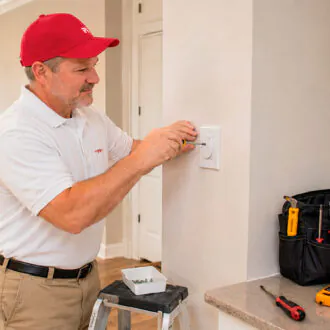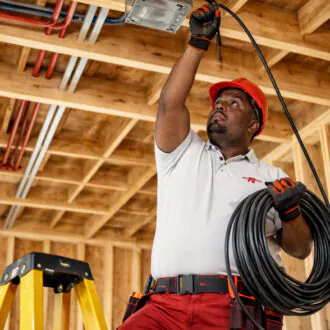
A commercial electrician is a licensed professional who installs, maintains, and repairs electrical systems in business settings such as office buildings, retail stores, schools, hospitals, and warehouses. They work with voltages ranging from 120V to 480V, including three-phase power systems, and ensure all work meets the National Electrical Code (NEC) and strict commercial building codes.
If you have ever walked into an office building, a shopping center, or a hospital and the lights were on, the outlets worked, and everything ran without a hitch, a commercial electrician made that possible. They are the professionals behind the electrical systems that keep businesses running safely every single day.
Commercial electrical work is a different world from residential. The systems are larger, the voltages are higher, the codes are stricter, and the stakes are higher because businesses depend on reliable power to operate. A single electrical fault in a commercial building can shut down operations, create safety hazards, and cost thousands of dollars in downtime.
At Palmer Electric, commercial electrical work has been part of our core business since 1951. We have worked on everything from small retail spaces to large medical facilities throughout Central Florida, and we understand what it takes to keep a commercial property powered, safe, and code-compliant.
Commercial Electrician Key Takeaways
- A commercial electrician specializes in electrical systems for businesses, institutions, and commercial properties.
- Their work includes installation, maintenance, troubleshooting, and repair of high-voltage and three-phase power systems.
- Commercial electricians primarily run wiring through metal or PVC conduit. While plastic-sheathed cable is standard in residential work, commercial installations rely on conduit systems for greater protection, code compliance, and long-term flexibility.
- They install and maintain large-scale systems, including power distribution panels, transformers, generators, lighting arrays, emergency lighting, fire alarms, security systems, and data networks.
- They upgrade and rewire older commercial properties to support modern technology, communication networks, and energy-efficient systems.
- Commercial electricians work in offices, retail spaces, schools, hospitals, warehouses, and new commercial construction.
- Commercial electricians must be licensed in most states. The baseline credential is a journeyman or master electrician license, but some jurisdictions require additional commercial endorsements. Contractors bidding on commercial jobs also need an electrical contractor business license to pull permits and hire employees.
- Commercial electrical work requires reading complex blueprints and coordinating with general contractors, project managers, and other trades.
- Hiring a licensed commercial electrician protects your business, your employees, and your compliance with local codes.
Commercial Electrician Overview
| Category | Details |
|---|---|
| Specialization | Electrical systems in commercial, institutional, and business properties. |
| Work Settings | Offices, retail stores, schools, hospitals, warehouses, restaurants, new commercial construction. |
| License Required | Yes, in most jurisdictions. Commercial electricians performing the work typically need a journeyman, commercial endorsement, or master electrician license. The contracting company must hold a licensed electrical contractor credential to legally bid on jobs, pull permits, and take legal responsibility for the work. Requirements vary by state and locality. |
| License Issued By | State licensing board or local authority varies by jurisdiction. |
| License Structure | Varies by state: journeyman license as baseline, with commercial endorsements or contractor license required depending on jurisdiction and scope of work. |
| Governing Code | National Electrical Code (NEC), plus local and commercial building code amendments. |
| Typical Voltage Range | 120V, 208V, 240V, 277V, and 480V three-phase systems. |
| Common Services | Wiring and conduit installation, power distribution panels, transformers, generators, automated and emergency lighting, fire alarm systems, security systems, data networks, troubleshooting and maintenance. |
| System Upgrades | Rewiring older properties to support modern technology, communication networks, and energy-efficient systems. |
| Blueprint Reading | Required, involves complex schematics and coordination with construction drawings. |
| Coordination | Works alongside general contractors, project managers, inspectors, and other trades. |
| Works Under | Licensed electrical contractor in most states. |
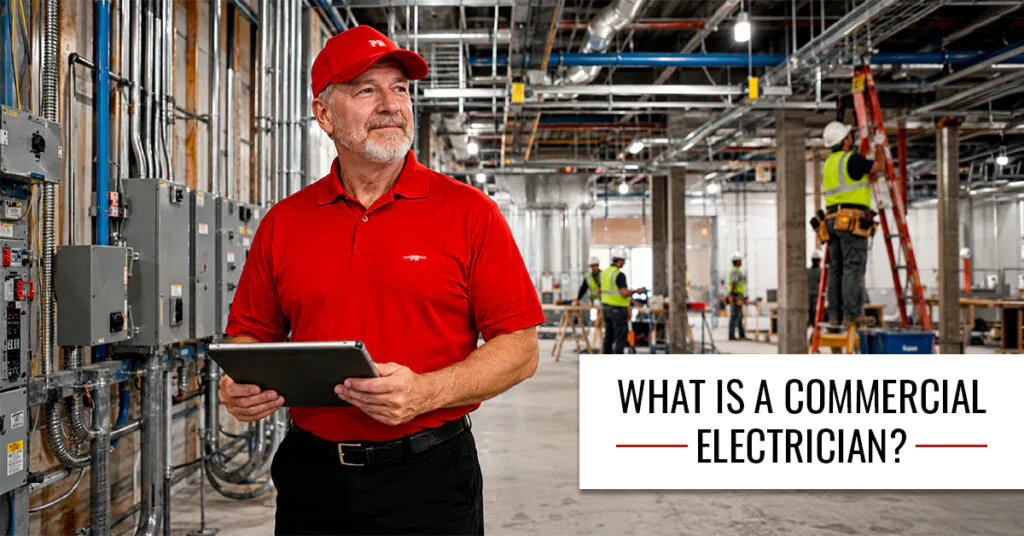
What Is a Commercial Electrician?
A commercial electrician is a licensed tradesperson trained to work on the electrical systems found in business and commercial properties. That covers everything from the main service entrance and distribution panels that receive and distribute power throughout a building, to the branch circuits, conduit systems, lighting, and specialized equipment that keep a business operational.
What sets a commercial electrician apart is the scope and complexity of the work. Commercial buildings use different wiring methods, higher voltage systems, and more sophisticated infrastructure than homes. While residential electricians typically run plastic-sheathed cable through wood studs, commercial electricians primarily pull wire through metal or PVC conduit, which provides greater protection, code compliance, and long-term flexibility for commercial systems. Instead of single-phase 120 and 240 volt systems, they work with three-phase power at voltages up to 480 volts to handle heavy equipment, large lighting arrays, and high-demand electrical loads.
Commercial electricians also work in a very different environment from residential electricians. They are on active job sites, coordinating with general contractors, project managers, inspectors, and other trades. In retrofit and maintenance work, they often work in occupied buildings, which means minimizing disruption to ongoing business operations while doing complex electrical work safely.
What Does It Mean to Be a Commercial Electrician
Being a commercial electrician means specializing in the electrical systems of business and commercial properties, working with high-voltage systems up to 480V, reading complex blueprints, coordinating with other trades, and taking full responsibility for installations that businesses depend on every day.
It also means being reliable. Businesses depend on their electrical systems to function every day. When something fails or a new installation needs to go in on schedule, the commercial electrician is the person who makes it happen without disrupting operations. That combination of technical skill, professionalism, and accountability is what defines the role.
Commercial Electrician Job Description
A commercial electrician is responsible for the full scope of electrical work inside business and commercial properties, from roughing in new construction to maintaining complex systems in occupied buildings. Their job combines deep technical knowledge, code expertise, and the ability to work within fast-moving commercial construction and maintenance environments.
What makes this role distinct is scale and coordination. Commercial electricians rarely work alone. They are part of larger crews on job sites, working alongside general contractors, project managers, mechanical and plumbing trades, and inspectors. Every decision they make has to align with the project timeline, the building plans, and strict commercial code requirements.
At Palmer Electric, our commercial electricians bring that same level of coordination and expertise to every project we take on in Central Florida, from tenant build-outs and office renovations to large-scale new construction for healthcare facilities and educational institutions.
What Do Commercial Electricians Do
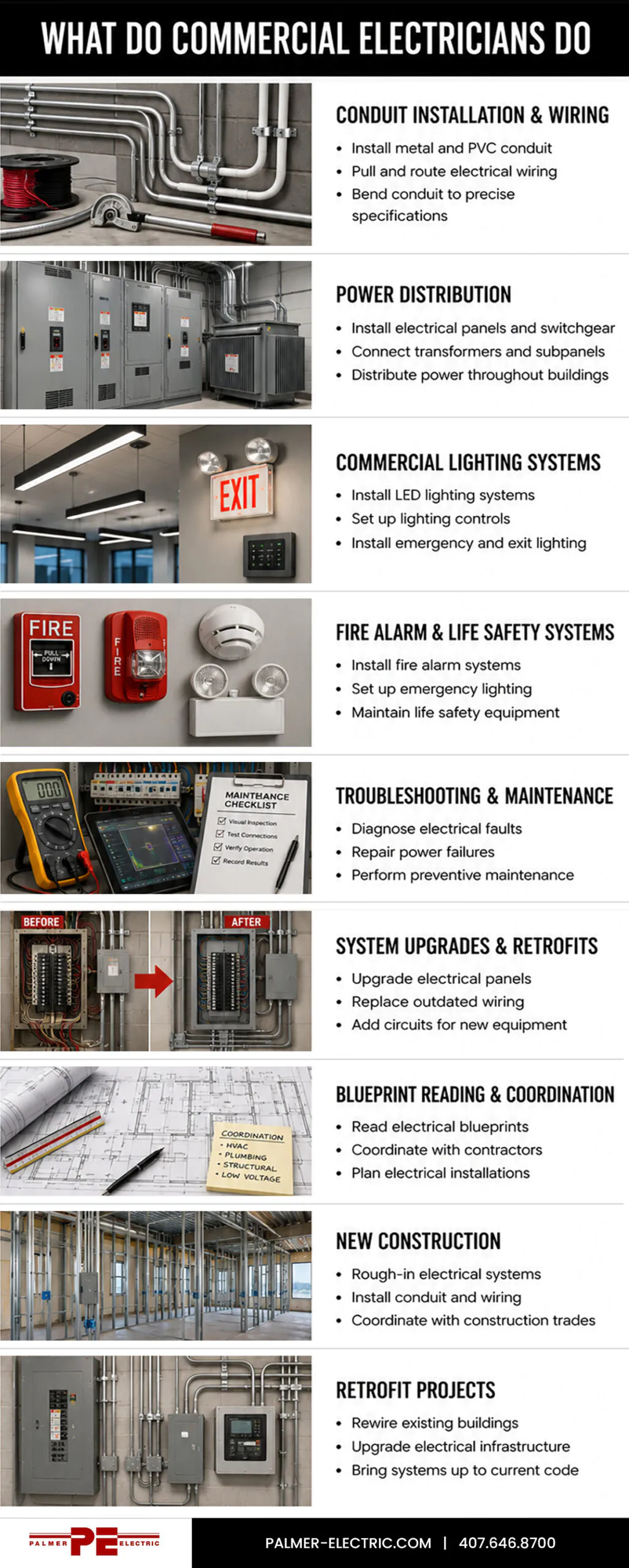
A commercial electrician installs, maintains, and repairs the electrical systems that power businesses and commercial buildings. Their work covers everything from high-voltage power distribution and conduit installation to lighting systems, fire alarms, and emergency power.
Commercial Electrician Job Duties
Here is a breakdown of what commercial electricians handle on a daily basis:
Conduit Installation and Wiring
Running and bending metal and PVC conduit through commercial buildings and pulling wire through those systems. This is one of the most physically demanding and technically precise parts of commercial electrical work. Conduit must be bent, measured, and installed to exact specifications before a single wire goes in.
Power Distribution
Installing and maintaining high-capacity electrical panels, transformers, and switchgear that distribute power throughout a commercial building. Commercial power distribution systems are significantly more complex than residential panels, often involving multiple sub-panels and dedicated circuits for heavy equipment.
Commercial Lighting Systems
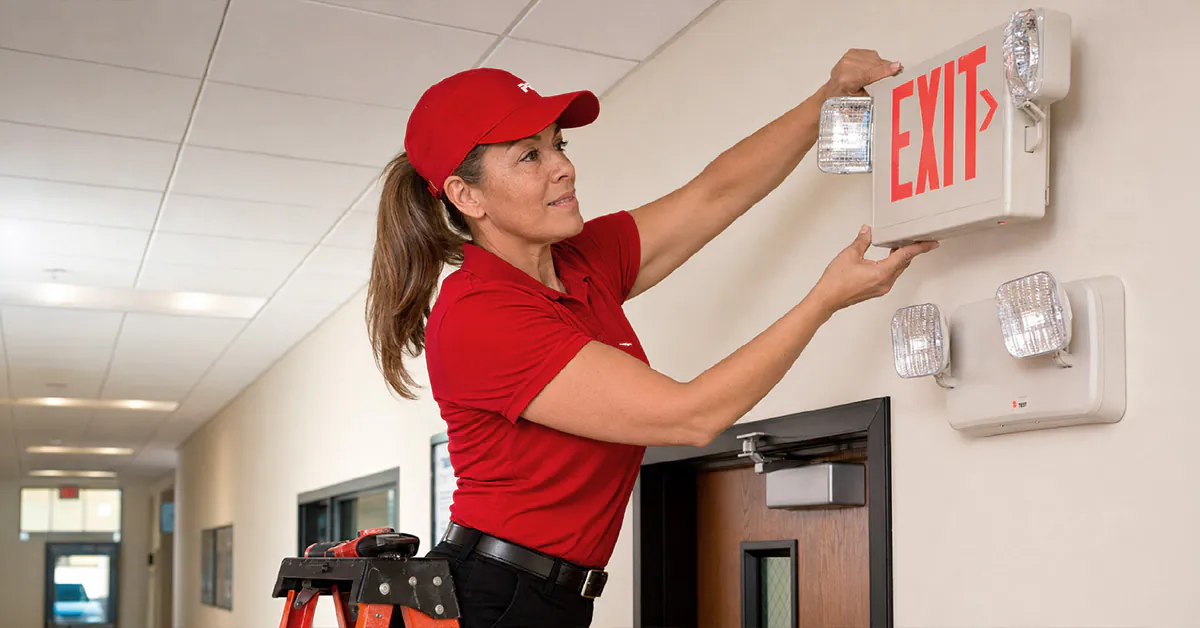
Setting up large-scale lighting arrays including automated lighting controls, energy-efficient LED systems, and code-required emergency and exit lighting. At Palmer Electric, lighting retrofits are one of the most common commercial service requests we receive, as Central Florida businesses upgrade to energy-efficient systems to reduce operating costs.
Fire Alarm and Life Safety Systems
Installing and maintaining fire alarm systems, emergency lighting, and other life safety systems required by commercial building codes. Per the National Fire Protection Association (NFPA) 72, the national standard for fire alarm and signaling systems, commercial buildings are required to meet specific installation and maintenance standards for these systems.
Troubleshooting and Maintenance
Diagnosing faults in complex commercial electrical systems, from tripping breakers and power failures to equipment malfunctions and wiring degradation. Commercial troubleshooting requires systematic thinking and experience with high-voltage systems that most residential electricians do not encounter.
System Upgrades and Retrofits
Rewiring older commercial properties to support modern technology, energy-efficient systems, and updated code requirements. This includes upgrading panels, replacing outdated wiring methods, and integrating new communication and data network infrastructure.
Blueprint Reading and Coordination
Interpreting complex electrical schematics and coordinating with general contractors, architects, and other trades to ensure the electrical installation aligns with the overall building design and project timeline.
Commercial New Construction vs Retrofit (Renovation) vs Maintenance
Commercial electricians work across three distinct project types, and each one demands a different set of skills and priorities.
New Construction
In new commercial construction, electricians rough in the entire electrical system before walls and ceilings are closed. This means installing conduit, pulling wire, setting panels, and coordinating with every other trade on site. Timing is critical. If the electrical rough-in falls behind, it can delay the entire project.
At Palmer Electric, our commercial new construction division has been working with top general contractors and construction managers in Central Florida for over six decades. We understand what it takes to deliver on time and on spec on large commercial projects.
Retrofit
Retrofit work, which is the electrical term for renovating or upgrading the systems in an existing building, involves modifying circuits, replacing panels, or rewiring older properties to meet current code or handle increased electrical demand. This could mean adding circuits for new equipment, upgrading a panel to handle increased load, or rewiring an older property to meet current code. Retrofit work is often more complex than new construction because the electrician has to work around existing systems, finished walls, and active building operations.
Maintenance
Ongoing maintenance keeps commercial electrical systems running safely and efficiently. This includes scheduled inspections, testing of emergency systems, panel maintenance, and responding to service calls when something fails. For businesses, regular electrical maintenance is not just good practice. It is often required by local codes and insurance policies.
Commercial Electrician Work by Project Type
| Project Type | Scope | Key Focus |
|---|---|---|
| New Construction | Full electrical rough-in from ground up | Timing, coordination with other trades, code compliance from day one |
| Tenant Build-Out (Customizing a Leased Space for a New Occupant) | Electrical installation within a leased commercial space | Adapting existing infrastructure to new tenant requirements |
| Retrofit (Renovation) | Upgrading or modifying systems in existing buildings | Working around existing systems, minimizing business disruption |
| Maintenance | Scheduled inspections, testing, and service calls | System reliability, code compliance, emergency preparedness |
| Emergency Repair | Unplanned fault diagnosis and repair | Speed, safety, minimizing business downtime |
Commercial Electrician Tools
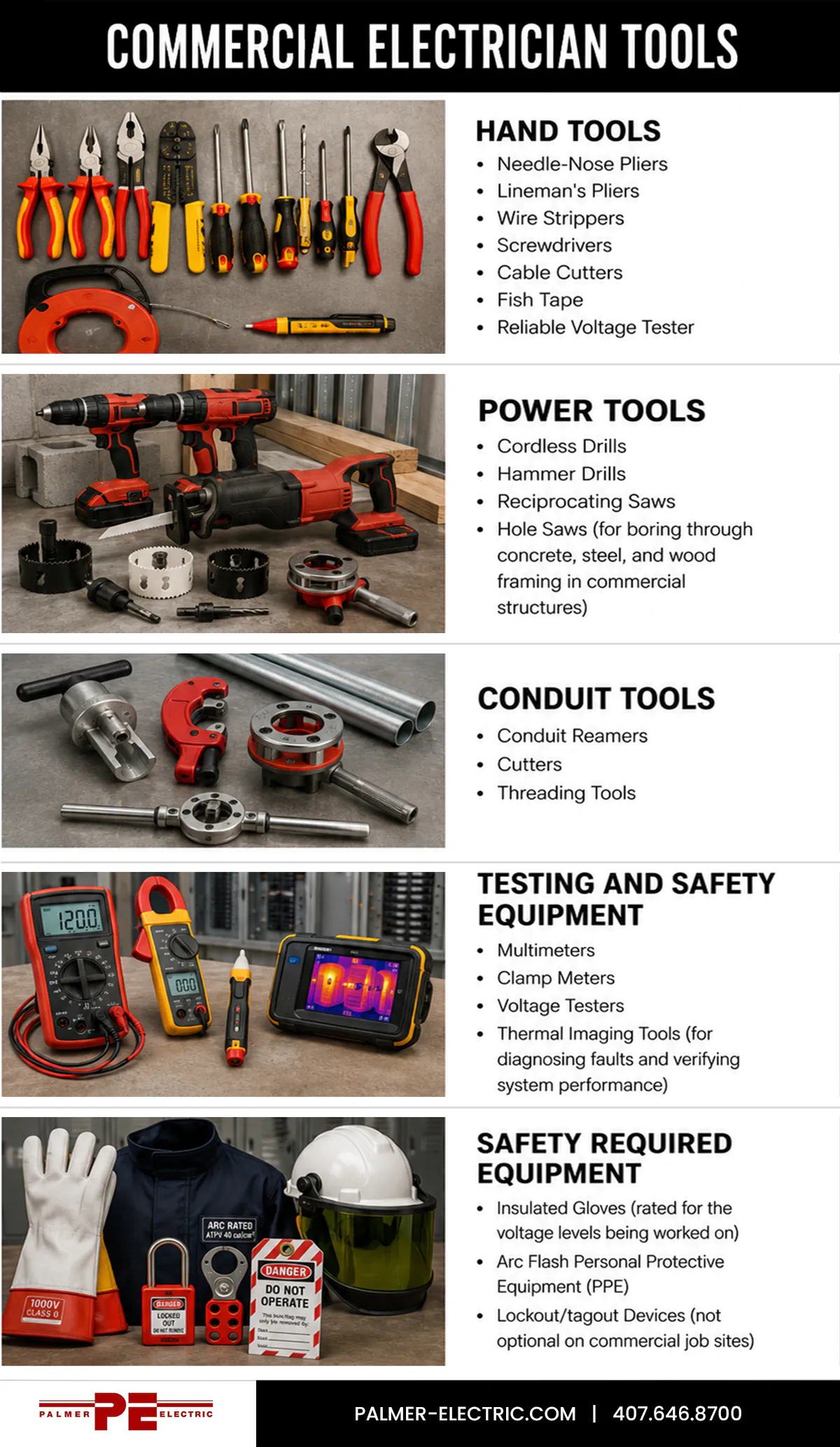
Commercial electricians work with a broader and heavier-duty set of tools than residential electricians. The work demands it. Pulling wire through long conduit runs, bending heavy gauge metal conduit, and working with high-voltage systems require specialized equipment that goes well beyond a standard tool belt.
What Tools Do I Need as a Commercial Electrician?
A commercial electrician needs tools that fall into four main categories: hand tools, power tools, conduit tools, and testing and safety equipment. The specific tools vary depending on the type of project, but the core set is consistent across most commercial work.
Hand Tools
The everyday essentials:
- Needle-Nose Pliers
- Lineman’s Pliers
- Wire Strippers
- Screwdrivers
- Cable Cutters
- Fish Tape
- Reliable Voltage Tester
These are the tools a commercial electrician reaches for on every job.
Power Tools
- Cordless Drills
- Hammer Drills
- Reciprocating Saws
- Hole Saws (for boring through concrete, steel, and wood framing in commercial structures)
Commercial buildings have more structural complexity than homes, and the right power tools make the difference between an efficient installation and a frustrating one.
Conduit Tools
This is where commercial tool requirements really diverge from residential.
- Conduit Reamers
- Cutters
- Threading Tools
Conduit benders, both manual and hydraulic, are essential for shaping EMT and rigid conduit to exact specifications. A commercial electrician who cannot bend conduit accurately is going to struggle on the job.
Testing and Safety Equipment
Some essential testing tools are:
- Multimeters
- Clamp Meters
- Voltage Testers
- Thermal Imaging Tools (for diagnosing faults and verifying system performance)
On the safety side, here is some required equipment:
- Insulated Gloves (rated for the voltage levels being worked on)
- Arc Flash Personal Protective Equipment (PPE)
- Lockout/tagout Devices (not optional on commercial job sites)
Per OSHA standard 29 CFR 1910.333, the federal workplace safety standard that governs electrical work, workers must use appropriate protective equipment when working on or near energized electrical equipment.
Summary Table: Commercial Electrician Tool List by Category
| Category | Tools | Notes |
|---|---|---|
| Hand Tools | 9-inch linesman pliers, needle-nose pliers, wire strippers, side cutters, cable cutters, multi-bit screwdrivers, dual tongue-and-groove pliers (Channel Locks), fish tape | Used daily for cutting, stripping, and assembling wiring and conduit connections |
| Conduit Tools | Manual conduit benders for 1/2″ and 3/4″ EMT (90-degree, offset, and saddle bends), conduit cutters, conduit reamers, threading tools | Conduit bending is a core commercial skill. Reamers remove sharp burrs inside cut pipe that can tear wire insulation |
| Layout and Leveling | Magnetic torpedo level with 30, 45, and 90 degree vials | Required to keep conduit runs straight and code-compliant |
| Testing Equipment | Digital multimeter (CAT III or IV rated), non-contact voltage tester, clamp meter, thermal imaging camera, circuit tracer | Never use a residential-rated meter on a commercial site. CAT III or IV rating is required for high-voltage commercial environments |
| Safety Equipment | Voltage-rated rubber gloves with leather protectors, arc flash PPE, insulated hand tools rated to 1,000V, lockout/tagout (LOTO) kit, safety glasses, hard hat | Lockout/tagout devices physically prevent breakers from being re-energized while work is in progress. Per OSHA 29 CFR 1910.333, appropriate PPE is mandatory when working on or near energized equipment |
| Power Tools (Contractor-Provided) | Portable band saw (Portaband), hydraulic knockout punch set, cordless hammer drill, impact driver, motorized wire pullers | These are typically supplied by the contractor, not the individual electrician. Portaband is the fastest tool for cutting metal conduit and strut channel |
| Lifting and Access | Extension ladders, step ladders, scissor lift or aerial lift | Required for high-ceiling commercial spaces |
How to Be a Good Commercial Electrician?
Being good at commercial electrical work comes down to three things: technical mastery, professionalism, and reliability.
Technical mastery
Technical mastery means knowing the NEC inside and out, understanding how commercial power systems are designed and how they fail, and being able to read and work from complex blueprints without constant supervision. It also means staying current. Codes get updated, technology changes, and the best commercial electricians treat learning as part of the job.
Professionalism
Professionalism on a commercial job site means showing up on time, communicating clearly with the project team, and doing your work in a way that does not create problems for the other trades. Commercial construction is a team sport. An electrician who causes delays or leaves a messy rough-in for the drywaller to work around quickly gets a reputation that follows them.
Reliability
Reliability is what keeps commercial electricians busy. General contractors and facility managers want to work with people they can count on. If you say the rough-in will be done by Friday, it needs to be done by Friday. That kind of consistency is what builds a long-term career in commercial electrical work.
At Palmer Electric, these are the standards we hold our commercial electricians to on every project. Central Florida’s commercial construction market is competitive and demanding, and our reputation since 1951 has been built on showing up, doing the work right, and standing behind it.
What Benefits Do Commercial Electricians Get?
Commercial electricians typically enjoy one of the strongest benefit packages in the skilled trades, particularly those working for established electrical contractors or through union apprenticeship programs. The combination of job security, career advancement, and ongoing training makes this a compelling long-term career choice.
Earn While You Learn: Most commercial electricians start through a paid apprenticeship, which means no student debt. You earn a wage from day one, receive scheduled raises as you progress through the program, and have your licensing and continuing education costs covered by the contractor or union program.
Job Security and Consistent Demand: Infrastructure demands, new construction, and the push toward renewable energy ensure consistent demand for qualified commercial electricians well into the next decade.
Predictable Work Schedule: Commercial electrical work typically follows a standard Monday to Friday schedule, especially on new construction and tenant build-out projects. This is more predictable than residential work, which can involve weekend calls and irregular hours.
Complex and Stimulating Work: Commercial job sites offer variety that keeps the work intellectually engaging. Blueprints, high-voltage systems, building automation, energy-efficient lighting retrofits, and coordination with other trades means no two projects are exactly alike.
Career Advancement: Experience in commercial electrical work opens doors to supervisory roles, project management, and eventually running your own electrical contracting business. Many of the most successful electrical contractors started as commercial apprentices and worked their way up through every level of the trade.
Overtime Opportunities: Commercial projects frequently involve overtime, particularly during the push to meet construction deadlines, adding meaningful hours for those who want them.
Continuing Education and Licensing Support: Many established contractors cover the cost of apprenticeship training, NEC code update courses, and specialty certifications to keep their electricians current with evolving technology like EV charging infrastructure, solar integration, and smart building systems.
Tool and Vehicle Allowances: Some contractors provide company vehicles, fuel cards, or tool stipends for field electricians, reducing out-of-pocket costs for workers in the field.
Commercial Electrician Job Qualifications
Becoming a commercial electrician requires meeting a specific set of requirements that go beyond basic electrical training. The commercial environment demands a higher level of technical knowledge, safety awareness, and code familiarity than residential work.
Commercial Electrician Qualifications at a Glance
| Requirement | Typical Standard |
|---|---|
| Minimum Age | 18 years old. |
| Education | High school diploma or GED, is highly valued a strong math and physics foundation. |
| Apprenticeship or OJT Hours | 8,000 hours over 4 to 5 years through a registered program such as the IBEW/NECA Electrical Training Alliance, Independent Electrical Contractors (IEC), or Associated Builders and Contractors (ABC). |
| Classroom Instruction | 720 to 900 hours over the apprenticeship program, covering NEC, electrical theory, blueprint reading, conduit work, and commercial safety standards. Per the Electrical Training Alliance, the joint apprenticeship program of NECA and IBEW, commercial programs run approximately 180 hours per year over four to five years. |
| Baseline License | Journeyman electrician license in most states, legally required to perform commercial electrical work independently. |
| Commercial Endorsement | Required in some states and municipalities for high-voltage commercial work above standard journeyman scope. |
| Master Electrician or Contractor License | Required for supervisory roles, bidding on jobs, and pulling permits. Requires 2 to 4 additional years as a licensed journeyman and a higher-level exam covering business law, advanced code calculations, and project management. |
| Safety Certifications | None universally mandatory by federal law. OSHA 10 is required by most general contractors as a site access condition. Supervisors and foremen are typically required to hold OSHA 30. NFPA 70E training is strongly preferred for work involving energized equipment. |
| Specialized Certifications | None universally mandatory. For electricians seeking advanced safety credentials, the NFPA Certified Electrical Safety Worker (CESW) is the relevant certification. Low voltage and fire alarm certifications may be legally required depending on jurisdiction and scope of work. |
| Background Check | Required by most commercial contractors and many project owners. |
| Continuing Education | Required for license renewal in most jurisdictions. |
How to Become a Commercial Electrician?
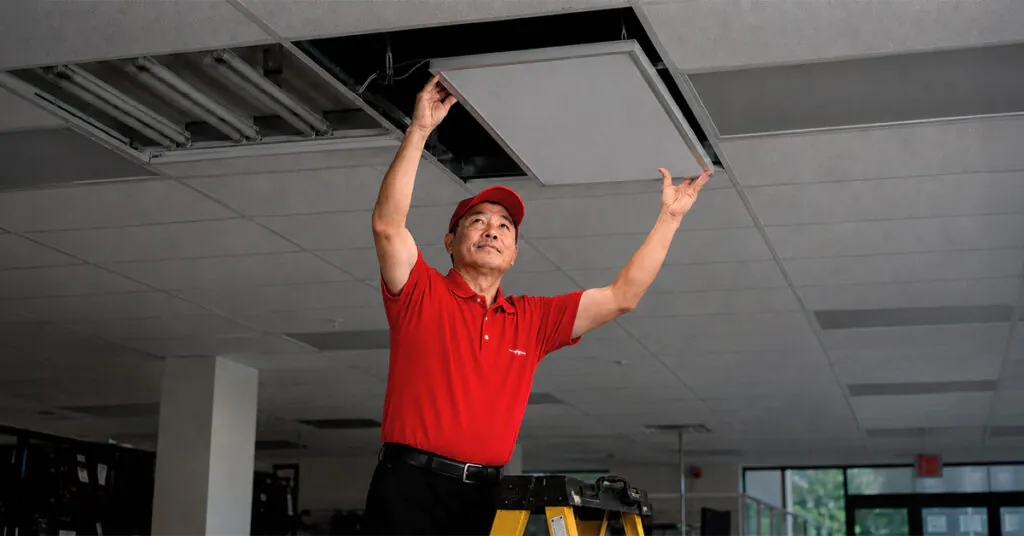
Most commercial electricians follow the same core path as the broader electrical trade, but with a focus on commercial and industrial experience from the start.
- Complete a registered apprenticeship through a commercial or industrial program, such as the IBEW/NECA Electrical Training Alliance, IEC, or ABC. These programs combine 8,000 hours of on-the-job training with classroom instruction over four to five years
- Document your hours and earn your journeyman license by passing your state or local licensing exam
- Build commercial experience across different project types, new construction, retrofit, and maintenance, to develop the full range of skills the commercial trade requires
How Long Does It Take to Become a Commercial Electrician?
Becoming a commercial electrician typically takes four to five years through a registered apprenticeship, plus the time needed to apply for and pass the journeyman licensing exam. For those pursuing supervisory roles or contractor status, add another two to four years of journeyman experience before qualifying for the master electrician exam. Most electricians reach full commercial journeyman status in five years from the time they enter an apprenticeship.
Commercial Electrician Career
According to the U.S. Bureau of Labor Statistics, the federal agency that tracks employment and wage data across all industries, electrician employment is projected to grow 9 percent from 2024 to 2034, with approximately 81,000 job openings per year on average over the decade. For commercial electricians, that demand is being driven by new construction, data center expansion, EV infrastructure, and the ongoing push toward energy-efficient commercial buildings.
Commercial electricians who develop expertise in high-demand areas like energy-efficient systems, EV charging infrastructure, fire alarm systems, or data networks are particularly well positioned as commercial construction continues to grow.
For example, here in Central Florida, where we are headquartered, commercial development has been consistently strong, and demand for qualified commercial electricians remains high.
What Business Owners Should Know Before Hiring a Commercial Electrician
Hiring the right commercial electrician comes down to verifying credentials, understanding scope, and choosing a contractor with proven commercial experience.
Verify the license
Ask for the contractor’s license number and verify it with your state or local licensing authority. The contractor must hold a valid electrical contractor license to pull permits and take legal responsibility for the work.
Confirm commercial experience
Not all electricians specialize in commercial work. Ask specifically about experience with your type of facility, whether that is an office, restaurant, retail space, healthcare facility, or warehouse. Commercial systems vary significantly by occupancy type and code requirements.
Make sure they are licensed and insured. The license covers the technical credential. Bonding and insurance protect your business if something goes wrong during the project.
Get the work permitted and inspected
Any significant commercial electrical work requires permits and inspections. A contractor who suggests skipping permits is a red flag. Unpermitted work can create code violations, insurance issues, and liability exposure for your business.
Ask about ongoing maintenance
Commercial electrical systems need regular maintenance to stay safe and code-compliant. A good commercial electrical contractor will offer maintenance agreements, not just one-time installations.
At Palmer Electric, we have been serving Central Florida businesses since 1951. Our commercial electrical services cover everything from new construction and tenant build-outs to maintenance and emergency repairs. Every project is backed by licensed, bonded, and insured electricians with decades of commercial experience.
Commercial Electrician FAQs
What Is the Difference Between a Commercial and Residential Electrician?
A commercial electrician works in business and commercial properties, handling voltages up to 480V, three-phase power, and conduit-based wiring systems. A residential electrician specializes in homes, working with 120 and 240 volt single-phase systems. The licensing, training, code requirements, and tools differ significantly between the two. For a full comparison, see: The Difference Between Commercial, Industrial and Residential Electricians.
Does Florida Have a Commercial Electrician License?
Florida does not issue a license specifically titled commercial electrician. The Florida Department of Business and Professional Regulation (DBPR), the state agency that oversees contractor licensing, issues Certified and Registered Electrical Contractor licenses that authorize commercial work. A Certified license is valid statewide, while a Registered license is valid within a specific local jurisdiction.
Can a Commercial Electrician Also Do Residential Work?
Yes, in most jurisdictions. A licensed journeyman or master electrician can perform both commercial and residential work, as long as their license covers the scope of work being performed. However, commercial electricians who have spent most of their careers on large-scale projects may need to adjust to the different code requirements, tighter spaces, and direct homeowner communication that residential work involves. Some states also have residential-specific license requirements, so always verify locally.
Is Commercial or Residential Electrical Work Better for a Career?
Both offer strong careers, just in different directions. Commercial work suits electricians who enjoy large-scale projects, complex systems, and structured job site environments. Residential work fits those who prefer variety, direct client interaction, and working in different homes every day. Most electricians discover which one they prefer after spending time in both.
It comes down to what you enjoy. Some electricians love the scale and challenge of commercial work, wiring entire buildings from the ground up and working with high-voltage systems. Others prefer the personal connection that comes with residential work, where every home is different and you are working directly with the people who live there. There is no wrong answer, and many electricians do both throughout their careers.
What Is the Hardest Part of Being a Commercial Electrician?
Most commercial electricians will tell you the hardest part is managing the pace and coordination demands of large job sites. You are working within tight project timelines, coordinating with multiple trades, interpreting complex blueprints, and troubleshooting high-voltage systems, sometimes all on the same day. The physical demands are real too, bending heavy conduit, working at height, and lifting large equipment in commercial spaces is demanding work day in and day out.
Conclusion
Commercial electricians are the professionals who power the buildings where we work, learn, shop, and receive care. The work is technically demanding, physically challenging, and carries real responsibility because businesses depend on their electrical systems every single day.
At Palmer Electric, we have deep respect for the skill and commitment it takes to do commercial electrical work at a high level. Our commercial electricians have been showing up for Central Florida businesses since 1951, handling everything from complex new construction to emergency repairs, and we are proud of the trust those businesses have placed in us over the decades.
Whether you are a business owner looking to hire a reliable commercial electrical contractor, or someone considering a career in the commercial trade, understanding what a commercial electrician does and what they bring to the job helps you make better decisions.
Ready to Work With a Commercial Electrician You Can Trust?
Palmer Electric has been Central Florida’s trusted commercial electrical contractor since 1951. From new construction and tenant build-outs to maintenance and emergency service, our licensed, bonded, and insured team is ready to help. Contact Palmer Electric today to schedule a consultation or request a quote.
References
- U.S. Bureau of Labor Statistics, Occupational Outlook Handbook: Electricians: https://www.bls.gov/ooh/construction-and-extraction/electricians.htm
- NFPA 72, National Fire Alarm and Signaling Code, National Fire Protection Association: https://www.nfpa.org/codes-and-standards/7/2/72
- NFPA 70, National Electrical Code (NEC), National Fire Protection Association: https://www.nfpa.org/codes-and-standards/7/0/70
- OSHA Electrical Safety Standards, 29 CFR 1910.333: https://www.osha.gov/laws-regs/regulations/standardnumber/1910/1910.333
- Electrical Training Alliance (NECA/IBEW Joint Apprenticeship): https://www.electricaltrainingalliance.org
- U.S. Department of Labor, Apprenticeship Finder: https://www.apprenticeship.gov
- Florida Department of Business and Professional Regulation (DBPR), Electrical Contractor Licensing: https://www.myfloridalicense.com/DBPR/electrical-contractors/
- Electrician Licensing Requirements by State, SparkShift: https://sparkshift.app/electrician-licensing-requirements-by-state