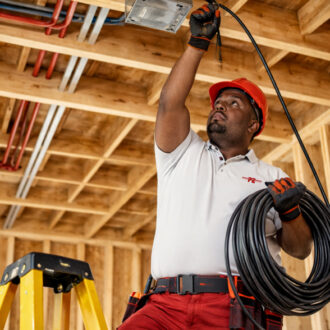
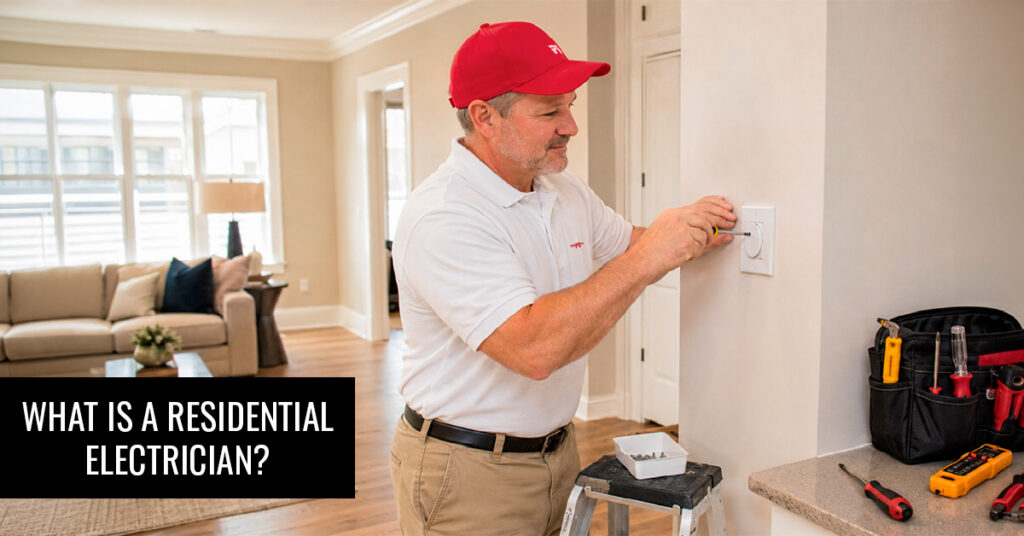
A residential electrician is a licensed professional trained to install, maintain, and repair the electrical systems inside homes and residential properties. Depending on the state, they may hold a residential electrician license, a journeyman license, or a master electrician license. They ensure all work meets the National Electrical Code (NEC) and local building codes, covering systems that typically operate at 120 and 240 volts.
If you have ever had a breaker that keeps tripping, an outlet that stopped working, or a home that needed rewiring for a renovation, a residential electrician was the right person for that job. They are the specialists who know home electrical systems inside and out, from the panel on your garage wall to the outlets in every room.
Residential electrical work is more specialized than most people realize. Homes have unique code requirements, tighter working spaces, and a direct connection to the safety of the people living in them. That combination requires someone who knows exactly what they are doing.
At Palmer Electric, residential electrical work has been a core part of what we do since 1951. Central Florida homeowners trust us because we understand both the technical requirements and the real-world conditions that homes here face, from hurricane season to year-round heat and humidity.
Residential Electrician Key Takeaways
- A residential electrician specializes in the electrical systems of homes and residential properties.
- Their work includes wiring, troubleshooting and diagnostics, installations, repairs, upgrades, panel replacements, safety inspections, and modern upgrades like EV chargers, smart home systems, and generators.
- They work under the National Electrical Code (NEC), the standard that governs electrical installations across the U.S., plus any local code amendments.
- Residential electrical work is distinct from commercial work in scope, code requirements, voltage levels, and system complexity.
- Hiring a licensed residential electrician protects your home, your family, and your homeowner’s insurance coverage.
- Licensing requirements vary by state. Some states issue licenses at the state level, others delegate to counties or municipalities, and a small number have no statewide requirement at all.
Residential Electrician Overview
| Category | Details |
|---|---|
| Specialization | Electrical systems in homes and residential properties |
| Work Settings | Single-family homes, apartments, condominiums, multi-family dwellings, new residential construction, and remodels |
| License Required | Yes, in most jurisdictions. Electricians performing residential work typically need a journeyman, residential, or master electrician license. The contracting company must hold a licensed electrical contractor credential to legally perform and permit the work. Requirements vary by state. |
| License Structure | Varies by state: some issue a statewide general journeyman license, others offer a residential-specific license with narrower scope and lower hour requirements, and some delegate licensing entirely to local municipalities. |
| License Issued By | State licensing board or local authority, varies by jurisdiction |
| Governing Code | National Electrical Code (NEC), plus local amendments |
| Typical Voltage Range | 120V and 240V residential systems |
| Common Services | Wiring and rewiring, troubleshooting and diagnostics, panel upgrades, outlet and fixture installation, lighting, EV charger installation, smart home wiring, generator hookups, surge protection, solar integration |
| Works Under | Licensed electrical contractor in most states |
| Blueprint Reading | Required for new construction and remodel work |
| Customer Service | Direct communication with homeowners on repairs, costs, and safety |
What Is a Residential Electrician?
A residential electrician is a tradesperson trained and licensed to work specifically on the electrical systems found in homes. That covers everything from the service panel that receives power from the utility company, to the wiring running through your walls, to the outlets, switches, fixtures, and safety devices that make a home functional and safe.
What sets a residential electrician apart from a general electrician is their specialized focus on the unique electrical needs of homes. Residential systems operate at lower voltages than commercial or industrial systems, typically 120 volts for standard circuits and 240 volts for larger appliances. But lower voltage does not mean simpler work. Homes have their own set of code requirements, inspection standards, and safety considerations that take real training and experience to get right.
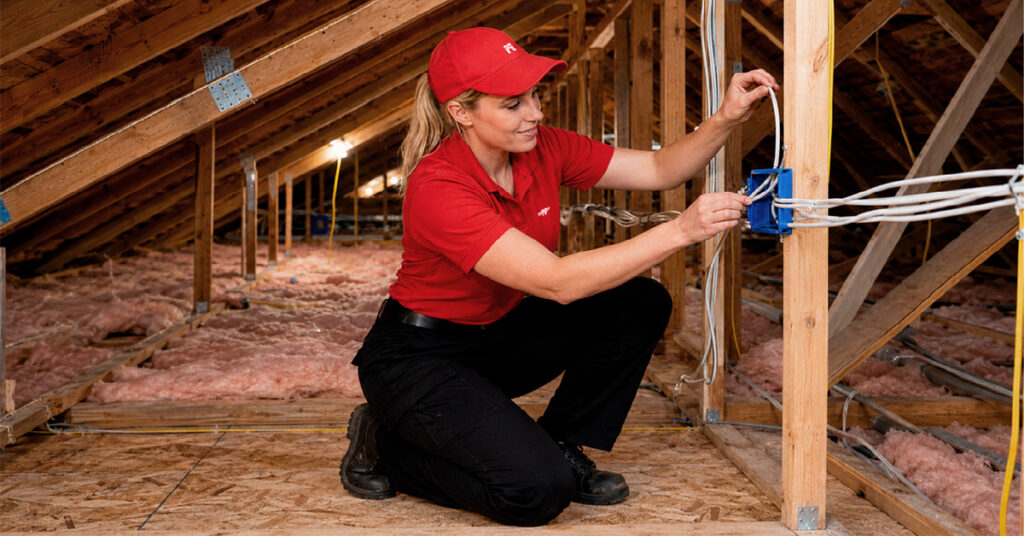
Residential electricians work on both existing homes and new construction. In existing homes, they often work in tight spaces, inside walls, attics, and crawl spaces, tracing circuits, making repairs, and bringing older systems up to current code. In new construction, they rough in the entire electrical system from the ground up before walls are closed.
Residential Electrician Synonyms
You may come across different titles that refer to the same role. Here are the most common:
| Title | Notes |
|---|---|
| Residential Electrician | Most widely used title in job postings and industry usage |
| Home Electrician | Informal term used by homeowners, not a licensing title |
| Residential Wireman | Used in some union and apprenticeship program classifications |
| Domestic Electrician | More common in the UK, occasionally used in the U.S. |
| Residential Electrical Contractor | Used when the electrician also holds a contractor license |
Residential Electrician Job Description
A residential electrician is responsible for the full scope of electrical work inside homes, from rough-in wiring on new construction to troubleshooting a tripping breaker in an occupied house. Their job combines technical skill, code knowledge, and direct communication with homeowners.
What makes this role distinct is the environment. Residential electricians work in private homes, which means they are often the only tradesperson on site, working directly with the homeowner, explaining what needs to be done, why it matters, and what it will cost. That requires not just technical ability but also strong communication skills and professionalism.
At Palmer Electric, our residential electricians are trained to treat every home they enter with the same care and respect they would want for their own. That combination of technical expertise and customer-first approach is something our Central Florida clients have counted on since 1951.
What Does a Residential Electrician Do?
A residential electrician installs, repairs, and maintains the electrical systems inside homes and residential properties. Their work covers everything from new wiring and panel upgrades to troubleshooting faults and installing modern upgrades like EV chargers and generators.
Residential Electrician Duties
Residential electricians handle a wide range of tasks depending on the type of job. Here is a breakdown of their core responsibilities:
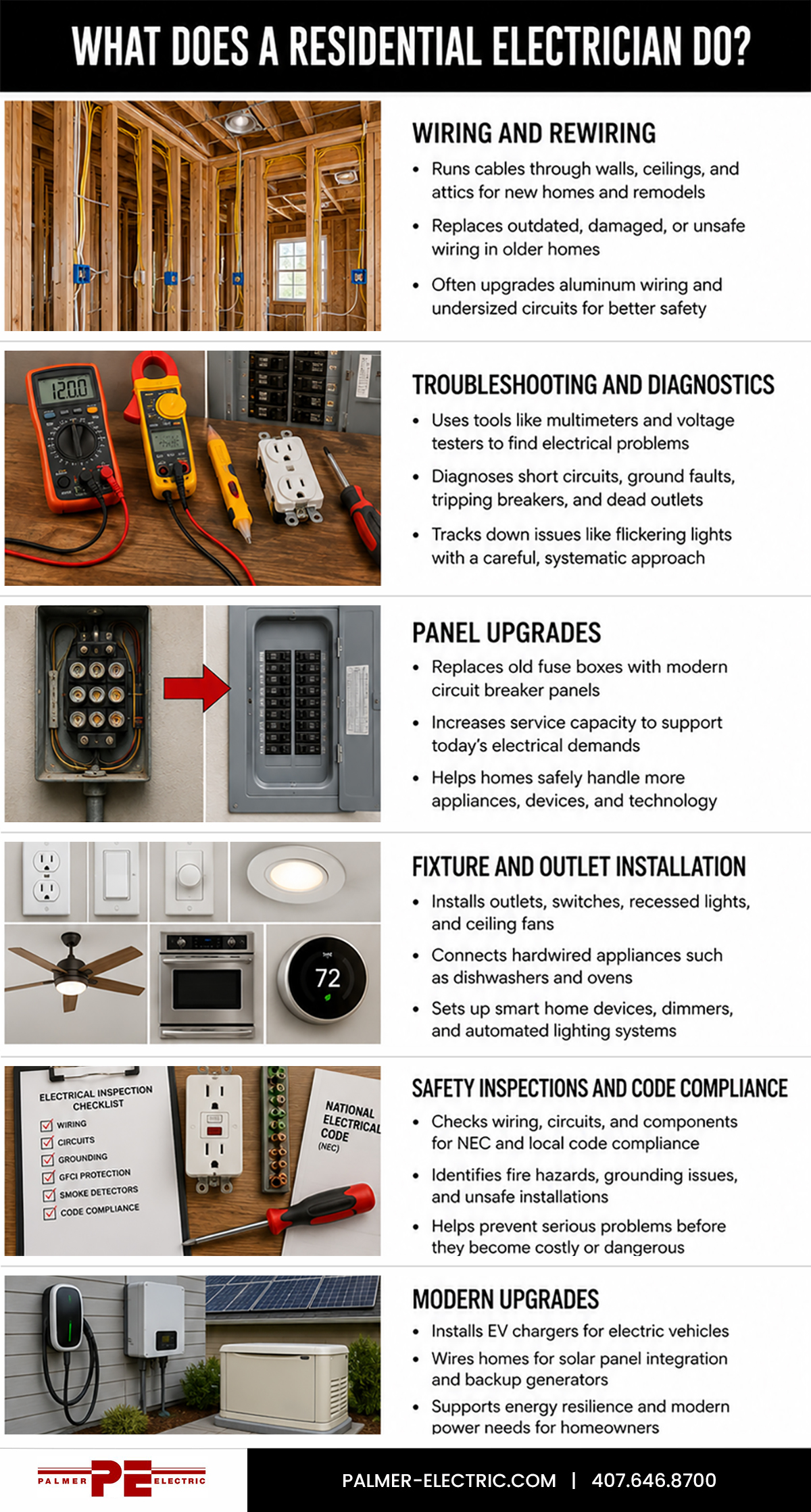
Wiring and Rewiring
Running cables through walls, ceilings, and attics for new construction and remodels. Replacing outdated or damaged wiring in older homes. At Palmer Electric, rewiring projects are one of the most common calls we get from Central Florida homeowners, especially in older homes where aluminum wiring or undersized circuits are still in place.
Troubleshooting and Diagnostics
Using testing tools like multimeters and voltage testers to locate short circuits, ground faults, tripping breakers, flickering lights, and dead outlets. Residential troubleshooting requires patience and a systematic approach because faults in home systems are not always obvious.
Panel Upgrades
Replacing outdated fuse boxes with modern circuit breaker panels and upgrading service capacity to handle today’s electrical loads. Homes built decades ago were not designed for the number of devices and appliances we run today.
Fixture and Outlet Installation
Installing outlets, switches, recessed lighting, ceiling fans, and hardwired appliances like dishwashers and ovens. This also includes smart home devices, dimmers, and automated lighting systems.
Safety Inspections and Code
Compliance Checking that all wiring, circuits, and components meet the NEC and local code requirements. Identifying fire hazards, improper grounding, and code violations before they become serious problems.
Modern Upgrades Installing
EV chargers for electric vehicles, wiring for solar panel integration, and connecting backup generators to home electrical systems. These are among the fastest-growing service requests we see at Palmer Electric, especially as more Central Florida homeowners invest in energy resilience ahead of hurricane season.
Common Residential Electrical Projects
Residential electricians work across a wide range of project types. Some are planned upgrades, others are urgent repairs. Here is a look at the most common ones:
Summary Common Residential Electrical Projects by Type
| Project Type | Examples |
|---|---|
| New Construction Wiring | Full electrical rough-in, service panel installation, circuit layout |
| Remodel Wiring | Adding circuits for kitchen or bathroom upgrades, home additions |
| New Outlets and Switches | Adding, replacing, or relocating 120V receptacles and single-pole or three-way switches |
| Dedicated Circuits | Independent wiring for high-power appliances like electric stoves, dryers, refrigerators, and central A/C units |
| Heavy Appliance Hookups | 240V circuits for hot tubs, saunas, and EV chargers |
| Panel Upgrade | Replacing fuse box, commonly upgrading from 100A to 200A service |
| Subpanel Installation | Adding a secondary breaker box for a detached garage, basement, or home addition |
| Troubleshooting and Repair | Tripping breakers, dead outlets, flickering lights, power outages |
| Interior Lighting and Fixtures | Ceiling lights, recessed lighting, under-cabinet lighting, chandeliers |
| Ceiling Fans | Replacing light fixtures with ceiling fans or installing new ceiling fan circuits |
| Exterior and Landscape Lighting | Soffit lights, security motion detectors, pathway lighting |
| EV Charger Installation | Level 2 home charging station wiring and installation |
| Generator Hookup | Standby or portable generator connection including transfer switch installation |
| Surge Protection | Whole-home surge protector installed at the main panel, protects against lightning strikes and grid spikes |
| Rewiring | Full or partial home rewiring, including aluminum wiring remediation and knob-and-tube replacement |
| GFCI and AFCI Installation | Upgrading to ground fault and arc fault protection in kitchens, bathrooms, and other required locations |
| Smart Home Wiring | Automated lighting, smart switches, home automation systems |
Residential Electrician License
In most U.S. states, performing residential electrical work requires a state or locally issued license. The most common path is completing a 4 to 5 year apprenticeship with 8,000 hours of on-the-job training and passing a trade exam based on the National Electrical Code (NEC). Licensing is regulated at the state and local level, not federally, so requirements vary depending on where you live.
The rules vary significantly depending on where you live, but the core principle is consistent: residential electrical work requires a credentialed professional in most parts of the country.
Do You Need a License to Do Residential Electrical Work?
Yes, in most jurisdictions a license is required to perform residential electrical work. The type of license depends on the state, the scope of work, and whether the person is an individual electrician or a contracting business.
Here is how licensing is generally structured across the country:
- Statewide General License: States like Texas and Colorado require a state-issued license covering both residential and commercial work
- Statewide Residential License: Some states, like California, issue a separate residential-only license with a narrower scope and lower hour requirements
- Local Municipal Licensing: In states like New York and Florida, licensing is handled by individual cities or counties
- Hybrid Licensing: Some states issue a baseline state credential but allow local municipalities to add stricter requirements on top
- No Statewide License: A handful of states, like Pennsylvania, have no state-level license. Local municipalities still require their own
The individual electrician performing the work typically holds one of three credentials:
- Residential Electrician License: A limited-scope credential for residential work only, with lower hour requirements in some states
- Journeyman License: The most common credential, covering a broader scope of work across residential and in many cases commercial settings
- Master Electrician License: Required in some jurisdictions to supervise work, pull permits, or operate a contracting business
Some states also offer specialty residential licenses with a narrower scope than a full journeyman license. Texas, for example, issues a Residential Wireman license for residential-only installations and a separate Residential Appliance Installer license for appliance hookups and pool electrical work. These credentials vary significantly by state, so always check what your specific jurisdiction offers before choosing a licensing path.
One important note for homeowners: regardless of how your state handles licensing, the contractor you hire should always be licensed, bonded, and insured. That is your protection if something goes wrong.
As a homeowner, you may be allowed to perform limited electrical work on your own primary residence in some jurisdictions. However, the work still needs to be permitted and inspected. Unpermitted electrical work can create serious safety hazards, void your homeowner’s insurance, and cause complications when you sell your home.
Florida Residential Electrician License
Florida does not have a single statewide residential electrician license in the traditional sense. Instead, the Florida Department of Business and Professional Regulation (DBPR), the state agency that oversees contractor licensing, issues two types of electrical contractor licenses that cover residential work:
- Certified Electrical Contractor: Valid statewide, allowing the holder to perform residential and commercial electrical work anywhere in Florida without additional local approval
- Registered Electrical Contractor: Valid only within a specific local jurisdiction, such as a county or municipality. A contractor working in multiple counties needs to register in each one
At the journeyman level, licensing in Florida is handled at the county level rather than by the state. Requirements, exams, and renewal processes vary by county.
At Palmer Electric, we hold the proper licensing to serve throughout Central Florida. If you ever have questions about whether a contractor is properly licensed for your county, the Florida DBPR license lookup tool is a good place to start.
Residential Electrician Qualifications
Becoming a residential electrician requires a combination of education, hands-on training, and passing a licensing exam. The specific requirements vary by state, but the core framework is consistent.
Summary Table: Residential Electrician Qualifications at a Glance
| Requirement | Typical Standard |
|---|---|
| Minimum Age | 18 years old |
| Education | High school diploma or GED |
| Apprenticeship or OJT Hours | 4 to 5 years, approximately 8,000 hours for a general journeyman license. Some states issue a residential-only license with lower hour requirements |
| Classroom Instruction | 500 to 1,000 hours depending on the program |
| License Exam | State or locally administered, covers NEC and local code requirements |
| License Type Options | Residential electrician license, journeyman license, or master electrician license depending on jurisdiction |
| Background Check | Required in many states |
| Continuing Education | Required for license renewal in most jurisdictions |
How to Become a Residential Electrician
To become a residential electrician, complete a registered apprenticeship combining on-the-job training and classroom instruction, document your required hours, and pass your state or local licensing exam. The timeline typically ranges from 2 to 5 years depending on the type of license pursued. States with a residential-specific license require approximately 4,000 hours, or 2 to 3 years. A general journeyman license requires 8,000 hours, or 4 to 5 years.
Most electricians follow the same core path regardless of specialization:
- Complete a registered apprenticeship or residential-specific training program. The timeline ranges from 2 to 3 years for a residential-only license requiring approximately 4,000 hours, to 4 to 5 years for a general journeyman license requiring 8,000 hours
- Document your required hours with verified employer records or apprenticeship program documentation
- Apply with your state or local licensing authority and pass the required licensing exam
For the full step-by-step breakdown including how to find a program and prepare for the exam, read our complete guide: [How to Become an Electrician].
Is there a residential-specific path?
Yes, in some states. A residential-only track exists with lower hour requirements and a narrower scope of practice. Texas, for example, offers a Residential Wireman license requiring approximately 4,000 hours rather than the 8,000 required for a general journeyman license. California offers a separate residential electrician certification with its own requirements. These credentials authorize residential work only and cannot be used for commercial projects.
If your goal is to work specifically in residential electrical, check whether your state offers a residential-specific license before committing to the full general journeyman path. It could save you time while still getting you licensed for the work you want to do.
Is Being a Residential Electrician Hard
Residential electrical work is physically and mentally demanding in ways that are unique to the setting. You are working in occupied homes, navigating tight spaces like attics and crawlspaces, dealing with unpredictable conditions in older properties, and making decisions that directly affect the safety of the family living there. For example, in Florida, attic work alone can mean temperatures exceeding 130 degrees Fahrenheit in the summer.
What makes it distinct from other electrical work is the environment. Commercial job sites are controlled. Residential work is not. Every home is different, and working directly with homeowners is part of the job. Most of the time that is straightforward, but explaining technical issues in plain language while staying focused on the work requires a specific kind of professionalism that takes time to develop.
Residential Electrician Career
A career as a residential electrician offers solid job stability, a clear path for advancement, and the kind of hands-on work that many people find genuinely rewarding. According to the U.S. Bureau of Labor Statistics, the federal agency that tracks employment and wage data across all industries, electrician employment is projected to grow 9 percent from 2024 to 2034, which is much faster than the average for all occupations.
Residential electricians can advance through several paths. Many work their way up from apprentice to journeyman to master electrician, eventually qualifying to run their own electrical contracting business. Others specialize in high-demand areas like smart home technology, solar integration, or EV charging infrastructure, which are growing rapidly as homeowners modernize their properties.
At Palmer Electric, we have seen talented residential electricians grow into some of our most trusted team members over the years. The trade rewards people who take their craft seriously and keep learning.
What Homeowners Should Know Before Hiring a Residential Electrician
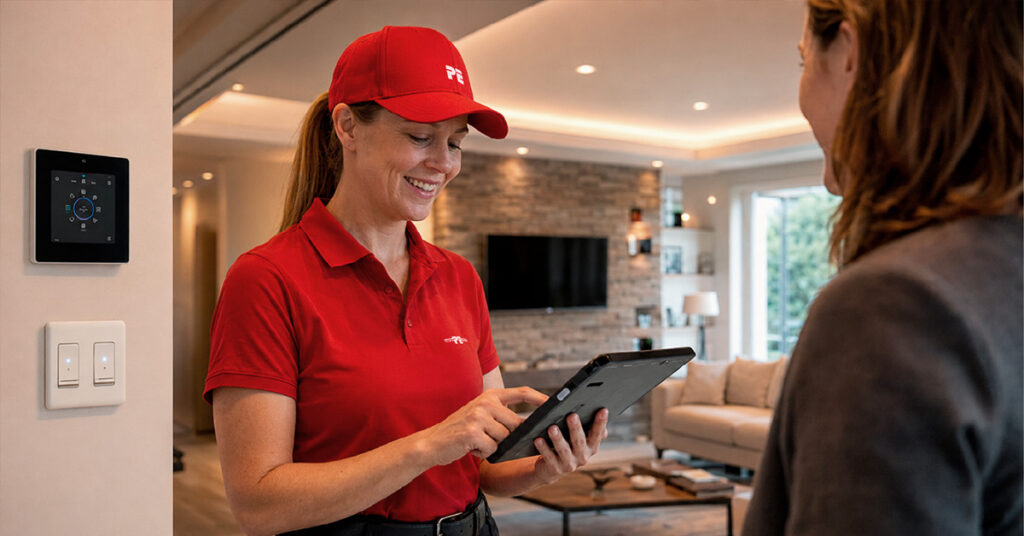
Hiring the right residential electrician comes down to a few things that are easy to verify before anyone sets foot in your home.
Check their license. Ask for the electrician’s license number and verify it with your state or local licensing authority. A legitimate contractor will provide this without hesitation. In Florida, you can verify credentials through the Florida DBPR license lookup tool.
Make sure they are licensed and insured. The license covers the technical credential. Bonding and insurance protect you if something goes wrong on the job, whether that is property damage or an injury on your property.
Ask who will be doing the work. A licensed electrical contractor does not always mean the person showing up at your door holds the license. Ask whether the electricians performing the work are journeyman or master credentialed, and confirm the company has a master electrician on record.
Get the work permitted. Any significant electrical work should be permitted and inspected. If a contractor suggests skipping the permit to save time or money, that is a red flag. Unpermitted work can void your homeowner’s insurance and create problems when you sell your home.
Look for experience with residential work specifically. Not all electricians specialize in residential settings. Someone with deep commercial experience may not be as familiar with the quirks of older home wiring, residential code requirements, or working in occupied spaces.
Do I Need a Residential or Commercial Electrician?
For work in single-family homes, apartments, or townhomes, you need a residential electrician. For retail stores, offices, restaurants, warehouses, or large apartment complexes, you need a commercial electrician. The right choice depends on the type of property and the scope of work involved.
For a full breakdown of how the two roles differ in training, licensing, and system complexity, see our guide: The Difference Between Commercial, Industrial and Residential Electricians.
At Palmer Electric, we have been serving Central Florida homeowners since 1951. Our residential electrical services are backed by licensed and insured electricians who treat every home with the care and professionalism it deserves.
Residential Electrician FAQs
Can a Residential Electrician Do Commercial Work?
In most states, a residential electrician license does not authorize commercial work. Residential licenses are limited-scope credentials covering homes and residential properties only. Commercial work involves higher voltage systems up to 480 volts, three-phase power, conduit-based wiring methods, and stricter code requirements that go beyond what a residential license covers. To perform commercial work legally, an electrician typically needs a general journeyman license or a commercial electrical contractor license. Some states allow residential electricians to expand their scope by completing additional hours and passing a broader licensing exam.
Can a Residential Electrician Transition to Commercial Work?
Yes, and many do. The core electrical principles are the same, but commercial work is a different environment. Residential systems run on 120 and 240 volts. Commercial buildings often use 277 and 480 volt three-phase systems. Instead of running Romex through wood studs, commercial work primarily requires pulling wire through metal or PVC conduit. Commercial projects also rely on complex blueprints and architectural specifications rather than standard home layouts.
The transition is common and very doable. Most electricians who make the switch gain commercial experience under a licensed contractor, study the NEC as it applies to commercial buildings, and upgrade their license accordingly. For a full comparison of both roles, see: The Difference Between Commercial, Industrial and Residential Electricians.
Do I Need a Licensed Residential Electrician for Home Electrical Work?
In most jurisdictions, yes. Significant electrical work requires a licensed electrician, a permit, and an inspection. Electrical mistakes are one of the leading causes of house fires in the United States. According to the National Fire Protection Association (NFPA), the organization that publishes electrical and fire safety codes, electrical failures or malfunctions are a leading cause of home fires annually. A licensed electrician knows the code, does the work correctly, and ensures it gets inspected. Some states allow homeowners to perform limited work on their own primary residence, but even that work needs to be permitted and inspected. Unpermitted electrical work can also void your homeowner’s insurance and create serious complications when you sell your home.
Does Florida Have a Residential Electrician License?
Florida does not issue a license specifically called a residential electrician license. The Florida Department of Business and Professional Regulation (DBPR), the state agency that oversees contractor licensing, issues Certified and Registered Electrical Contractor licenses that cover residential work. At the journeyman level, licensing is handled by individual counties, and requirements vary depending on where the work is performed.
Can a Residential Electrician Work for Themselves?
Yes, in most states, but not with a journeyman license alone. To operate independently, take on clients, and pull permits, a residential electrician typically needs to obtain an electrical contractor license, which in most states requires holding or employing a master electrician. Some states have a residential contractor license with lower requirements than a full electrical contractor license. Requirements vary by jurisdiction, so check with your state or local licensing authority.
Conclusion
Residential electricians are the professionals who keep homes safe, functional, and up to code. They are the ones who show up when something is wrong, upgrade aging systems before they become hazards, and wire new homes and renovations from the ground up. The work is technical, physically demanding, and carries real responsibility, and the best residential electricians take all of that seriously.
At Palmer Electric, residential electrical work is at the heart of what we do. We have been doing it in Central Florida since 1951, and we are proud of the trust homeowners have placed in us over the decades. Whether it is a simple repair or a full rewire, we bring the same level of care and expertise to every job.
Looking for a Residential Electrician in Central Florida?
If you need a licensed, experienced residential electrician in Orlando or the surrounding area, Palmer Electric is ready to help. Our team is licensed and insured, and every job we take on is backed by decades of experience and a commitment to doing the work right. Contact Palmer Electric today to schedule service or request a quote.
References
- U.S. Bureau of Labor Statistics, Occupational Outlook Handbook: Electricians: https://www.bls.gov/ooh/construction-and-extraction/electricians.htm
- NFPA 70, National Electrical Code (NEC), National Fire Protection Association: https://www.nfpa.org/codes-and-standards/7/0/70
- Florida Department of Business and Professional Regulation (DBPR), Electrical Contractor Licensing: https://www.myfloridalicense.com/DBPR/electrical-contractors/
- U.S. Department of Labor, Apprenticeship Finder: https://www.apprenticeship.gov
- Electrical Training Alliance (NECA/IBEW Joint Apprenticeship): https://www.electricaltrainingalliance.org
- OSHA Electrical Safety Standards, 29 CFR 1926 Subpart K: https://www.osha.gov/laws-regs/regulations/standardnumber/1926/1926SubpartK