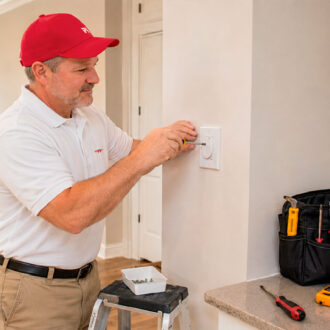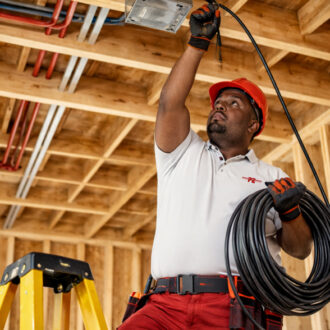

Electricians work in residential, commercial, industrial, construction, and specialized settings. Common workplaces include homes, apartments, offices, schools, hospitals, factories, manufacturing plants, construction sites, utility systems, data centers, solar installations, and marine vessels. The exact work environment depends on the electrician’s specialty and the type of project.
Electricians work just about everywhere electricity is used, which in the modern world means virtually every type of building, facility, and infrastructure system you can think of.
At Palmer Electric, we have been doing this work in Central Florida since 1951. Over the decades, our electricians have worked in single-family homes, hospitals, schools, warehouses, new construction sites, and everything in between. The variety is one of the things that makes this trade genuinely interesting.
If you have ever wondered where electricians work, the answer goes far beyond houses and office buildings. Each environment comes with different systems, tools, and day-to-day challenges, and often requires a different type of electrician. To learn more about the different specializations in the trade, see our guide: Types of Electricians.
Key Takeaways
- Electricians work in residential homes, commercial buildings, industrial facilities, construction sites, and a growing range of specialized environments.
- According to the U.S. Bureau of Labor Statistics, electricians held about 821,000 jobs in 2025, with 66 percent employed as electrical contractors and other wiring installation contractors, 7 percent self-employed.
- Employment is projected to grow 9 percent from 2025 to 2035, much faster than the average for all occupations.
- The physical work environment varies widely, from indoor finished spaces to outdoor job sites, tight attic spaces, and high-voltage industrial facilities.
- Emerging work environments include AI data centers, EV charging infrastructure, solar installations, and renewable energy systems.
- CareerOneStop projects electrician employment to grow 10 percent nationally from 2024 to 2034 and 17 percent in Florida from 2022 to 2032, making Florida a strong market for electrical careers.
- The AI and data center boom is also increasing demand for electricians. U.S. industrial construction is projected to reach $684 billion by 2031, with skilled trades needed to support that growth.
- The type of environment an electrician works in directly affects the credentials, tools, and experience required for the job.
Where Do Electricians Work Overview
| Work Setting | Type of Electrician | Key Examples |
|---|---|---|
| Residential | Residential electrician | Single-family homes, apartments, condominiums, townhomes |
| Commercial | Commercial electrician | Offices, retail stores, schools, hospitals, restaurants |
| Industrial and Manufacturing | Industrial electrician | Factories, manufacturing plants, warehouses |
| Construction Sites | Construction electrician | New residential builds, commercial new construction |
| Data Centers and Technology | Commercial or specialty electrician | Server farms, AI infrastructure facilities |
| Renewable Energy | Electrician specializing in electrical installation and grid connection | Rooftop solar wiring, solar farm electrical systems, wind farm electrical infrastructure |
| Refineries and Energy Sites | Industrial or specialty electrician | Oil refineries, petrochemical plants, offshore platforms |
| Utility Lines and Power Grid | Lineworker or utility electrician | Power poles, electrical grids, substations, transmission lines |
| Roadways and Infrastructure | Highway systems electrician | Streetlights, traffic signals, road signs, tunnel lighting |
| Transportation and Marine | Marine or transit electrician | Airports, seaports, ships, rail systems, transit facilities |
| Government and Public Buildings | Government or facilities electrician | Military bases, courthouses, public schools, municipal buildings |
Where Can Electricians Work
Electricians can work in residential homes, commercial buildings, industrial facilities, construction sites, data centers, renewable energy installations, government and public infrastructure, and transportation systems. The setting determines the voltage levels, tools, licensing requirements, and technical complexity involved. Most electricians specialize in one or two environments over the course of their career.
Electricians work across a broader range of environments than most people realize, and each one comes with its own systems, codes, and day-to-day challenges. Here is a look at the four core work environments, plus the specialized and emerging settings creating new opportunities in the trade.
Residential Settings
Residential work is very hands-on, and it can feel pretty personal too. You are working inside someone’s home, sometimes squeezing into tight attics, crawlspaces, or finished walls to get the job done.
The conditions can change a lot depending on the age of the home and where you are working. Older homes can be especially tricky. You might run into outdated wiring, unusual layouts, or previous repairs that do not follow the methods we use today. That is where patience and experience really come in.
Here in Central Florida, heat is another big part of the job. At Palmer Electric, our electricians often work in hot attics and other spaces without air conditioning, especially during the summer. That is why residential electricians need to understand the local climate and know how to work safely in extreme heat, cold, wind, and high humidity.
Residential electricians also handle emergency calls, which can come at any hour. A tripping breaker, a burning smell, or a complete power loss in an occupied home cannot wait until Monday morning. That on-call reality is part of what makes residential electrical work distinct from a standard nine-to-five job.
Here in Florida, electrical emergencies can also happen before, during, or after a major storm or hurricane. That means residential electricians need flexible schedules and must be ready to adapt when unexpected situations come up.
For most residential electrical projects, permits and inspections are part of the process. The electrician typically takes care of coordinating those steps and making sure the work is ready for inspection.
The goal is pretty simple: the installation needs to meet the National Electrical Code, or NEC, along with any local electrical requirements. Once the work passes the required inspection, the job can be officially completed. For homeowners, that process provides an extra layer of confidence that the electrical work was done safely and correctly.
For a full breakdown of what residential electricians do and what homeowners should look for before hiring one, see our guide: What Is a Residential Electrician.
Commercial Settings
Commercial electricians work in offices, retail stores, schools, hospitals, restaurants, warehouses, and other business facilities. These settings involve higher voltages than residential work, often including three-phase power systems operating at 208, 240, 277, and 480 volts, and require coordination with general contractors, project managers, and other trades on active job sites.
What makes commercial settings distinct is scale and complexity. A hospital, for example, requires dedicated emergency power circuits, nurse call systems, and fire alarm integration alongside the standard lighting and power infrastructure. A retail build-out involves coordinating the electrical installation around a landlord’s existing infrastructure and a tenant’s specific layout. Every commercial setting has its own code requirements, load demands, and operational realities that a commercial electrician has to understand before the first piece of conduit goes in.
At Palmer Electric, commercial electrical work has been a core part of what we do since 1951. Central Florida’s commercial construction market has grown significantly over the decades, and our electricians have worked on everything from small tenant build-outs to large medical facilities and educational campuses.
For a deeper look at the commercial electrician role, see our guide: What Is a Commercial Electrician.
Industrial Settings
Industrial electricians work in factories, manufacturing plants, warehouses, refineries, and processing facilities. This is some of the most technically demanding electrical work in the trade. Industrial systems operate at higher voltages, involve automated controls and motor systems, and require electricians who understand the specific safety requirements of industrial environments.
Per OSHA standard 29 CFR 1910 Subpart S, the federal workplace safety standard that governs electrical work in general industry, industrial electricians must follow strict protocols when working on or near energized equipment, including lockout/tagout procedures and voltage-rated insulating gloves and sleeves selected according to the specific electrical hazard class, as required under ASTM F496 and OSHA 29 CFR 1910.137, the federal standard governing electrical protective equipment.
Construction Sites
Construction electricians work on active building sites, both residential and commercial, putting the electrical system in place before the walls and ceilings are closed up. That can mean installing conduit, pulling wire, setting panels, and making sure everything is ready for the next stage of construction.
What really makes this kind of work different is the amount of coordination involved. Electricians are working right alongside plumbers, HVAC crews, and drywall installers, and every trade has its turn in the schedule. If the electrical rough-in gets delayed, the next crew may not be able to move forward.
That is why construction electricians need more than solid electrical skills. They also need to communicate well, stay organized, and understand how their work fits into the bigger picture. On a busy job site, keeping the electrical work on schedule helps keep the whole project moving.
At Palmer Electric, our commercial new construction team works closely with general contractors throughout Central Florida to keep projects moving on time and on spec.
Specialized and Emerging Work Environments
Beyond the four core settings (residential, commercial, industrial, and construction), electricians work in data centers, renewable energy installations, transportation and marine systems, and government infrastructure. These environments are growing rapidly, driven by the AI infrastructure boom, the expansion of renewable energy, and ongoing investment in public systems. For electricians looking to specialize, these settings often offer some of the most in-demand and technically interesting work in the trade.
Data Centers and Technology Infrastructure
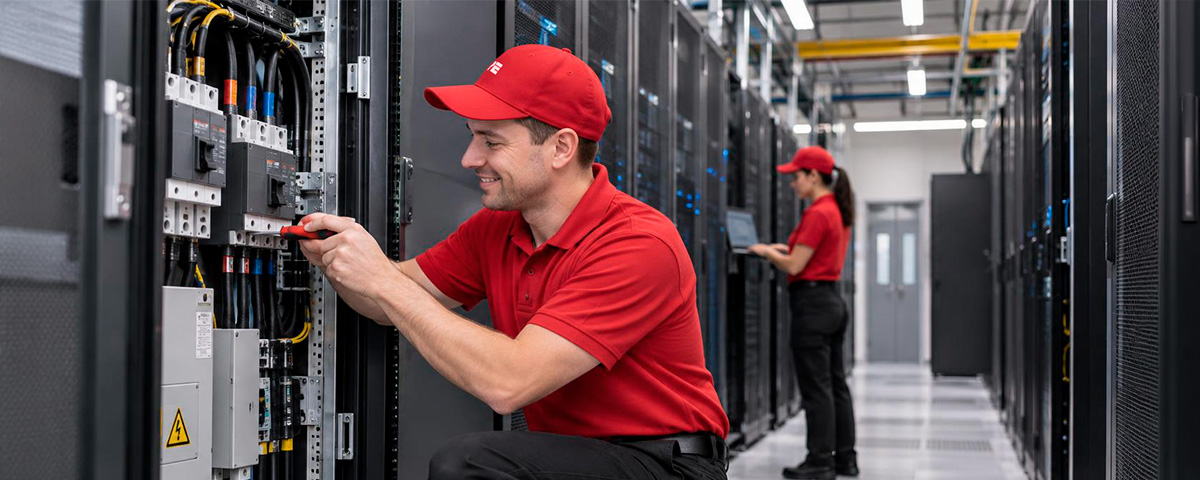
Data centers are one of the most significant emerging work environments for electricians right now. These are the facilities that house the servers, networking equipment, and power systems that support cloud computing, artificial intelligence, and digital infrastructure at a massive scale.
Building and maintaining a data center requires electricians at nearly every stage of the project. According to McKinsey, the global management consulting firm, a typical large data center adds up to 1,500 workers on-site during the construction phase, with electricians among the most critical trades required. And unlike most construction projects, data centers are not one-and-done. According to Brittany Kaiser, CEO of AI infrastructure company Alpha Compute, cited by Fox News, data centers are a constant construction project, requiring workers across construction, electricity, energy development, monitoring, and maintenance as facilities grow and expand.
The scale of investment is significant. McKinsey projects that companies will invest almost $7 trillion in capital expenditures on data center infrastructure globally by 2030, with more than 40 percent of that spending in the United States. The Information Technology and Innovation Foundation (ITIF), a nonprofit science and technology policy research organization, reported that as of November 2025, the construction industry was already facing a shortage of approximately 439,000 workers, with electricians among the hardest positions to fill. With over 400 data centers currently under development by major technology companies, that gap is not closing anytime soon.
Renewable Energy and Solar Installations
Electricians are a big part of making renewable energy systems work. With solar and wind projects, their job is focused on the electrical side: wiring the system, connecting it to inverters and distribution equipment, and tying everything into the building’s electrical system or the utility grid.
It is important to separate that from the mechanical work. Installing solar panels on a roof or handling the mechanical parts of a wind turbine can involve different trades. Electricians step in where the power needs to be connected, controlled, and safely delivered where it needs to go.
Rooftop solar installations on homes and businesses, utility-scale solar farms, and wind farm electrical infrastructure are all active work environments for electricians. As renewable energy adoption accelerates across the country, this segment is growing rapidly. Per the U.S. Bureau of Labor Statistics, the federal agency that tracks employment data, the continued expansion of solar and wind power is one of the key factors driving projected growth in electrician employment through 2035.
Transportation and Marine Settings
Electricians also work in places like airports, rail systems, transit facilities, seaports, and marine environments. These jobs can look very different from a typical home or commercial project because the systems are larger, more specialized, and often have their own safety and code requirements.
In transportation, electricians help keep essential systems running. That can include power, lighting, communications, controls, and backup systems. On a rail project, for example, electricians may work with traction power, signal systems, communication networks, and platform lighting. It is specialized work, and it usually requires a strong understanding of the standards that apply to that type of facility.
Marine electricians work on ships, ferries, and other vessels, taking care of the electrical systems that keep everything running. That can include navigation equipment, communications, lighting, safety systems, and even parts of the propulsion system.
This is a pretty specialized corner of the trade because boats and ships operate under their own electrical standards. In the U.S., ABYC E-11 (American Boat and Yacht Council) is commonly used for AC and DC systems on boats and smaller craft. Commercial vessels may also need to follow U.S. Coast Guard rules under Title 46, while international vessels can be subject to IEC (International Electrotechnical Commission) 60092 standards. In other words, marine electricians are not just working in a different environment, they are also working under a different set of rules.
Government and Public Infrastructure
Electricians working in government and public infrastructure settings cover a wide range of environments, from military bases and courthouses to public schools, municipal buildings, transit systems, and highway infrastructure.
Highway and Roadway Systems
Highway systems electricians install and maintain streetlights, traffic signals, road signs, and tunnel lighting systems. This work is largely outdoor, involves coordination with state and local transportation departments, and requires familiarity with standards set by the Institute of Transportation Engineers (ITE) and local department of transportation specifications.
For example, here in Florida, when a hurricane approaches, electricians working on highway and roadway systems may be called in before and after the storm. Before the hurricane, they might inspect roadway lighting, backup power systems, and other equipment to make sure everything is secure. After the storm passes, they may help identify damaged wiring, restore power to roadway lighting, repair electrical equipment, or support traffic signal systems where permitted. Fallen trees, flooding, wind damage, and power outages are very common after a storm and can create electrical problems that need to be addressed quickly.
As you can see, electricians play a critical role after natural disasters by restoring power, repairing damaged electrical systems, and helping homes, businesses, and infrastructure operate safely again.
Public Transit
Transit electricians work on rail, subway, and bus rapid transit systems, maintaining traction power systems, signal and communication networks, and platform and tunnel lighting. This is a distinct specialty that requires knowledge of transit-specific electrical standards and close coordination with transit authorities and operations teams.
Here in Central Florida, after Hurricane Nicole in November 2022, SunRail crews inspected the 61.5-mile rail corridor, reinstalled gates at 126 railroad crossings, and tested signals before regular service could safely resume. Anyone who has been through a hurricane knows how disruptive it can be to lose electricity for days and sometimes for weeks. Losing access to public transportation after a natural disater can make recovery even harder. Situations like this show just how important electrical and signal systems are to keeping public transit safe and operational after a major storm.
Federal and Military Facilities
Military installations require electricians cleared to work on secure facilities, often with additional background check and security clearance requirements beyond standard licensing. Government electrical work follows strict procurement and inspection processes that differ significantly from private sector contracting.
Refineries and Energy Sites
Refineries, petrochemical plants, and offshore platforms represent some of the most technically demanding and highly regulated electrical work environments in the trade. Electricians in these settings work with equipment designed for hazardous locations, specialized wiring methods, and strict compliance requirements under OSHA 29 CFR 1910 Subpart S and the National Electrical Code’s Article 500, which covers electrical installations in hazardous classified locations. This type of work generally requires specialized training and experience beyond standard journeyman work, with specific requirements varying by employer, facility, and jurisdiction.
Utility Lines and Power Grid
Lineworkers, also called line installers and repairers, install and maintain the transmission and distribution lines that carry electricity from power plants to homes and businesses. This is outdoor work performed at significant heights on power poles and transmission towers, often in all weather conditions. Per the U.S. Bureau of Labor Statistics, line installers and repairers are classified as a separate occupation from electricians, though the work is closely related and many electricians move into linework as a specialization.
For example, here in Florida, hurricanes show just how important this work can be. After Hurricane Milton in 2024, Duke Energy Florida reported replacing 1,640 power poles, 1,350 transformers, and nearly 1 million feet of wire and cable as part of its storm response. Crews restored 95 percent of roughly 1 million reported outages within about four days. That gives you an idea of the scale of work utility crews can face after a major hurricane.
Who Employs Electricians
Most electricians in the United States, about 66 percent, work for electrical contractors and wiring installation companies, according to the U.S. Bureau of Labor Statistics, the federal agency that tracks employment data across all industries. The remaining workforce is spread across manufacturing, government, employment services, and self-employment, with electricians holding about 821,000 jobs in 2025.
Here is how that employment breaks down by employer type:
Largest Employers of Electricians in the U.S.
| Employer Type | 2025 Employment | Share of Total | Projected 2035 Employment | Projected Growth |
|---|---|---|---|---|
| Electrical contractors and other wiring installation contractors | 545,000 | 66.4% | 607,200 | 11.4% |
| Self-employed workers | 58,500 | 7.1% | 61,400 | 5.1% |
| Manufacturing | 52,600 | 6.4% | 53,500 | 1.9% |
| Government, excluding state and local education and hospitals | 24,600 | 3.0% | 25,000 | 1.6% |
| Employment services | 19,800 | 2.4% | 19,300 | -2.1% |
| Educational services, state, local, and private | 10,700 | 1.3% | 10,900 | 1.7% |
| All other industries combined | 109,800 | 13.4% | 120,100 | varies |
| Total, all industries | 821,000 | 100% | 896,900 | 9.2% |
The contractor category dominates because most electrical work, whether residential, commercial, or industrial, is performed by licensed electrical contracting companies rather than in-house staff. Self-employed electricians typically operate their own small contracting businesses and work primarily in residential or light commercial settings, and in most states must hold an electrical contractor license to operate independently.
What Is the Physical Work Environment Like for Electricians
Electricians work in both indoor and outdoor environments depending on the project and setting. Indoor work includes homes, offices, hospitals, and industrial facilities, often in tight spaces like attics and crawlspaces. Outdoor work includes construction sites, utility infrastructure, and renewable energy installations, with exposure to weather and heights. Most electricians regularly work between both.
Indoors vs Outdoors
Most electricians work in both indoor and outdoor environments depending on the project phase and type of work.
Indoor work includes finished residential and commercial spaces, industrial facilities, data centers, hospitals, and schools. Indoor electrical work often involves working in tight spaces, including attics, crawlspaces, ceiling cavities, and inside finished walls. Electricians may spend significant time kneeling, crouching, or working overhead depending on where the wiring and equipment are located.
Outdoor work includes construction sites, utility infrastructure, highway systems, and renewable energy installations. Outdoor electricians are exposed to weather conditions including heat, cold, rain, and wind. Per the U.S. Bureau of Labor Statistics, electricians may be required to work at significant heights, such as on construction sites, inside buildings during construction, or on renewable energy projects.
Travel and Commuting Requirements
Most electricians travel to different worksites rather than reporting to a fixed location every day. Per the U.S. Bureau of Labor Statistics, local or long-distance commuting is often required because electricians must travel to different worksites.
The amount of travel depends on the employer and type of work:
- Residential service electricians typically work within a defined service area and travel between multiple homes or properties in a single day.
- Commercial and industrial electricians may work on a single large project site for weeks or months at a time.
- Specialty electricians working on infrastructure, pipeline, or utility projects may travel regionally or nationally depending on where projects are located
- Self-employed electricians generally set their own service area and control their own travel requirements.
Where Do Electricians Work in Florida
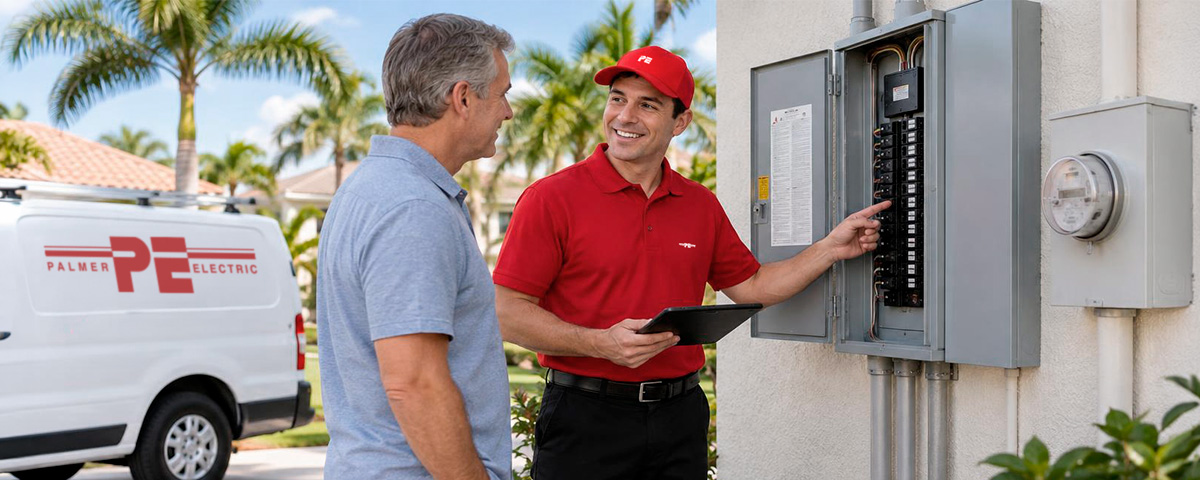
Here in Florida, is a busy place for electricians. The state keeps growing, construction happens year-round, and our climate puts extra demand on electrical systems.
In Florida, electricians do work that isn’t as common in many other parts of the country, from hurricane-related repairs and generator installations to surge protection, outdoor electrical work, and equipment exposed to heat and humidity. All of that helps keep demand for skilled electricians strong statewide.
According to CareerOneStop, the U.S. Department of Labor’s career information resource, electrician employment in Florida is projected to grow 17 percent over its state projection period of 2022 to 2032, significantly higher than the national rate of 10 percent projected by CareerOneStop for the same occupation over the 2024 to 2034 period.
Florida electricians work across all of the core environments covered in this article, but a few settings stand out as particularly active in the state:
Residential construction and service
Florida’s population growth drives constant new home construction and renovation activity. Central Florida alone has seen years of sustained residential development that keeps residential electricians consistently busy.
Commercial construction
Theme parks, hotels, retail centers, medical facilities, and educational campuses represent major ongoing commercial electrical work throughout the state.
Hurricane preparedness and recovery
Florida’s hurricane season creates demand for generator installations, surge protection systems, and post-storm electrical repairs that other states simply do not experience at the same volume. At Palmer Electric, storm season brings a significant increase in calls for generator installations and surge protection from Central Florida homeowners and businesses preparing for hurricane season.
Solar installations
Florida ranks among the top states for solar energy adoption, creating growing demand for electricians specializing in solar wiring and grid connection work.
Data centers
Florida’s growing technology infrastructure sector is adding data center capacity, particularly in the Miami and Tampa markets, creating new demand for electricians with data center experience.
At Palmer Electric, Florida has been our home for over 7 decades. The range of work our electricians do reflects exactly what this article describes: residential service calls, commercial new construction, emergency repairs, and everything in between.
How Work Setting Affects Your Electrician Career
Your work setting determines the license you need, the tools you use, the physical demands you face, and how much you can earn. Commercial and industrial settings generally require broader credentials and offer higher earning potential than residential work. Specialty settings like data centers and renewable energy offer some of the strongest advancement opportunities in the trade right now.
The setting where you work shapes almost every aspect of your career. Here is how those connections play out in practice.
Experience in one setting builds toward the next
Many electricians start in residential work and move into commercial or industrial settings as they gain experience and upgrade their credentials. The foundational skills, reading blueprints, pulling wire, following code, transfer across settings even as the systems become more complex.
Specialization creates opportunity
Electricians who keep building their skills often open the door to better career opportunities. Areas like data centers, renewable energy, and EV charging are growing fast, and electricians who understand those systems can stand out from the crowd.
The trade really rewards people who keep learning. Adding new certifications, getting experience with newer technology, and becoming the go-to person for a specialized type of work can all help move your career forward.
Where Do Electricians Work FAQs
Where Do Electricians Mainly Work?
Most electricians, about 66 percent, work for electrical contractors and wiring installation companies, according to the U.S. Bureau of Labor Statistics. In terms of physical settings, the largest share of electrical work happens in commercial and residential construction, followed by industrial facilities, government buildings, and a growing range of specialized environments including data centers and renewable energy installations.
Do Electricians Work Inside or Outside?
Most electricians work both indoors and outdoors depending on the project phase and type of work. Residential and commercial service work is primarily indoor. Construction site work, utility infrastructure, highway systems, and renewable energy installations involve significant outdoor exposure. Many electricians alternate between indoor and outdoor environments within the same week depending on the project.
Can Electricians Work From Home?
Not really, most electrical work is hands-on and requires being physically present at the job site. However, self-employed electricians and electrical contractors do handle administrative work, estimating, scheduling, and project planning from a home office. The field work itself requires on-site presence.
Where Can Electricians Work in Florida?
In Florida, electricians work across residential homes, commercial buildings, new construction sites, hospitals, schools, theme parks, hotels, solar installations, and data centers. Florida’s hurricane season also creates consistent demand for generator installations, surge protection, and storm recovery work. According to CareerOneStop, Florida projects 17 percent electrician employment growth over its state projection period, one of the highest rates in the country.
What Type of Electrician Works in a Factory?
Industrial electricians work in factories and manufacturing facilities. They install and maintain motor controls, automated systems, high-voltage equipment, and the complex electrical infrastructure that keeps manufacturing operations running. This is among the most technically demanding electrical work in the trade, requiring familiarity with industrial code requirements and safety protocols under OSHA 29 CFR 1910 Subpart S.
Do Electricians Travel for Work?
Yes, most electricians travel to different worksites as part of the job. Residential electricians typically work within a defined local service area, moving between multiple properties in a day. Commercial and industrial electricians may work on a single large project site for an extended period. Specialty electricians working on infrastructure or energy projects may travel regionally or nationally depending on where the work is located.
Conclusion
Electricians are needed almost anywhere electricity is used, so the job can take you into all kinds of places. One day that might be a family home or office building, and another day it could be a hospital, factory, data center, or renewable energy project.
That variety is a big part of the trade. Electricians help power the places we live and work, but they also work on the larger systems people depend on every day, from critical hospital equipment to EV charging stations and solar installations.
At Palmer Electric, our electricians have work in single-family homes and large commercial facilities, new construction and emergency repairs, and everything in between. That variety is what makes this trade genuinely rewarding.
Looking for a Licensed Electrician in Central Florida?
Whether you need residential service, commercial electrical work, or emergency repairs, Palmer Electric is ready to help. Our licensed and insured team has been serving Orlando and Central Florida since 1951. Browse our full range of electrical services or contact us by filling out a contact form or calling 407-646-8700 to schedule service or request a free quote.
References
- U.S. Bureau of Labor Statistics, Occupational Outlook Handbook: Electricians, updated August 27, 2026: https://www.bls.gov/ooh/construction-and-extraction/electricians.htm
- U.S. Bureau of Labor Statistics, Employment Projections: Electricians by Industry, 2025-2035: https://data.bls.gov/projections/nationalMatrix?queryParams=47-2111&ioType=o
- CareerOneStop, U.S. Department of Labor, Occupation Profile: Electricians, Florida: https://www.careeronestop.org/Toolkit/Careers/Occupations/occupation-profile.aspx?keyword=Electricians&location=Florida&onetcode=47-2111.00
- U.S. Bureau of Labor Statistics, Line Installers and Repairers, Occupational Outlook Handbook: https://www.bls.gov/ooh/installation-maintenance-and-repair/line-installers-and-repairers.htm
- McKinsey, The data center balance: How US states can navigate the opportunities and challenges, August 8, 2025: https://www.mckinsey.com/industries/public-sector/our-insights/the-data-center-balance-how-us-states-can-navigate-the-opportunities-and-challenges
- Information Technology and Innovation Foundation (ITIF), Construction Industry Facing a 439,000-Worker Shortage: https://itif.org/publications/2026/01/12/construction-industry-facing-worker-shortage-driven-by-growth-of-data-centers/
- Fox News, One of the world’s hottest industries is sparking a blue-collar jobs boom, August 28, 2026: https://www.foxnews.com/politics/worlds-hottest-industries-sparking-blue-collar-jobs-boom
- NFPA 70, National Electrical Code (NEC), National Fire Protection Association: https://www.nfpa.org/codes-and-standards/7/0/70
- OSHA, Electrical Safety Standards, 29 CFR 1910.302, Electric Utilization Systems: https://www.osha.gov/laws-regs/regulations/standardnumber/1910/1910.302
- OSHA, Electrical Safety Standards, 29 CFR 1910.303, General Electrical Safety Requirements: https://www.osha.gov/laws-regs/regulations/standardnumber/1910/1910.303
- OSHA, Electrical Safety Standards, 29 CFR 1910.307, Hazardous (Classified) Locations: https://www.osha.gov/laws-regs/regulations/standardnumber/1910/1910.307
- Associated General Contractors of America, Construction Employment Data, Florida, July 2025: https://www.agc.org
- American Boat and Yacht Council, ABYC E-11: AC and DC Electrical Systems on Boats: https://abycinc.org
- U.S. Coast Guard, Title 46 Code of Federal Regulations, Maritime Operations: https://www.ecfr.gov/current/title-46
- SunRail, SunRail to Resume Regular Service Monday, November 14, 2022, Hurricane Nicole Recovery: https://sunrail.com/agency-information/press-releases/sunrail-to-resume-regular-service-monday-november-14-2022/
- Duke Energy, Hurricane Milton Restoration, Emergency Response Award and Restoration Statistics: https://news.duke-energy.com/releases/eei-announces-duke-energy-florida-as-emergency-response-award-recipient
- Duke Energy, Hurricane Milton Restoration in Central Florida Counties: https://news.duke-energy.com/releases/duke-energy-florida-restores-power-for-several-counties-impacted-by-hurricane-milton-outages-decrease-from-1-million-to-approximately-105-000
- Duke Energy, Hurricane Irma Restoration, More Than 1 Million Florida Customers Restored: https://news.duke-energy.com/releases/duke-energy-crosses-the-1-million-mark-for-customers-restored-in-florida