Key Takeaways
- Electricians progress through clearly defined career levels and roles
- The term electrician levels can mean different things depending on context
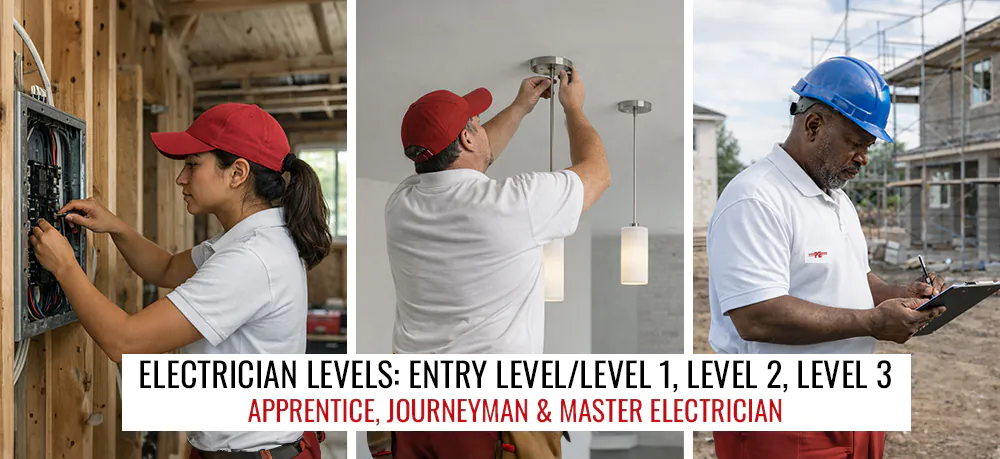
- There are informal electrician levels, such as Entry Level or Level 1 Electrician, Level 2 Electrician, and Level 3 Electrician, used to describe skill and experience
- There are formal electrician roles and licenses, including apprentice, journeyman, and master, that define authority and credentials
- Understanding the difference between levels and roles helps avoid confusion when reading job listings or career guides
- Each level and role comes with different experience, responsibility, and authority
- Knowing how electrician levels and roles fit together helps explain how electrical work is structured and supervised
Levels of Electrician Overview
Electrician levels and roles describe how experience, responsibility, and authority are structured in the electrical trade. The table below summarizes both informal skill levels and formal electrician roles to provide a complete overview.
| Classification | System Type | Typical Experience Range | Typical Responsibilities | Common Industry Usage |
|---|---|---|---|---|
| Entry Level Electrician | Informal skill level | 0–1 years | Assists with electrical installations, repairs, and maintenance under direct supervision | Used in job postings and training programs for beginners |
| Level 1 Electrician | Informal skill level | 0–2 years | Performs basic electrical work such as wiring support, lighting tasks, and general maintenance with close oversight | Employer-defined early skill tier |
| Level 2 Electrician | Informal skill level | 2–5 years | Handles a broader range of electrical work, troubleshooting, and installations with limited supervision | Used to indicate mid-level capability |
| Level 3 Electrician | Informal skill level | 5+ years | Performs complex electrical work and may guide others on job sites | Used to indicate advanced experience without referencing licensing |
| Apprentice Electrician | Formal role | 4–5 years (typical) | Learns the trade through hands-on work and classroom training under supervision | Recognized training role tied to licensing |
| Journeyman Electrician | Formal role | 5–8 years total | Independently installs, maintains, and repairs electrical systems; may supervise apprentices | Core working electrician role |
| Master Electrician | Formal role | 8–10+ years total | Oversees electrical work, planning, and compliance; holds final responsibility | Highest authority role in the trade |
This article covers informal “electrician levels” and formal “electrician roles”, clearly and separately.
Understanding Electrician Levels vs Electrician Roles
Electrician levels and electrician roles are not the same thing. Electrician levels describe informal skill and experience tiers, while Electrician roles and licenses define formal authority, credentials, and legal responsibility.
In the electrical industry, the word level is used in two different ways.
- Informal levels, often labeled as Level 1, Level 2, or Level 3 electrician. These are not licenses. They are skill-based classifications commonly used by employers, training programs, or internal pay structures.
- Formal electrician roles, such as apprentice electrician, journeyman electrician, and master electrician. These titles are tied to training requirements, experience, and in many cases, state or local licensing.
Both systems exist. They often overlap. But they are not the same, and understanding the difference is key to understanding electrician career paths.
Electrician Levels vs Electrician Roles Overview
The table below shows how electrician levels and electrician roles differ in purpose, authority, and usage across the industry.
| Category | Electrician Levels (Level 1–3) | Electrician Roles (Apprentice–Master) |
|---|---|---|
| Defined by | Employers or training programs | Licensing bodies and regulations |
| Legal standing | Not legally defined | Often legally defined |
| Purpose | Describe skill and experience | Define authority and accountability |
| Consistency | Varies by company | More standardized |
| Used for | Hiring, pay bands, internal progression | Permits, supervision, compliance |
This distinction helps explain why the same electrician might be described differently depending on where you see the title used.
At Palmer Electric, we hear both terms used all the time. Someone might be called a Level 2 electrician on a job site while also working toward or holding a formal journeyman license. What matters most is understanding the context. Levels describe experience. Roles and licenses define responsibility. Keeping that clear helps everyone understand who is doing the work and who is accountable for it.
If you’re new to the trade and want a broader explanation of the profession itself, read our guide on what is an electrician to understand the role, responsibilities, and scope of electrical work.
What Are the Levels of an Electrician
The levels of an electrician commonly refer to informal experience tiers, such as entry level, Level 1, Level 2, and Level 3, used to describe skill progression rather than licensing.
When people ask about electrician levels, they are often referring to skill and experience tiers, not formal licenses. These levels are commonly used by employers, training programs, and job listings to describe how experienced an electrician is and how much responsibility they can handle.
Electrician levels help describe where someone falls on the experience spectrum, especially in workplaces that use internal leveling systems. While the terminology can vary, the general idea stays the same, levels reflect growth in skill, independence, and responsibility.
Entry Level Electrician
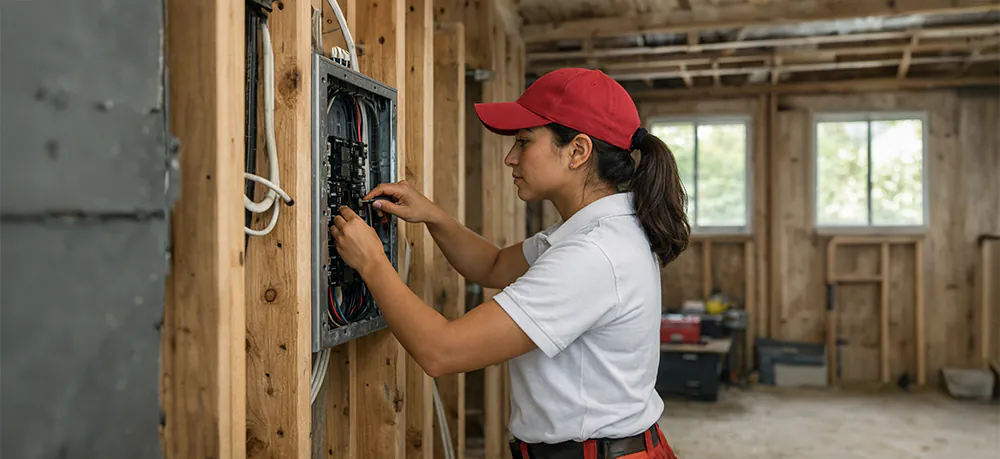
An entry level electrician is someone at the beginning of their electrical career who is gaining foundational skills under supervision. This term is commonly used in job postings and training programs to describe individuals who are learning the basics and gaining hands-on experience.
Entry level electricians typically work under supervision and focus on developing foundational skills. The term describes experience level, not licensing status, and may apply to individuals in different stages of formal training.
Level 1 Electrician
The term Electrician Level 1 is used informally to describe an electrician starting their electrical career. Someone who is still learning core electrical concepts and working closely under supervision.

Level 2 Electrician
A Level 2 electrician is an informal skill classification for electricians who have moderate experience and can complete a wider range of electrical work with limited supervision.

Level 3 Electrician
A Level 3 electrician is an informal term used to describe an advanced electrician with significant experience who can handle complex electrical work and provide guidance to others.
Levels of an Electrician Overview
This table summarizes how electrician levels are commonly understood across the industry.
| Level | Typical Years of Experience | Independence | Work Complexity | Typical Use Case |
|---|---|---|---|---|
| Entry Level | 0–1 | Very limited | Basic support tasks | Training and onboarding |
| Level 1 | 0–2 | Low | Simple electrical work | Early hands-on experience |
| Level 2 | 2–5 | Moderate | Standard electrical work | Trusted mid-level electrician |
| Level 3 | 5+ | High | Complex systems and troubleshooting | Senior skill tier |
Key Differences Between Level 1 and Level 2 Electricians
The key difference between Level 1 and Level 2 electricians is independence. Level 1 electricians require close supervision, while Level 2 electricians are trusted to handle more complex tasks with less oversight.
While both Level 1 and Level 2 electricians are still progressing in their careers, there are clear differences in experience and responsibility.
Level 1 electricians focus heavily on learning and support. Level 2 electricians have more hands-on experience and are trusted to complete a wider range of work with less oversight.
Level 1 and Level 2 Electricians Overview
| Category | Level 1 Electrician | Level 2 Electrician |
|---|---|---|
| Typical experience | 0–2 years | 2–5 years |
| Supervision | Required most of the time | Limited supervision |
| Scope of work | Basic wiring, lighting, maintenance support | Broader electrical installations and troubleshooting |
| Problem-solving | Guided | More independent |
| Employer trust level | Learning stage | Task ownership stage |
| Typical job fit | Entry-level positions | Mid-level electrician roles |
At Palmer Electric, we see these informal levels used most often in hiring and training conversations. While titles may differ from company to company, the progression is always based on experience and responsibility. Our focus is making sure electricians are supported as they grow, so each step forward comes with the skills and confidence needed to do the work right.
Formal Electrician Roles and Licensing Structure
While informal electrician levels describe skill and experience, formal electrician roles define training requirements, licensing, and authority, determining who can perform electrical work independently and who holds responsibility for it. These roles define who can perform electrical work independently and who holds responsibility for the outcome of that work.
Across the industry, formal electrician roles follow a well-established structure. Each role builds on the one before it, adding authority, responsibility, and accountability.
Apprentice Electrician
An apprentice electrician is an entry-level electrician who learns the trade through supervised, hands-on training and classroom instruction.
Apprentices work under supervision while developing foundational skills and understanding how electrical systems are installed, maintained, and evaluated.
This role focuses on learning and skill development rather than independent electrical work. Apprentices support projects while gaining the experience needed to progress.
Journeyman Electrician
A journeyman electrician is a fully trained electrician qualified to perform most electrical work independently and supervise apprentices.
Journeymen handle the majority of day-to-day electrical work. This role represents the backbone of the electrical workforce, combining hands-on expertise with growing responsibility.
Master Electrician
A master electrician is the highest formal role in the electrical trade, responsible for oversight, planning, and final accountability.
Master electricians have extensive experience and a deep understanding of electrical systems, planning, and oversight.
This role carries the highest level of responsibility, often involving supervision, system-level decision-making, and accountability for electrical work performed by others.
Electrician Roles and Licensing Structure Overview
| Formal Role | Typical Training Hours | Approx. Time Required | Licensing / Credential | Primary Focus |
|---|---|---|---|---|
| Apprentice Electrician | ~8,000 hours of on-the-job training plus ~576–800 classroom hours | 4–5 years | Apprentice registration or enrollment | Learning safety practices, electrical theory, NEC code, and blueprint reading under supervision |
| Journeyman Electrician | Completion of ~7,000–8,000 documented work hours | 5–8 total career years | Journeyman electrician license (state or local) | Performing electrical work independently and supervising apprentices |
| Master Electrician | Additional ~4,000+ hours beyond journeyman level | 8–10+ total career years | Master electrician license plus continuing education | Oversight, system planning, code compliance, and final accountability |
DISCLAIMER: Training hours and licensing requirements vary by state and local jurisdiction, but the ranges above reflect common industry standards.
Here at Palmer Electric, these roles are clearly defined because accountability matters. Apprentices learn under guidance, journeymen handle the bulk of hands-on work, and master electricians provide oversight to ensure every project meets our standards. This structure has helped us deliver reliable electrical service across Central Florida since 1951.
Typical Electrician Career Progression
An electrician’s career progression follows a structured path based on time, hands-on experience, and increasing responsibility. While exact requirements vary by state and jurisdiction, the stages below reflect common industry standards used across the U.S.
Please note: Timeframes and hour requirements vary by state and local jurisdiction, but the ranges below reflect common industry standards.
Education and Training
Typical Time: 6–12 months
Typical Hours: 500–1,000 combined classroom and lab hours
This stage prepares individuals for entry into the electrical trade by building foundational knowledge and basic skills. While not always mandatory, formal education can make the transition into an apprenticeship smoother and more competitive.
Basic Education and Requirements
- High School Diploma or GED:
Required for entry into most apprenticeship programs. Coursework in algebra, physics, and electrical or shop classes is strongly preferred. - Technical or Trade School (Optional):
Optional 1–2 year programs, leading to a certificate or associate degree, provide foundational training in circuitry, safety practices, and electrical theory. In some cases, this education can reduce the total length of an apprenticeship or accelerate advancement.
Apprenticeship
Typical Time: 4–5 years
Typical Hours:
- Approximately 8,000 hours of on-the-job training
- Approximately 576–800 hours of classroom instruction
The apprenticeship is the core training phase of an electrician’s career. Apprentices gain hands-on experience under supervision while completing required classroom education. This stage builds real-world skills and prepares electricians for independent work.
Journeyman License
Typical Time:
- 4–5 years from career start, after completing an apprenticeship
- In some cases, as early as 3.5 – 4 yea,rs depending on state requirements and documented hours
Typical Hours:
- Approximately 7,000–8,000 documented work hours
After completing apprenticeship requirements, electricians may qualify to test for a journeyman license. At this stage, electricians are trusted to perform most electrical work independently and may supervise apprentices. Responsibility and accountability increase significantly here.
Master License
Typical Time:
- 1–2 years beyond journeyman licensure in many states
- Often 6–10+ total years from career start, depending on experience requirements
Typical Hours: Approximately 4,000+ additional work hours as a journeyman
Total Career Hours: Often 12,000–16,000+ hours
The master electrician stage represents the highest level of formal progression. Master electricians take on oversight roles, system-level decision-making, and final responsibility for electrical work. Continuing education is typically required to maintain this license.
Electrician Career Progression Overview
| Career Stage | Typical Timeframe | Focus | Key Milestone | Outcome |
|---|---|---|---|---|
| Education / Training | 6–12 months | Fundamentals | Entry into apprenticeship | Ready for hands-on learning |
| Apprenticeship | 4–5 years | Skill development | Journeyman eligibility | Independent work |
| Journeyman | 2–4+ years | Advanced work | Master eligibility | Senior electrician |
| Master | Long-term | Oversight and leadership | Highest credential | Authority and accountability |
At our company, we’ve seen the most successful electricians treat career progression as a long-term investment. Each stage builds the experience and confidence needed for the next, which is why structured training and clear milestones matter.
As electricians gain experience, many choose to specialize. If you’re exploring career paths, read about the difference between commercial, industrial, and residential electricians to see how work environments and responsibilities vary.
How Responsibilities Change at Each Electrician Level
As electricians gain experience, their responsibilities expand well beyond just performing electrical work. Responsibility includes decision-making, independence, supervision, and accountability for outcomes.
Early-stage electricians focus on learning and task execution. As they progress, they take ownership of work quality, handle more complex systems, and eventually become responsible for planning, oversight, and final approval.
Responsibility Progression by Electrician Level
Responsibility increases as electricians gain experience, moving from task execution to system-level accountability.
| Stage | Decision Authority | Supervision Required | Accountability Scope |
|---|---|---|---|
| Entry Level / Level 1 | Follows instructions | Constant supervision | Individual tasks only |
| Level 2 | Makes job-level decisions | Occasional supervision | Assigned systems or areas |
| Level 3 | Makes system-level decisions | Minimal supervision | Complex electrical work |
| Master Electrician (Role) | Final authority | Oversees others | Full project and system accountability |
This progression explains why experience matters so much in electrical work. Each step adds responsibility that directly impacts system performance and safety.
For a more detailed breakdown of day-to-day duties, see our full guide on electrician tasks and responsibilities, which explains how electrical work is handled across different roles and experience levels.
Electrician License Types
Electrician license types define who is legally allowed to perform electrical work independently and who holds responsibility for compliance and oversight.
While license names and requirements vary by jurisdiction, most follow a similar structure tied to experience and demonstrated competency.
Common Electrician License Types
| License Type | Approximate Time to Qualify | Typical Experience Required | Scope of Authority |
|---|---|---|---|
| Apprentice Registration | Entry point | High school diploma or GED, enrollment in a training program | May perform electrical work only under supervision |
| Journeyman License | Approximately 4–5 years | Completion of apprenticeship, approx 7,000–8,000 documented work hours | May perform most electrical work independently |
| Master License | Approximately 6–10+ total career years | Additional experience beyond journeyman, approx 4,000+ hours | May oversee work, approve projects, and hold final responsibility |
Licensing ensures accountability and establishes clear boundaries for who can perform and approve electrical work.
Levels of Electrician Compared
Comparing electrician levels and roles helps clarify differences in experience, authority, and responsibility across the profession.
While informal levels describe skill tiers, formal roles define credentials and legal authority.
Levels of Electrician Key Differences Summary
| Category | Electrician Levels (Level 1–3) | Electrician Roles (Apprentice–Master) |
|---|---|---|
| Defined by | Employers or training programs | Licensing bodies and regulations |
| Legal standing | Not legally defined | Often legally defined |
| Purpose | Describe skill and experience | Define authority and accountability |
| Consistency | Varies by company | More standardized |
| Used for | Hiring, pay bands, internal progression | Permits, supervision, compliance |
Journeyman vs Apprentice
The difference between a journeyman and an apprentice electrician comes down to experience, independence, and responsibility. While apprentices focus on learning under supervision, journeymen are qualified to perform most electrical work independently.
| Category | Apprentice Electrician | Journeyman Electrician |
|---|---|---|
| Experience Level | Entry-level, learning stage | Fully trained working electrician |
| Approximate Experience | Approximately 0–4 years | Approximately 4–8 years |
| Supervision | Works under direct supervision | Works independently on most jobs |
| Training & Education | On-the-job training plus approximately 144 hours of classroom instruction per year | Completed required apprenticeship and training |
| Responsibility | Focused on learning and task support | Responsible for assigned electrical work |
| Emergency Work | Assists under supervision | Often trusted to respond independently |
| Licensure | Not licensed to work independently | Typically holds a journeyman license |
| Pay Level | Entry-level earning stage | Higher earning potential than apprentices |
Journeyman Electrician vs Master Electrician
The difference between a journeyman electrician and a master electrician lies in authority, oversight, and accountability. Journeymen focus on performing electrical work, while master electricians are responsible for planning, supervision, and final responsibility for electrical systems and projects.
| Category | Journeyman Electrician | Master Electrician |
|---|---|---|
| Experience Level | Advanced working electrician | Senior-level electrician |
| Approximate Experience | Approximately 4–8 years | Approximately 8–10+ years |
| Independence | Works independently on most electrical tasks | Oversees work performed by others |
| Scope of Work | Installs, maintains, and repairs electrical systems | Plans systems and reviews completed work |
| Supervision Role | May supervise apprentices | Supervises journeymen and apprentices |
| Decision-Making | Job-level and task-level decisions | System-level and project-level decisions |
| Accountability | Responsible for assigned work | Holds final accountability |
| Licensure | Journeyman electrician license | Master electrician license |
| Pay Level | Strong earning potential | Highest earning potential in the trade |
At Palmer Electric, journeymen handle the majority of hands-on electrical work, while master electricians provide oversight and final approval. This structure ensures every project benefits from both experience and accountability.
Journeyman vs Foreman
The difference between a journeyman and a foreman electrician is role focus, not trade level. A journeyman is a licensed electrician responsible for performing electrical work, while a foreman is a leadership position often held by an experienced journeyman or master electrician to manage people, workflow, and job site coordination.
| Category | Journeyman Electrician | Foreman |
|---|---|---|
| Experience Level | Experienced electrician | Senior electrician with leadership duties |
| Approximate Experience | Approximately 4–8 years | Often 6–10+ years |
| Role Type | Licensed trade role | Job site leadership role |
| Primary Focus | Performing electrical work | Managing crews and workflow |
| Trade License | Journeyman license | Usually a journeyman or master license |
| Hands-On Work | Performs most electrical tasks | May perform limited electrical work |
| Supervision | May supervise apprentices | Supervises electricians and apprentices |
| Decision-Making | Task-level and job-level decisions | Crew-level and site-level decisions |
| Accountability | Quality of assigned electrical work | Overall crew performance and job progress |
| Pay Level | Strong earning potential | Often higher due to leadership responsibilities |
At our company, responsibility progression is taken seriously. Electricians are only given more authority when they’ve shown the experience and judgment to handle it. This structured approach helps ensure every job receives the right level of oversight and accountability, a key factor in delivering reliable electrical service across Central Florida since 1951.
Electrician levels describe experience, but electricians can also specialize in different areas. Learn more in our guide to the types of electricians and how each specialty fits into the trade.
Levels of Electrician FAQs
What Are the Levels of an Electrician?
Electrician levels can refer to informal skill classifications, such as Level 1 Electrician, Level 2 Electrician, and Level 3 Electrician, or to formal roles like apprentice, journeyman, and master. These systems describe different aspects of experience and authority.
How Many Levels of Electrician Are There?
There is no single universal number of electrician levels because informal levels vary by employer, while formal roles follow licensing structures.
The most common informal electrician skill levels are: Electrician Level 1, Electrician Level 2, and Electrician Level 3.
Formal electrician roles are: apprentice, journeyman, and master electrician.
What Is a Level 1 Electrician
A Level 1 electrician is an informal term used to describe an entry-level electrician with limited experience. This classification typically refers to electricians who perform basic tasks under close supervision and are still developing core skills. Level 1 electricians focus on understanding how electrical systems are installed and maintained while building confidence in real-world environments. This level emphasizes learning and skill development rather than independent decision-making.
What Is a Level 2 Electrician
A Level 2 electrician is an informal skill classification for electricians who have moderate experience and can complete a wider range of electrical work with limited supervision. At this level, electricians are more comfortable working independently on assigned tasks and applying problem-solving skills. Level 2 indicates growing responsibility and trust, but it does not represent a formal license.
What Is a Level 3 Electrician
A Level 3 electrician is an informal term used to describe an advanced electrician with significant experience who can handle complex work and provide guidance to others. This level reflects a high degree of competence and confidence. However, like other level classifications, Level 3 does not automatically indicate a specific license or credential.
What Are the Stages of an Electrician?
The stages of an electrician typically include education, apprenticeship, journeyman-level work, and advancement to master electrician. Each stage builds experience and responsibility.
Conclusion
Electrician levels and roles exist to ensure electrical work is performed with the right balance of experience, supervision, and accountability. Informal levels help describe skill progression, while formal roles and licenses define authority and responsibility.
Understanding both systems makes it easier to navigate career paths, read job listings accurately, and understand how electrical work is structured on real job sites.
If you live in Orlando or anywhere in Central Florida and need an experienced residential or commercial electrician, contact us at 407-646-8700 or fill out a contact form. Our licensed, certified electricians are available 24/7 and have proudly served the Central Florida community since 1951. Whether it’s an electrical repair, upgrade, emergency service, or new installation, we’re here to help keep your home or business safe and powered.