
To become an electrician, you need a high school diploma or GED, completion of a registered apprenticeship combining roughly 8,000 hours of on-the-job training with classroom instruction over four to five years, and a passing score on your state or local journeyman licensing exam. Most states do not require a college degree.
A lot of people think becoming an electrician means spending years in a classroom before you ever touch a wire. However, most electricians start earning a paycheck from their first week in an apprenticeship program, learning the trade hands-on while working alongside experienced journeymen and master electricians.
Becoming an electrician follows a structured, well-defined path that’s more accessible than most people expect. You do not need a college degree; you do not need prior electrical experience, and you do not need to figure it out alone. Apprenticeship programs guide you step by step from day one.
At Palmer Electric, we have been part of this trade in Central Florida since 1951. Over the decades, we have seen what it takes to build a career in electrical work, and it starts with understanding the path clearly before you commit to it.
For a full overview of the different types of electricians and their responsibilities, see: Types of Electricians and Electrician Levels Explained.
Key Takeaways
- You do not need a college degree to become an electrician. A high school diploma or GED is the minimum education requirement.
- Most electricians complete a four- to five-year registered apprenticeship combining approximately 8,000 hours of on-the-job training with classroom instruction.
- According to the U.S. Bureau of Labor Statistics, the federal agency that tracks employment and wage data across all industries, electrician employment is projected to grow 9 percent from 2025 to 2035, with approximately 72,700 job openings per year on average over the decade.
- Licensing requirements vary significantly by state and local jurisdiction. Most require passing a licensing exam based on the National Electrical Code (NEC), the standard that governs electrical installations across the U.S., though the credential name varies. Some states call it a journeyman license, others use different titles, and some states leave individual electrician licensing to counties or municipalities.
- The two main training paths are a registered apprenticeship, which pays you while you learn, and a trade or technical school program, which can sometimes count toward apprenticeship hour requirements.
- The fastest path to becoming a licensed journeyman electrician is entering a full-time registered apprenticeship immediately after high school and staying consistent.
- Electrician school covers electrical theory, the NEC, algebra- and geometry-level math, blueprint reading, and hands-on lab work.
- Skills needed include electrical theory, blueprint reading, code knowledge, math, troubleshooting, physical stamina, and the ability to reliably identify wires, conductors, and electrical components.
How Do I Become an Electrician: Summary
| Step | What It Involves | Typical Timeline |
|---|---|---|
| Meet Basic Requirements | High school diploma or GED, be at least 18 years old, legal work authorization | Before applying |
| Choose Your Training Path | Registered apprenticeship or trade school plus apprenticeship | Before starting |
| Complete an Apprenticeship | Approximately 8,000 to 10,000 hours of on-the-job training plus classroom instruction, with a recommended minimum of 144 hours per year under federal registered apprenticeship standards | 4 to 5 years |
| Get Licensed (Journeyman) | Pass a state or local licensing exam based on the NEC. The credential is called a journeyman license in most states, though titles and requirements vary by jurisdiction. | After completing required training and work hours |
| Gain Experience and Advance to Master (Optional) | Gain additional experience as a licensed journeyman, then meet local requirements and pass the master electrician exam. | Typically 2 to 4 additional years, depending on jurisdiction |
How Long Does It Take to Become an Electrician: Typical Total Timeline
| Credential | Typical Time From Starting Your Training |
|---|---|
| Journeyman Electrician | About 4 to 5 years |
| Master Electrician | About 6 to 9 years |
What Do You Need to Become an Electrician?
To become an electrician, you need a high school diploma or GED, completion of a registered apprenticeship, and a passing score on your state or local journeyman licensing exam. Most apprenticeship programs also require you to be at least 18 years old and legally authorized to work in the United States.
What Education Is Needed to Become an Electrician?
A high school diploma or GED is the minimum formal education required to become an electrician. No college degree is needed. What matters more than formal education is completing a structured apprenticeship and passing the licensing exam.
That said, your high school coursework does matter in one practical way. Strong foundations in algebra, geometry, and basic physics will help you with electrical calculations, blueprint reading, and the classroom portion of your apprenticeship. Per the U.S. Bureau of Labor Statistics, the technical instruction apprentices receive includes mathematics, electrical theory, and blueprint reading.
There are two main educational paths into the trade:
1. Registered apprenticeship
The most common path. Combines paid on-the-job training with classroom instruction over four to five years. No trade school required before entering
2. Trade or technical school first
You do not have to go to trade school before starting an apprenticeship, but some people choose to because it gives them a chance to learn the basics first. Most programs last anywhere from about six months to two years and cover things like electrical theory, circuits, tools, and safety.
Depending on the program and where you live, some of that training may also count toward your apprenticeship requirements.
Do You Need a Degree to Be an Electrician?
No. A college degree is not required to become an electrician anywhere in the United States. The credential that matters is a state or local journeyman license, which you earn by completing a registered apprenticeship and passing a licensing exam, not by graduating from a university.
This is one of the most appealing aspects of the electrical trade. You can build a well-paying, in-demand career without taking on college debt. The apprenticeship itself pays you a wage from day one, and that wage increases as you progress through the program.
Skills Needed to Become an Electrician?
To become an electrician, you need six core skills: electrical theory and code knowledge, troubleshooting and problem-solving, blueprint reading, safety awareness and compliance, mechanical aptitude, and communication and customer service. Physical requirements include stamina, the ability to lift up to 50 pounds, good hand-eye coordination, and color vision to identify wires correctly.
1. Electrical System Knowledge and Theory
Every electrical installation starts with understanding how electricity actually works. That means learning how circuits are designed, how to read wiring diagrams, and how to calculate loads correctly. It also means getting comfortable with the National Electrical Code (NEC), the standard that governs electrical installations across the U.S., because the NEC is a major reference for electrical training, inspections, and many licensing exams, alongside state and local requirements.
2. Troubleshooting and Problem-Solving
Electrical faults are rarely obvious. A circuit that trips intermittently, a panel that shows no fault but trips under load, a wiring issue buried inside a finished wall. Tracking those problems down takes patience, logical thinking, and experience with test equipment like multimeters and voltage testers. This is the skill that separates good electricians from great ones, and it develops mostly through time in the field, not in a classroom.
3. Blueprint and Schematic Reading
Floor plans, wiring diagrams, and electrical schematics tell you where every circuit goes, where every outlet lands, and how the entire system is laid out before a single wire is pulled. Reading those technical drawings accurately is not optional. It is part of the job from day one on a construction site or renovation project.
4. Safety Awareness and Compliance
Electrical safety is not something you learn once and forget. Every time you work near energized equipment, the rules matter. That means following guidelines from OSHA (the Occupational Safety and Health Administration, the federal workplace safety agency), using personal protective equipment correctly, and applying lockout/tagout procedures before touching anything live. Getting those habits right early in your career is one of the most important things an apprentice can do.
5. Mechanical Aptitude and Hand-Eye Coordination
Electrical work is very hands-on, and a lot of it happens in tight or awkward spaces. You might be bending conduit to the right angle, making connections inside a crowded panel, or fishing wire through a finished wall without damaging anything.
That kind of work takes steady hands, good coordination, and comfort using tools. The good news is that these skills usually get better with practice and experience.
Electricians are also on the move all day. Running wire, pulling cable through walls, climbing ladders, and moving between rooms and floors means the job requires real physical stamina from start to finish. According to the U.S. Bureau of Labor Statistics, the federal agency that tracks employment and wage data across all industries, electricians need to be strong enough to move heavy components, which may weigh up to 50 pounds.
6. Communication and Customer Service
Electricians deal with people just as much as they deal with wiring and equipment. In residential work, you may be inside someone’s home explaining what went wrong, what you are fixing, and what they should expect next.
On commercial jobs, you are often coordinating with general contractors, project managers, and other trades. Being able to explain things clearly, stay professional when the job gets stressful, and keep people informed is a big part of doing the work well.
One thing to know about color vision: being color blind does not automatically rule you out from becoming an electrician. OSHA has said it does not have a standard requiring electricians to have normal color vision.
More importantly, electricians should never rely on wire color alone to determine whether a circuit is safe. Proper testing equipment and safe work procedures come first. Some employers or apprenticeship programs may still have their own requirements, so it is a good idea to check with the specific program you plan to enter.
At Palmer Electric, we have seen that the apprentices who do well are not always the ones who know the most on day one. The ones who stand out are usually the ones who listen, take safety seriously, and speak up when they are not sure about something.
The technical skills come with time and practice. What really helps early on is showing up with the right attitude, good habits, and a willingness to learn.
Steps to Becoming an Electrician
To become an electrician, complete a high school diploma or GED, choose a training path, complete a registered apprenticeship with 8,000 to 10,000 hours of on-the-job training, pass your licensing exam, and get your journeyman credential. The full path takes four to five years for most people.
Step 1: Meet the Basic Requirements
Before applying to any apprenticeship or trade school program, you need to meet a standard set of requirements that most programs across the country share:
Age: At least 18 years old, a typical requirement for union apprenticeship programs according to the Electrical Training Alliance, the training organization of the International Brotherhood of Electrical Workers and the National Electrical Contractors Association
Education: A high school diploma or GED. Focus on algebra, geometry, and basic physics if you still have electives available. These subjects come up constantly in electrical work.
Driver’s license: Many apprenticeship programs and electrical contractors require a valid driver’s license. Electricians travel between job sites regularly, and reliable transportation is a practical requirement of the work.
Physical ability: The job requires standing, bending, lifting, and working in tight spaces throughout the day
Drug screening: Most registered apprenticeship programs and electrical contractors require passing a drug screening before enrollment or hire
Step 2: Choose Your Training Path
There are two main paths into the electrical trade. The difference is cost, timeline, and how you spend your training years.
Registered Apprenticeship
A registered apprenticeship is one of the most common ways to enter the electrical trade. You apply to a program, get accepted, and start earning a paycheck while learning on real job sites with experienced electricians.
Classroom training is part of the apprenticeship too, often around 144 hours each year. Depending on the program, those classes may be free or offered at a much lower cost.
That makes an apprenticeship a pretty practical way to learn the trade. You are getting the classroom knowledge you need without taking on the same education costs that often come with other career paths.
Trade or Technical School First
Some people attend a trade or technical school before entering an apprenticeship. Programs typically run six months to two years and cover basic electrical theory, wiring, and safety. Completing one can sometimes earn credit toward your required apprenticeship hours, depending on your state and the program. This path costs money upfront but can give you foundational knowledge before your first day on a job site.
At Palmer Electric, we have worked with electricians who came through both paths. The ones who entered registered apprenticeships directly and stayed consistent tended to reach journeyman status on the most straightforward timeline. That said, the best path is the one you will actually complete.
Step 3: How to Become an Electrician Apprentice?
To become an electrician apprentice, you need a high school diploma or GED, a strong foundation in basic math, a valid driver’s license, and a completed application to a union or non-union training program. Most programs also require passing a basic aptitude test covering reading comprehension and algebra.
3.1. Gather your documents
Most programs require proof of education, a valid ID, a driver’s license, and a resume. Some ask for transcripts showing completion of an algebra course.
3.2. Choose between union and non-union programs
Union programs: Apply through the International Brotherhood of Electrical Workers (IBEW) or a local Joint Apprenticeship and Training Committee (JATC). These offer structured, seniority-based advancement and strong benefits.
Non-union programs: Apply through the Independent Electrical Contractors (IEC), Associated Builders and Contractors (ABC), or directly through a non-union electrical contractor. These offer performance-based advancement and often have more flexible application windows.
The U.S. Department of Labor’s apprenticeship finder at apprenticeship.gov is a good starting point to locate registered programs in your area.
3.3. Take the aptitude test
Most programs require a basic skills test covering reading comprehension and algebra. It is not advanced math. Reviewing algebra fundamentals and basic word problems is sufficient preparation for most candidates.
3.4. Complete the interview
Many programs include an interview with a hiring committee. They are looking for work ethic, reliability, and genuine interest in the trade, not technical knowledge you have not learned yet.
3.5. Start your apprenticeship
Once accepted, you begin working on job sites under the supervision of a licensed journeyman or master electrician while attending classroom instruction. For a full breakdown of what the apprentice stage involves, see our guide: Electrician Levels Explained.
Step 4: Complete Your Hours and Classroom Instruction
This is where you really put in the time. Most registered apprenticeships involve about 8,000 to 10,000 hours of paid, on-the-job training spread over four to five years. You also complete classroom instruction along the way, often around 144 hours per year. That classroom time covers the technical side of the trade, including electrical theory, the NEC, blueprint reading, load calculations, and safety.
One thing you do not want to overlook is your paperwork. Keep good records of your hours from the beginning. Your supervising electrician or apprenticeship coordinator will usually need to verify them later. When it is time to apply for an exam or license, documents like W-2s, employer affidavits, and apprenticeship records may be used to prove your experience.
Step 5: Get Licensed
Once you have finished the required training and logged enough experience hours, the next step is usually the licensing or competency exam.
What is on the exam depends on where you live, but you can expect topics like the NEC, electrical theory, load calculations, and sometimes local code requirements. The rules are different from one state or city to another, so it is important to check with your local licensing authority before you apply.
This is where things can get a little confusing, because licensing is not set up the same way in every state. Some states license individual electricians at the state level, while others leave journeyman licensing to cities or counties. You may also see separate residential, specialty, master electrician, or contractor credentials depending on the jurisdiction.
| LICENSING STRUCTURE | REPRESENTATIVE STATES | NOTES |
|---|---|---|
| Statewide Journeyman or Equivalent Credential | Texas, Colorado, Washington, Oregon, Michigan | State issues a journeyman, general electrician, or equivalent credential, although local permits and other requirements may still apply |
| Statewide Residential Specialty Credential | California, Alaska, Colorado, Oregon | Separate residential credential is available with a more limited scope and generally lower experience requirements than the general or journeyman credential |
| Local Journeyman Licensing | Florida, New York, Illinois, Ohio | No statewide general journeyman electrician license, and local licensing requirements may apply. Florida licenses electrical contractors at the state level, and Ohio currently licenses electrical contractors at the state level |
| Hybrid State and Local System | Tennessee | State electrical credentials apply in certain circumstances, while local licensing and permitting requirements can also apply |
| No Statewide General Electrician License | Pennsylvania | Electrical licensing requirements are generally established by individual municipalities |
Throughout this guide, we use “journeyman license” as a general shorthand for the credential that authorizes independent electrical work. The official name varies by state. Some call it a journeyman electrician license. Others use terms like General Electrician certification, Certificate of Fitness, or tradesman certification.
Step 6: Advance to Master Electrician (Optional)
After earning your journeyman license, you can continue working in the trade at that level indefinitely. Many electricians do exactly that and build full careers as journeymen. If your goal is to supervise crews, pull permits, or own an electrical contracting business, the next step is the master electrician credential. In jurisdictions that offer a master electrician credential, applicants may need additional journey-level experience before qualifying for the master exam. The required amount of experience varies by state and locality. For a full breakdown of what that path involves, see our guide: What Is a Master Electrician.
At Palmer Electric, training does not stop once someone is hired. We participate in the FEAT Apprenticeship Program and offer paid training and apprenticeship opportunities for eligible team members in Central Florida.

How to Get Started as an Electrician
To get started as an electrician, earn your high school diploma or GED, get a valid driver’s license, and apply to a registered apprenticeship program. You will need basic math skills and to pass a short aptitude test as part of the application. From there, the program guides you through everything else.
If you are not sure which program to apply to, start with the U.S. Department of Labor’s apprenticeship finder at apprenticeship.gov. Search by zip code and trade. You will find both union and non-union registered programs in your area. Apply to more than one if you can. Acceptance is not guaranteed on the first try, and having multiple applications in progress increases your chances of starting sooner.
At Palmer Electric, we are always interested in motivated people who want to build a career in the electrical trade in Central Florida. The path starts with a single application. Visit our careers page to learn about opportunities with our team.
How Long Does It Take to Become an Electrician?
It typically takes four to five years to become a licensed journeyman electrician through a registered apprenticeship. That includes approximately 8,000 to 10,000 hours of on-the-job training and classroom instruction, often at least 144 hours per year, depending on the program. If you attend trade school first, add six months to two years before entering the apprenticeship.
Electrician Timeline by Path Overview
| TRAINING PATH | TIMELINE TO JOURNEYMAN LICENSE | NOTES |
|---|---|---|
| Registered apprenticeship only | 4 to 5 years | Most direct path, paid from day one |
| Trade school then apprenticeship | About 4.5 to 7 years total | Trade school adds 6 months to 2 years upfront |
| Journeyman to master electrician | 2 to 4 additional years | Varies by state, requires passing master exam |
| Full path, entry to master license | 6 to 9 years | From no experience to master electrician credential |
How Much Does It Cost to Become an Electrician?
Depending on the training route, aspiring electricians may spend almost nothing on formal instruction or more than $30,000 before entering the trade. Paid apprenticeships generally keep upfront education costs much lower, while private trade or technical schools can add tuition, books, tools, and fees before you begin earning as an electrician.
The cost difference between paths is significant, but tuition is only part of the picture. Every path into the trade comes with some out-of-pocket expenses regardless of how you get started, and understanding those upfront helps you plan before you apply.
Cost Breakdown by Training Path Summary
| TRAINING PATH | ESTIMATED TUITION RANGE | NOTES |
|---|---|---|
| Union apprenticeship, IBEW or JATC | $0 | Often tuition-free, wage paid from day one |
| Non-union apprenticeship, IEC or ABC | $0 to $2,000 | Some contractors reimburse book and class fees |
| Community college program | $3,000 to $7,000 | Certificate or associate degree, may count toward apprenticeship hours |
| Private trade school | $5,000 to $30,000 or more | Faster start but out-of-pocket cost; usually does not replace required on-the-job hours |
Additional costs regardless of path (general estimates that vary by program and location):
- Tools and safety gear: $500 to $2,500 depending on your contractor and program
- NEC code books and study materials: $200 to $1,000 over the course of training
- Licensing and exam fees: $100 to $400 paid to your state or local licensing authority
One thing to keep in mind when you look at the cost is that a registered apprenticeship pays you while you train. You are earning a wage at the same time you are building the experience you need, so the overall financial burden is often much lower than the tuition numbers might make it seem.
Trade school works differently. You usually pay tuition upfront, and in many states, you still need to complete apprenticeship or on-the-job training hours afterward.
Best Way to Become an Electrician?
The best way to become a licensed electrician is to enter a registered apprenticeship directly after meeting the basic requirements. It is the most recognized path by employers and licensing boards; it pays you while you train, and it gets you to your journeyman credential without taking on tuition debt.
If you cannot get into an apprenticeship program immediately, working as an electrical helper for a licensed electrical contractor can be a solid entry point. You can start building practical experience on real job sites while you wait for an apprenticeship opening or acceptance. Depending on the work performed and local licensing requirements, documented on-the-job electrical experience may also count toward future journeyman qualification requirements.
Fastest Way to Become an Electrician?
The fastest way to become a licensed electrician is to start working as an electrical helper or laborer with a local contractor as soon as possible while simultaneously completing an accelerated trade school program. In states that count trade school hours toward the apprenticeship requirement, this combination may shorten the total time to your journeyman exam compared to the standard apprenticeship path alone.
Here is how to execute that path:
Take an accelerated trade school course
A short-term electrical technology program, typically seven to nine months, gives you foundational knowledge and can count toward your classroom instruction requirement in some states.
Apply directly to local contractors
Research and contact local electrical companies about entry-level helper or laborer positions. This bypasses the waitlists that formal union or non-union apprenticeship programs sometimes have
Register as an electrical trainee if required
Some states require a trainee card before you can accumulate hours outside a formal apprenticeship. Check with your state or local licensing authority early so you are not losing countable hours.
Prioritize commercial and industrial experience
Some states credit hours differently based on where you work. Commercial and industrial settings often count toward a broader license scope than residential-only work, which can keep more options open when you sit for the exam
Study the NEC from day one, not just before the exam
Licensing exams include questions on the NEC and on state and local codes, according to the BLS. Starting code study early, even in your first months on the job, puts you significantly ahead when exam time comes.
Electrician Education
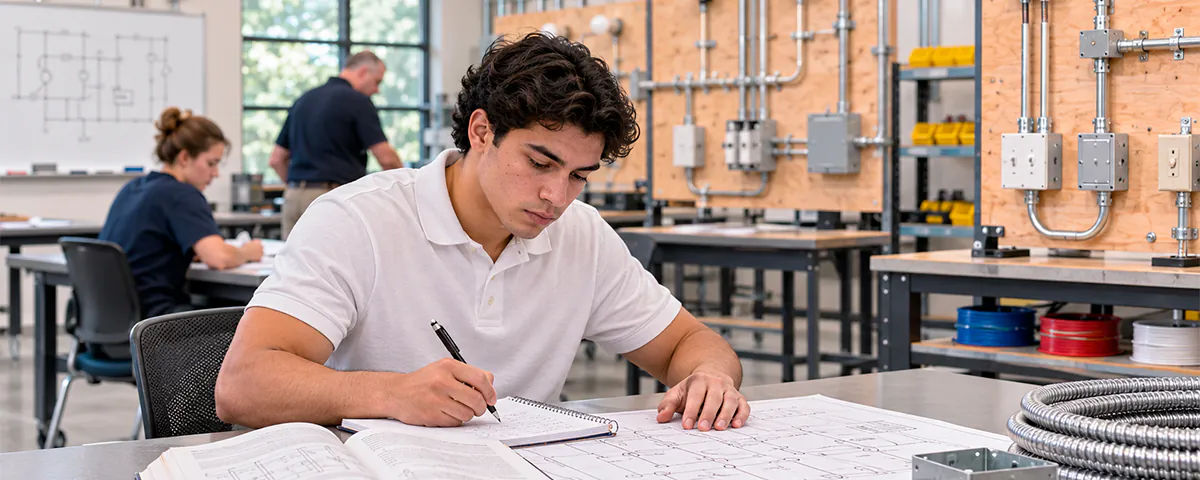
Electrician education combines classroom instruction and hands-on training. Whether you enter through an apprenticeship or a trade school program, the curriculum covers the same core subjects: electrical theory, code, math, safety, and practical skills applied on real job sites.
What Classes Do Electricians Take?
Electricians study the technical knowledge they need to install, maintain, and troubleshoot electrical systems safely. Coursework varies by apprenticeship or training program, but it commonly includes electrical principles, code requirements, construction drawings, jobsite math, safety, and the equipment used in residential, commercial, and industrial work.
According to the U.S. Department of Labor’s Registered Apprenticeship guidance, apprenticeship programs include organized instruction in the technical subjects related to the occupation. Federal regulations recommend at least 144 hours of related instruction for each year of apprenticeship, although individual programs may structure their classroom training differently.
Common areas of study include:
Electrical Fundamentals: Voltage, current, resistance, circuits, alternating current, direct current, and other principles that explain how electrical systems operate.
Code and Wiring Practices: How electrical codes apply to conductors, circuits, wiring methods, grounding, equipment, and safe installations.
Blueprints and Electrical Drawings: How to read floor plans, electrical symbols, wiring diagrams, and schematics used on construction and service jobs.
Applied Electrical Math: Arithmetic, algebra, and geometry used for measurements, circuit calculations, conduit bending, electrical loads, and other everyday tasks.
Electrical Safety: Recognizing electrical hazards, using personal protective equipment, following safe work procedures, and understanding practices such as lockout/tagout.
Electrical Systems and Equipment: Depending on the program, students may also study motors, transformers, lighting, controls, grounding and bonding, electrical services, and newer technologies such as solar power and EV charging.
Classroom training helps you understand the why behind electrical work, while supervised field experience shows you how to use that knowledge on a real job site.
The exact classes and training hours can vary depending on the apprenticeship program, the state, and the organization running the program.
What Do Electricians Learn and Study?
Electricians learn a combination of electrical theory in the classroom and practical installation skills on the job. The two reinforce each other throughout the apprenticeship, with classroom content becoming more meaningful as hands-on experience builds.
On the practical side, electricians develop skills in:
Wiring and installation: Running conduit, pulling wire, connecting circuit breakers, panels, switches, and lighting systems
Tools and testing equipment: Using multimeters, voltage detectors, conduit benders, clamp meters, and standard hand and power tools correctly and safely
Motor controls and panel work: Wiring and operating control circuits, installing breakers, and understanding how electrical panels are organized and loaded
Working in different environments: Learning how to choose and install wiring methods appropriate to the location and code requirements, including cable and raceway systems used in residential, commercial, and industrial installations.
Coordination with other trades: Learning how electrical work sequences with framing, plumbing, and HVAC on construction sites, including when rough-in happens, what clearances are required, and how inspections are scheduled
At Palmer Electric, our electricians continue learning throughout their careers. New systems, updated code cycles, and emerging technologies like EV charging and solar integration mean that the learning does not stop when the apprenticeship ends.
What Do Electricians Need to Know?
Electricians need to master electrical theory, safety principles, code knowledge, and hands-on technical skills before working independently. Beyond the classroom curriculum, there are a few foundational concepts that every electrician needs to understand deeply before touching energized equipment.
Shock severity depends on current, path, and duration
Per OSHA guidance, it is electrical current measured in amperes, not voltage itself, that causes injury. Voltage determines how much current flows through the body depending on resistance. Wet skin or a wet environment dramatically lowers the body’s resistance and increases the current that flows through it at any given voltage. Understanding this distinction changes how you think about low-voltage situations that might otherwise feel safe.
Always test, never assume
Wire colors are helpful, but you should never trust color alone to tell you whether a circuit is live. Wires can be mislabeled, swapped, or changed by previous work.
That is why electricians test before they touch. Using a multimeter or voltage tester to confirm whether a conductor is energized is one of those basic safety habits that should become automatic from day one.
The NEC is a floor, not a ceiling
The National Electrical Code, adopted by states and local jurisdictions across the U.S., sets the minimum standards for safe electrical installations. Local jurisdictions can and do adopt amendments that are stricter than the NEC. Knowing your local code as well as the base NEC is part of what separates competent electricians from those who pass inspection by the minimum margin.
Can You Become an Electrician Without Going to School?
Yes. A separate trade school or college program is not required for every electrician career path. Many people enter the trade through an apprenticeship, which combines paid, supervised jobsite experience with technical instruction. Education, work-hour, and licensing requirements vary by state and locality, so the exact path depends on where you plan to work.
How Hard Is It to Become an Electrician?
Becoming an electrician is genuinely demanding. The process requires a four- to five-year commitment, mastery of electrical theory and the NEC, physical endurance, and passing a licensing exam that tests everything you have learned. The first year of an apprenticeship is typically the hardest, combining full-time physical work with evening classroom instruction simultaneously.
That said, the path is structured and well-supported. Apprenticeship programs are designed to build your skills progressively. Each year you know more than the last, and the work becomes more manageable as your experience grows.
For a deeper look at the physical and mental demands of the job itself once you are licensed, see our guide: Is Being an Electrician Hard.
How Hard Is Electrician School?
Electrician school can be challenging because you need to learn electrical theory, code requirements, safety practices, and applied math while also developing hands-on skills. The coursework is manageable for most students who keep up with the material, practice regularly, and learn how to apply classroom concepts to real electrical work.
The math is practical rather than advanced. You will typically use arithmetic, algebra, and geometry for tasks such as load calculations, measurements, conduit bending, and circuit calculations.
The National Electrical Code can also take time to learn because electricians need to know how to navigate, interpret, and apply code requirements correctly. The goal is not to memorize the entire NEC. It is to understand how the code is organized and how to find and use the rules that apply to a particular installation.
If you are completing an apprenticeship, the challenge is also about time management. You may be working on job sites while completing technical instruction, so staying organized and keeping up with coursework matters just as much as understanding the material.
How to Become an Industrial Electrician
To become an industrial electrician, complete a high school diploma or GED, finish a registered apprenticeship or technical training program, pass your state or local licensing exam, and develop specialized knowledge in industrial systems including motor controls, programmable logic controllers (PLCs), and high-voltage equipment.
The path into industrial electrical work follows the same foundational steps as any other electrician specialization. What sets the industrial path apart is the additional technical depth required after licensing.
Here is what distinguishes the industrial electrician path:
Complete the standard apprenticeship path
The foundational steps, education, apprenticeship, and journeyman licensing are the same regardless of specialization. Industrial electricians start on the same path as residential and commercial electricians
Seek industrial experience during your apprenticeship
If you already know you want to work in industrial electrical, try to get experience in manufacturing plants, processing facilities, or heavy construction projects during your apprenticeship.
The more time you spend around industrial equipment and systems, the more comfortable you will be when it is time to move into that kind of work full time.
Develop PLC and motor controls knowledge
Programmable Logic Controllers are central to modern industrial electrical systems. Many industrial employers expect journeyman electricians to have at least foundational PLC knowledge, and many industrial electricians pursue additional training in this area after licensing.
Add safety certifications
Industrial electrical work can come with more hazards than a typical residential or commercial job, so extra safety training can really help.
Many industrial employers look for certifications like OSHA 30-Hour Construction or General Industry training. NFPA 70E training is also common because it focuses on electrical safety in the workplace, including how to work around energized equipment and reduce the risk of shock and arc flash.
Am I Too Old to Become an Electrician?
No. There is no legal or formal upper age limit for entering the electrical trade or starting an apprenticeship. People enter the trade in their 30s, 40s, and 50s regularly. According to DataUSA, a public data site that compiles U.S. government survey data, the average age of electricians in the U.S. workforce in 2024 was approximately 40 years old, which means career changers who start in their 30s are entering a workforce where their age is entirely normal.
Starting later comes with real advantages and real trade-offs worth understanding before you commit.
Is 25 Too Old to Become an Electrician?
No. At 25, you still have a 40-year career ahead of you before standard retirement age. Many contractors value the work habits, communication skills, and reliability that older apprentices often bring. Starting at 25 is not late. For many people, it is the right time.
Is 30 Too Old to Become an Electrician?
No. Starting at 30 still gives you 30 to 35 working years in the trade. The average electrician in the U.S. workforce is approximately 40 years old, according to DataUSA. The trade-off is accepting apprentice-level compensation for four to five years. That requires financial planning, but it is manageable for most people who make the commitment deliberately.
Is 40 Too Old to Become an Electrician?
No, though starting at 40 requires an honest assessment of a few realities. The physical demands of the trade are genuine. Apprenticeships require several years of full-time physical work, and recovery from physical labor can take longer as you get older. You will also spend those first years working under supervisors and journeymen who may be younger than you, which requires patience and a genuine willingness to start over.
Starting later can actually work in your favor in some ways. Contractors often appreciate older apprentices because they tend to bring maturity, reliability, and a strong work ethic to the job.
Even if you start at 40, you can still build a long career in the trade. And as you gain experience, you do not have to stay in the most physically demanding roles forever. Over time, you may move into commercial service, estimating, inspection, supervision, or project management.
How to get started as an electrician FAQs
These are the most common questions people ask when they are researching how to enter the electrical trade.
How to Become an Electrician Apprentice?
To become an electrician apprentice, you need a high school diploma or GED, a valid driver’s license, and a completed application to a registered union or non-union apprenticeship program. Most programs require passing a basic aptitude test covering reading comprehension and algebra before acceptance. The U.S. Department of Labor’s apprenticeship finder at apprenticeship.gov lists registered programs by location and trade.
How Long Does It Take to Become an Electrician?
It typically takes four to five years to become a licensed journeyman electrician through a registered apprenticeship, combining approximately 8,000 to 10,000 hours of on-the-job training with classroom instruction, often at least 144 hours per year. Attending trade school first adds six months to two years before the apprenticeship begins.
What License Do Electricians Need?
Most states require electricians to be licensed, although the credential name and requirements vary by state and locality. The license typically requires completing an apprenticeship or documented work experience and passing an exam based on the National Electrical Code. Requirements vary by state and local jurisdiction. Some states also offer residential-only or specialty licenses with narrower scope and different hour requirements.
What Is Required to Become an Electrician?
To become an electrician, you need a high school diploma or GED, completion of a registered apprenticeship combining on-the-job training with classroom instruction, and a passing score on your state or local licensing exam. Many programs also require a valid driver’s license, a drug screening, and proof of legal work authorization before enrollment.
How to Get Into Electrical Work?
Start by meeting the basic requirements: a high school diploma or GED, a valid driver’s license, and basic algebra skills. Then apply to a registered apprenticeship program through apprenticeship.gov, the IBEW, IEC, or ABC. If you cannot get into a formal program immediately, contact local electrical contractors about entry-level helper or laborer positions to start building experience while your application is pending.
Do Electricians Need a College Degree?
No. A college degree is not required to become an electrician anywhere in the United States. What matters is meeting the training and licensing requirements in the state or locality where you plan to work, earned through a registered apprenticeship and a licensing exam. Some candidates attend a community college or trade school program first, which can count toward apprenticeship hour requirements in some states. Military veterans with electrical training from branches like the Navy or Air Force can sometimes apply that experience toward apprenticeship hour requirements, accelerating the path to licensure.
Conclusion
Becoming an electrician takes time, but the process is pretty straightforward once you know what to expect. You start by learning the basics, get hands-on experience on real job sites, and gradually take on more responsibility as your skills grow.
You are also not expected to figure it all out by yourself. Apprenticeship programs, experienced electricians, employers, and licensing authorities all help guide you along the way.
Yes, four to five years is a real commitment. But during that time, you are earning a paycheck, learning skills that are needed across all kinds of industries, and building toward a career with room to grow.
At Palmer Electric, we have been hiring, training, and working alongside electricians in Central Florida since 1951. The people who do well in this trade are the ones who show up, take safety seriously, and keep learning. If that sounds like you, there is a clear path forward.

Need a Licensed Electrician in Central Florida?
If you need a licensed electrician for your home or business in the Orlando area, Palmer Electric is ready to help. Our licensed and insured team has been serving Central Florida since 1951. Contact Palmer Electric today or call 407.646.8700 for a free estimate.
References
- U.S. Bureau of Labor Statistics, Occupational Outlook Handbook: Electricians, updated 2026: https://www.bls.gov/ooh/construction-and-extraction/electricians.htm
- U.S. Bureau of Labor Statistics, Employment Projections: Electricians by Industry, 2025-2035: https://data.bls.gov/projections/nationalMatrix?queryParams=47-2111&ioType=o
- U.S. Department of Labor, Apprenticeship Job Finder: https://www.apprenticeship.gov/apprenticeship-job-finder
- International Brotherhood of Electrical Workers (IBEW): https://www.ibew.org
- Independent Electrical Contractors (IEC): https://www.ieci.org
- Associated Builders and Contractors (ABC): https://www.abc.org
- Electrical Training Alliance, Joint Apprenticeship Program of NECA and IBEW: https://www.electricaltrainingalliance.org
- OSHA, Controlling Electrical Hazards (OSHA 3075): https://obis.osha.gov/Publications/3075.html
- DataUSA, Electricians Workforce Demographics 2024: https://datausa.io/profile/soc/electricians
- U.S. Department of Labor, 29 CFR 29.5, Standards of Apprenticeship (eCFR): https://www.ecfr.gov/current/title-29/subtitle-A/part-29/section-29.5
- OSHA, Standard Interpretation on Normal Color Vision and Electricians, January 29, 2004: https://www.osha.gov/laws-regs/standardinterpretations/2004-01-29-0
- Electrical Training Alliance, Apprenticeship Training: https://www.electricaltrainingalliance.org/training/apprenticeshipTraining
- Laws of Florida, Chapter 2021-214 (s. 489.5335, F.S., journeyman licenses issued by counties and municipalities): https://laws.flrules.org/2021/214