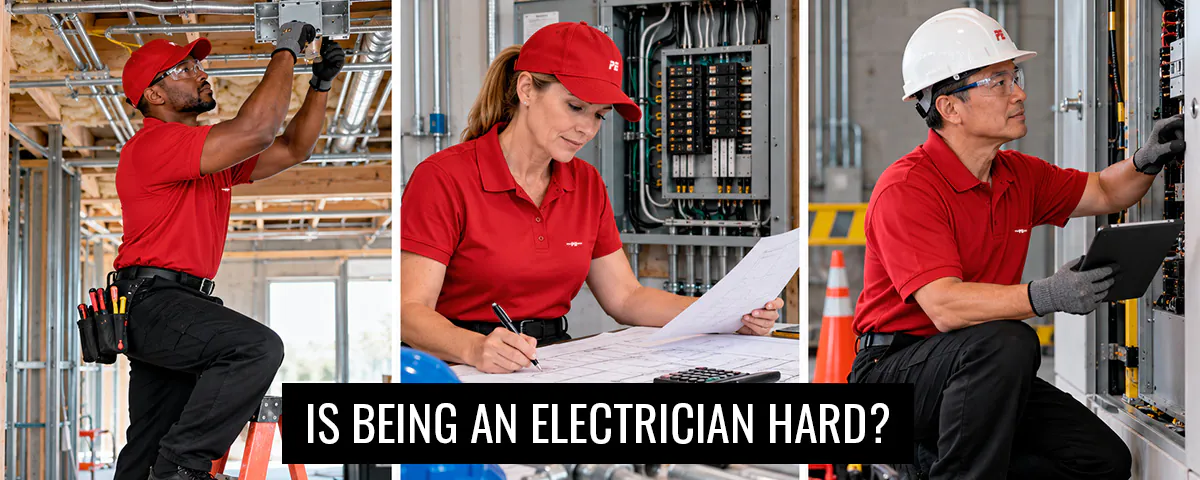
Yes, being an electrician is hard work. The job is physically demanding, technically challenging, and involves safety risks. Electricians may lift heavy materials, work in tight or uncomfortable spaces, read blueprints, perform electrical calculations, and follow detailed electrical codes and safety procedures. However, the work also comes with career benefits and becomes more manageable as your training, skills, and experience grow.
From the start, the electrical trade asks a lot of you. The first year of an apprenticeship can feel overwhelming. The physical demands are real, the learning curve can be steep, and there is a lot to take in when you are brand new to the job.
But there is another side to that challenge: skilled electricians are in strong demand. As AI and automation continue changing the way many office and technology jobs are done, electrical work still depends on trained people who can show up on site, troubleshoot real equipment, install wiring, and make safe decisions in the field. In fact, the U.S. Bureau of Labor Statistics projects about 72,700 electrician openings each year on average from 2025 to 2035.
Most electricians who stick with it will tell you that the difficulty is part of what makes the trade worth it. The career path is clear, the skills are useful almost everywhere, and there is a real sense of accomplishment that comes from finishing work people depend on for their safety and comfort.
At Palmer Electric, we have been in this trade since 1951. We have watched apprentices come through our doors with very little experience and grow into some of the most skilled electricians in Central Florida. The challenges are real, but so are the opportunities and the rewards.
If you want to understand what electricians actually do before diving into how hard the work is, start here: What Do Electricians Do.
Key Takeaways
- Being an electrician is physically demanding, involving heavy lifting, working in tight spaces, and long hours on your feet
- The mental challenge is equally real, requiring code knowledge, complex math, blueprint reading, and high-stakes troubleshooting
- Electrician school covers electrical theory, the NEC, blueprint reading, and hands-on lab work. The math involved is at an algebra level, not calculus, which surprises a lot of people who assumed it would be harder.
- No single year of an apprenticeship is easy, but each brings different challenges: year one is hardest physically and financially as you adjust to trade work and night school simultaneously, year two introduces the most demanding academic content, and the final year brings certification pressure and the responsibility of working more independently
- Long-term body wear is a real consideration; knees, back, and joints take the most strain over a career
- The difficulty decreases as skills develop. By the third and fourth year of an apprenticeship, electricians are applying accumulated knowledge rather than learning everything from scratch, which makes both the physical and technical demands more manageable.
- Electrician employment is projected to grow 9 percent from 2025 to 2035, according to the U.S. Bureau of Labor Statistics, the federal agency that tracks employment data across all industries
Is Being an Electrician Hard Overview
| Dimension | Difficulty Level | What Makes It Hard | What Makes It Manageable |
|---|---|---|---|
| Physical Demands | High | Lifting, climbing, crawling, overhead work, and working in tight spaces | Proper technique, better tools, and experience make many tasks easier over time |
| Mental and Technical | High | NEC requirements, troubleshooting, load calculations, and blueprint reading | Skills are taught progressively and reinforced through hands-on work |
| Math Requirements | Moderate | Algebra, load calculations, voltage drop, and circuit calculations | The math is practical, and most concepts become easier with repeated use on real jobs |
| Electrician School | Moderate | Learning electrical theory and code while also completing hands-on training | Structured coursework breaks the material into manageable stages |
| Apprenticeship First Year | High to Very High | Adjusting to physical work, entry-level tasks, classroom training, and a lower starting wage | Skills, confidence, and pay typically increase as the apprenticeship progresses |
| Long-Term Body Impact | Moderate to High | Years of kneeling, lifting, reaching overhead, and working in awkward positions | Ergonomic habits, proper lifting, protective equipment, and conditioning can reduce strain |
| Stress and Safety Pressure | Moderate to High | Electrical hazards, code compliance, troubleshooting, and responsibility for safe work | Training, established safety procedures, supervision, and experience help electricians manage the pressure |
| Learning Curve Overall | High at First | New tools, terminology, code requirements, job-site expectations, and increasing responsibility | Each year builds on the last, so tasks that feel difficult early on usually become more familiar with experience |
How Hard Is It To Be An Electrician?
The difficulty of being an electrician depends on where you are in your career. The apprenticeship years are the hardest overall, combining full-time physical work with evening classroom instruction. The journeyman stage brings more independence and technical complexity. At the master level, physical demands may ease, but project responsibility increases significantly.
As an apprentice
The combination of full-time physical work and evening classroom instruction is the most demanding stage. You are learning everything from scratch while doing it simultaneously.
As a journeyman
The physical demands are consistent, but the technical complexity increases as you take on more independent responsibility and more complex systems. To understand what the journeyman stage involves, see: What Is a Journeyman Electrician
As a master electrician
The hands-on physical work may decrease, but the responsibility for design, code compliance, project management, and crew oversight increases significantly. In most states, reaching this level also opens the path to operating your own electrical contracting business. For a full look at what that level involves, see: What Is a Master Electrician?
Understanding which type of hard you are asking about helps set realistic expectations for anyone considering the trade. The sections below break each dimension down separately. For a full overview of how electricians progress through each stage, see: Electrician Levels Explained.
Is Being an Electrician Physically Demanding?
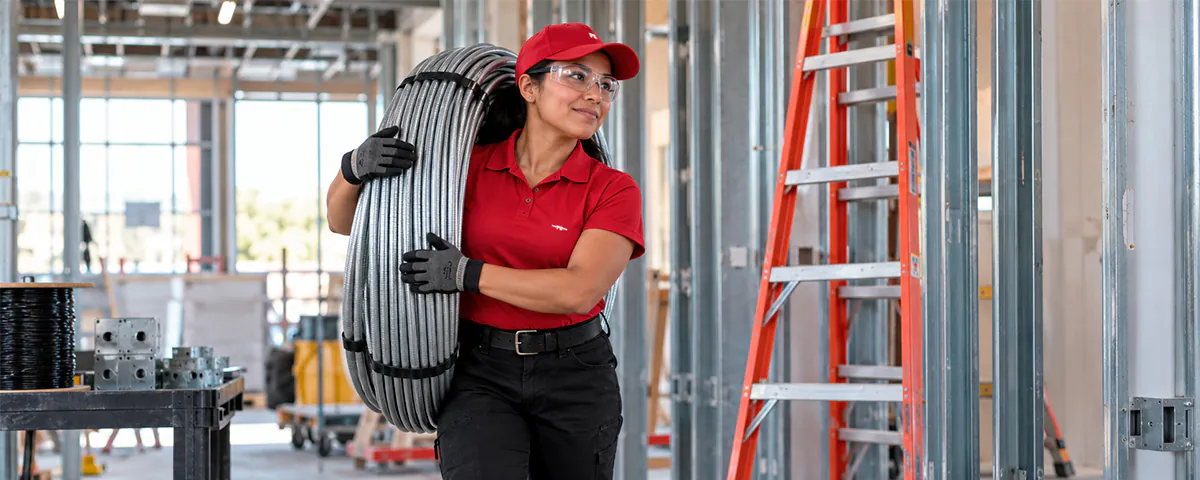
Yes, electrical work is physically demanding. Electricians lift heavy materials, work in confined and awkward spaces, stand for extended periods on hard surfaces, operate power tools, and regularly work at heights. The work also carries inherent safety risks. Electricians work around energized systems where contact with live voltage can cause serious injury or death. According to OSHA, the federal agency responsible for workplace safety standards, electrocution accounts for approximately 8.4 percent of all construction fatalities and is identified as one of the Fatal Four, the four leading causes of death in the construction industry. Proper training, safety protocols, and protective equipment are what keep those risks manageable on the job.
One day you might spend hours pulling wire in a finished commercial space. The next you are in a construction site attic in summer heat, drilling through concrete, or maneuvering conduit in a crawlspace that was not designed for human comfort. The variety is part of what makes the trade interesting, and part of what makes it physically demanding.
What the Physical Work Actually Looks Like
The physical side of electrical work can look a little different depending on the job. A residential service call is not the same as working on a commercial site or inside an industrial facility. Still, there are a few physical demands that electricians deal with pretty regularly:
Lifting and carrying
Electrical work involves plenty of lifting and carrying. Wire spools, conduit, panels, ladders, and tool bags can all get heavy fast.
For example, a 250-foot spool of 12-gauge wire weighs around 22 pounds, and a 200-amp electrical panel can weigh 30 to 50 pounds or more. Now imagine moving that kind of equipment around a job site several times a day. It is just part of the physical side of the trade.
Working in confined and awkward spaces
Attics, crawlspaces, inside finished walls, above drop ceilings, and inside electrical panels are all standard work environments. These spaces require crouching, kneeling, lying flat, or holding arms overhead for extended periods.
Standing and moving for extended hours
Most electrical work does not happen at a desk. Electricians are on their feet and moving for the majority of the workday, often on concrete floors or uneven construction site surfaces.
Working at heights
Ladders and aerial lifts are standard equipment on commercial and industrial job sites. Per the U.S. Bureau of Labor Statistics, working at heights is a regular part of the job for many electricians, particularly in construction and industrial settings.
You can see just how important this type of equipment becomes after a major storm. Following Hurricane Michael in October 2018, Duke Energy documented bucket trucks lining Highway 98 near St. Joe Beach and Mexico Beach as utility crews rebuilt damaged electrical infrastructure across Florida’s Panhandle. The restoration involved about 460,000 feet of cable and wire and 1,200 poles. It is a good real-world example of how electrical workers use aerial equipment to reach overhead power systems when major repairs are needed.
Tool and equipment operation
Drilling through concrete, bending heavy conduit, pulling wire through long runs, and operating power tools throughout the day all add to the cumulative physical load.
At Palmer Electric, our electricians work across residential and commercial settings in Central Florida. The physical demands vary by project, but the combination of lifting, confined space work, and time on your feet is consistent across virtually every job we take on. The work is demanding, but it is also skilled. That combination is part of why experienced electricians are well compensated and consistently in demand.
How Does Being an Electrician Compare to Other Trades
Electrical work sits in the middle range of physical demands compared to other skilled construction trades.
| Trade | Primary Physical Demands | Fatality Risk Level | Key Hazard |
|---|---|---|---|
| Electrician | Lifting, confined spaces, overhead work, heights | Moderate, electrocution is 8.4% of construction fatalities | Energized systems, arc flash, falls |
| Plumber | Similar to electrician, more trenching and heavy pipe work | Moderate | Confined spaces, trenching collapses |
| HVAC Technician | Lifting heavy equipment, rooftop work, confined spaces | Moderate | Falls from rooftops, refrigerant exposure |
| Carpenter and Framer | Heavy lifting, repetitive motion, outdoor exposure | Moderate to High | Falls, struck-by incidents |
| Ironworker | Heavy steel, significant heights, extreme physical output | High | Falls, struck-by, extreme loads |
| Roofer | Repetitive motion, heat exposure, significant heights | High, highest fall fatality rate in construction | Falls, heat illness |
| Lineworker | Heights, outdoor exposure, heavy equipment, high voltage | Very High | Electrocution, falls from utility poles |
The table reflects key physical characteristics of each trade based on BLS occupational profiles and CPWR construction safety data.
Construction is tough work, and safety has to be taken seriously. According to CPWR, the construction industry accounts for nearly one in five workplace deaths each year.
For electricians, one of the biggest concerns is electrocution. Electricians may have lower overall fatality rates than some trades, like roofers or ironworkers, but working around energized systems comes with a different kind of risk. One wrong move can have immediate consequences. That is why electricians spend so much time learning safe work practices, testing equipment, and following proper procedures before they touch anything.
For a deeper look at where electricians work and the environments they face daily, see our guide: Where Do Electricians Work.
Is Being an Electrician Hard on Your Body?
Electrical work does put real strain on the body over time, particularly on the joints, back, and hands. The specific impact depends on the type of work, the settings an electrician works in, and the habits they develop over the course of their career.
Common Physical Strains and Long-Term Risks
Like any job that is physically demanding, electrical work can put wear and tear on your body over the years. But many of those strains can be managed with the right habits.
Regular stretching, active breaks, proper lifting technique, and exercises that strengthen the muscles electricians use most can help reduce that buildup of strain over time. That is also why many unions and electrical contractors include ergonomics and injury prevention in their safety programs.
Here are the areas of the body that take the most consistent strain in electrical work:
Knees
Electricians spend a lot of time on their knees, whether that is on concrete floors, inside crawlspaces, or on uneven surfaces. After years of doing that, it can lead to knee pain, inflammation, and sometimes joint damage.
Knee pads definitely help, and they are a standard part of the job. But they only reduce the impact. They do not completely take the strain off your knees.
Back and spine
Lifting heavy materials, working in bent or twisted positions, and spending long hours on hard surfaces all affect the back. Lower back strain is among the most commonly reported physical complaints in the construction trades broadly, according to OSHA’s ergonomics guidance for construction workers.
Shoulders and arms
Electricians spend a lot of time working overhead, especially when running conduit, pulling wire through ceilings, or installing light fixtures. Holding your arms up for long periods can put a lot of strain on the shoulders and rotator cuff over time.
Hands and wrists
Your hands do a lot of the work in this trade. Electricians are constantly gripping tools, pulling wire, twisting, cutting, and making connections. After years of repeating those same motions, your hands and wrists can start to feel the strain. If you do a lot of repetitive wiring, that can also raise the risk of problems like carpal tunnel syndrome.
Hearing
Industrial electricians can spend a lot of time around loud machinery and equipment. Over the years, that kind of noise can damage your hearing if the right protection is not used consistently.
OSHA takes that risk seriously. Under standard 29 CFR 1910.95, employers must have a hearing conservation program when workers are exposed to an average of 85 decibels or more over an 8-hour workday. That includes monitoring noise levels, providing hearing tests, and making hearing protection available.
At Palmer Electric, protecting our employees is a big part of how we approach the job. Electrical work is physical, so we encourage safe work habits that help reduce unnecessary strain and injuries. That means using the right protective equipment, getting help when moving heavy panels or materials, and taking the time to do physically demanding tasks the right way.
For us, safety is not just about avoiding electrical hazards. It is also about helping our electricians protect their bodies so they can work safely, stay healthy, and build long careers in the trade.
Can You Work as an Electrician Long-Term?
Yes, many electricians work productively well into their 50s and 60s. The key factors that support longevity in the trade are developing good body mechanics early, using the right protective equipment consistently, and making smart choices about the type of work you take on as you accumulate experience.
As electricians build experience, a lot of them eventually move into jobs that are a little less physical. Instead of spending the whole day climbing ladders, carrying materials, and squeezing into tight spaces, they may start supervising crews, estimating projects, or managing jobs.
It is a natural progression in the trade. As you move from journeyman to master electrician, and sometimes into contracting, more of your day can shift toward planning jobs, guiding crews, solving problems, and making sure the work stays on track.
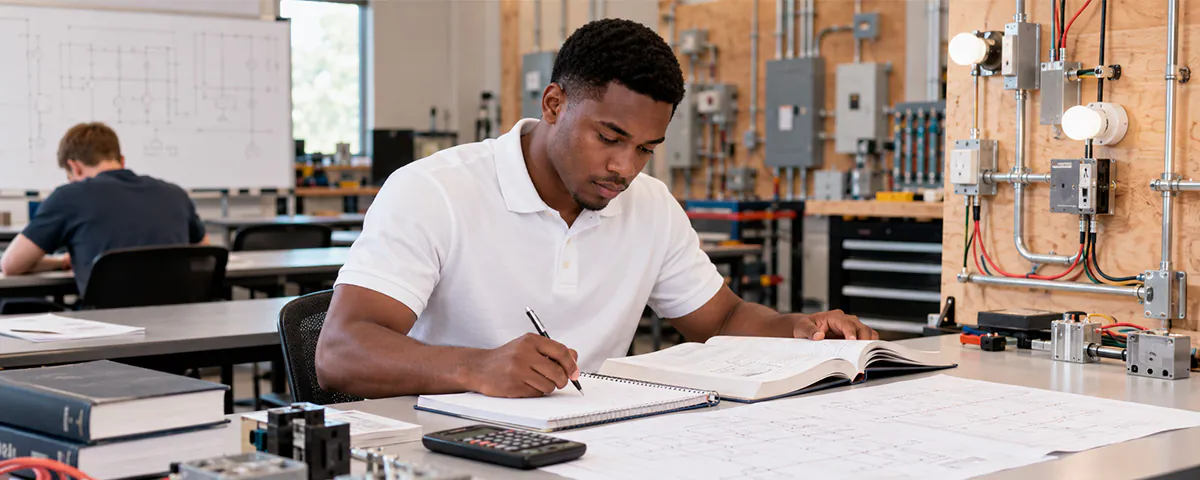
Is Electrician School Hard?
Electrician school is moderately challenging, but manageable for most students. You learn electrical theory, the National Electrical Code (NEC), blueprint reading, algebra-level math, and hands-on electrical skills. The material can feel difficult at first, but it usually becomes easier as you apply what you learn to real electrical work.
The academic content starts with foundational concepts and advances to more complex material as your hands-on experience grows alongside it. Here is what the curriculum actually covers.
What You Actually Study
Electrician school, whether through a registered apprenticeship program or a trade school, covers a core set of subjects that every electrician needs to know before working independently:
Electrical Theory
How electricity works, basic circuit principles, Ohm’s Law, voltage, current, resistance, and how these concepts apply to real installations. This is the foundation everything else builds on.
The National Electrical Code (NEC)
The National Electrical Code, or NEC, is the main standard electricians follow for electrical installations across the United States. It is published by the National Fire Protection Association, better known as the NFPA.
A big part of electrician training is learning how to actually use the NEC, not just memorize it. Electricians need to know how to find the right rule, understand what it means, and apply it correctly on a real job site.
Blueprint Reading
Blueprint reading is all about learning how to make sense of electrical drawings, wiring diagrams, and construction plans. At first, all those symbols can look a little intimidating. But once you learn what they mean and how the drawings are organized, it gets much easier to follow.
Math
Electricians use math regularly, but it is mostly practical math connected to the work. You will use algebra for electrical calculations, basic geometry and trigonometry for measurements and conduit work, and basic electrical formulas to calculate things like voltage, current, resistance, and loads.ther.
It is not advanced calculus, and the math often becomes easier once you see how it applies to real electrical work. If math was not your strongest subject in high school, that does not mean electrician training is out of reach.
Safety and Code Compliance
OSHA standards, lockout/tagout procedures, personal protective equipment requirements, and hazard recognition. Safety training is woven throughout the curriculum, not treated as a separate subject.
Hands-On Lab Work
Most electrician programs include lab sessions where you actually practice the skills you have been learning about instead of just reading about them.
Wiring Methods: Learning how to install wiring correctly in residential, commercial, and industrial settings using approved materials and methods.
Conduit Bending: Learning how to measure and bend EMT or rigid conduit so it lines up and fits the job the way it should.
Motor Controls: Getting hands-on practice wiring motors and the control circuits that run them, especially for commercial and industrial jobs.
Panel Work: Learning how breakers, panels, and service equipment are wired and put together.
Troubleshooting: Figuring out what went wrong in a circuit and using test tools to track down the problem.
Testing Equipment: Getting comfortable using multimeters, voltage testers, and clamp meters safely and correctly.
Is an Electrical Apprenticeship Difficult
Yes, an electrical apprenticeship can be challenging. Apprentices balance hands-on physical work with classroom instruction in electrical theory, math, code, and safety. Most programs last several years, but the training builds progressively, so the work usually becomes more manageable as your skills, experience, and confidence grow.
The difficulty shifts in type and intensity as you progress through the program. Here is what each stage actually looks like.
What Makes the First Year the Hardest
The first year demands the most adjustment. Most apprenticeship programs require evening classroom instruction three to four nights per week on top of a full day of physical work on the job site. According to the Electrical Training Alliance, the joint apprenticeship program of NECA and IBEW, first-year apprentices are introduced to foundational concepts while performing support tasks on active job sites. The combination of an unfamiliar physical environment, new academic material, and a demanding schedule is what makes year one the steepest part of the learning curve for most people.
How It Gets Easier as You Progress
An apprenticeship is built step by step. You start with the basics, then add new skills as you get more comfortable in the field. What feels difficult in your first year usually gets a lot easier once you have some real experience behind you.
Here is what that progression usually looks like in practice:
Year one
Focus on showing up consistently and building physical stamina. The technical knowledge comes with time. Your job in year one is to absorb as much as you can while developing the work habits that will carry you through the rest of the program
Year two
Lean into the academic side. AC theory and electrical math are challenging, but they are also the concepts that separate competent electricians from great ones. The investment pays off in every job you take on after
Years three and four
This is where the trade starts to feel like yours. You are applying real skills on real projects. Take on as much variety as you can and ask questions of every journeyman and master electrician around you
Final year
Treat the certification pressure as preparation, not punishment. The exam tests what you have spent years learning. Most candidates who study consistently pass on the first attempt
By the time most apprentices reach journeyman status, the hardest part is behind them. The credential is earned, the foundation is solid, and the real career begins. For a full look at what comes next, see our guide: What Is a Journeyman Electrician.
What Is the Hardest Part of Being an Electrician?
The hardest part of being an electrician is balancing technical problem-solving, physical demands, and serious safety responsibilities at the same time. Electricians often troubleshoot complex problems while working in tight spaces, at heights, or around electrical hazards, and the work still needs to be accurate, safe, and up to code.
Specifically, the most consistently challenging aspects electricians cite are:
High-stakes troubleshooting
Diagnosing faults in complex electrical systems requires systematic thinking, patience, and deep code knowledge. Unlike many trades where a mistake is visible and easily corrected, an electrical fault can be hidden inside a wall, intermittent, or the result of multiple interacting problems. Getting it wrong has consequences.
Code compliance under pressure
Electrical code is something electricians have to keep up with throughout their careers. The NEC is updated every three years, and local jurisdictions may adopt changes on their own timelines.
The challenge is staying current while still keeping active projects moving. On a busy job site, electricians need to make quick decisions without cutting corners on code or safety. That responsibility does not really go away, no matter how much experience you have.
Working under client and project pressure
Whether it is a homeowner waiting for power to be restored or a general contractor holding a construction timeline, electricians regularly work under the direct pressure of people who need the job done correctly and on time. That accountability is part of the job on every project.
Is Being an Electrician Stressful?
Yes, being an electrician can be stressful, but the level of stress depends on the type of work, job site, and level of responsibility. Tight deadlines, troubleshooting difficult problems, safety risks, and coordinating with customers or other trades can all add pressure, especially on complex commercial or service jobs.
The primary sources of stress are:
Working in other people’s spaces
Residential electricians often work inside someone’s home while the homeowner or family is there. That means you are not just focused on the electrical work. You also need to communicate clearly, protect the property, answer questions, and stay professional while getting the job done.
Safety responsibility
Electrical work comes with serious safety responsibilities. Electricians need to stay focused around energized equipment, follow proper safety procedures, and make sure the finished work is safe for the people who will use it. That level of responsibility can add pressure, especially when troubleshooting complicated problems.
Tight deadlines and emergency work
Not every electrical job happens on a relaxed schedule. Construction projects have deadlines, businesses may need power restored quickly, and emergency service calls can come in when customers need help right away. The challenge is working efficiently without rushing the safety or quality of the job.
Permit coordination and inspection timelines
Permits and inspections can add another layer of stress. Electricians may need to coordinate with local authorities, schedule inspections, and make sure the work is ready when the inspector arrives. If an inspection gets delayed, the whole project can be held up even when the electrical work itself is finished.
Physical fatigue accumulating over long projects
Electrical work is physical, and that fatigue can build up over a long project. Weeks of climbing, lifting, bending, working overhead, or spending time in tight spaces can wear you down. The challenge is staying sharp, working safely, and maintaining the same quality even late in the project.
Keeping up with changing technology
The trade keeps changing too. Electricians may need to learn new equipment and systems, including EV chargers, generators, solar equipment, smart home technology, and newer electrical controls. Keeping those skills current is part of the job.
More responsibility as your career advances
Stress can also change as you move up in the trade. Foremen, supervisors, master electricians, and electrical contractors may spend less time doing physical work, but they take on more responsibility for crews, schedules, inspections, budgets, and the quality of the finished job.
What helps make the stress manageable is that electrical work is very task-focused. You usually have a clear problem to solve or a specific installation to complete, and you can see the result when the work is finished. For many electricians, that hands-on problem-solving and sense of accomplishment are a big part of what makes the pressure worthwhile.
How a Supportive Work Environment Helps Reduce Stress
A good work environment can make a big difference in how electricians handle the pressure of the job. Clear communication, regular training, strong safety procedures, and knowing you can ask for help all take some of the uncertainty out of difficult situations.
At Palmer Electric, we put a lot of emphasis on training, safety, and supporting our electricians in the field. When employees know the right procedures, have experienced people they can turn to, and are not expected to figure everything out alone, stressful jobs become much more manageable.
That does not remove every challenge from the trade, but it gives electricians a stronger foundation for handling those challenges safely and confidently.
Is It Hard to Become an Electrician?
Yes, becoming an electrician can be challenging. The path usually involves several years of apprenticeship training that combines hands-on electrical work with classroom instruction in electrical theory, math, code, and safety. The training is demanding, but it follows a structured path that builds your skills and responsibilities over time.
You are also not expected to figure everything out on your own. Apprenticeship programs are designed to guide you step by step, with experienced electricians there to teach you, answer questions, and help you build confidence as your skills grow.
Is Being an Electrician Worth It Despite the Challenges?
For most people who complete the apprenticeship and earn their journeyman credential, the answer is yes. The electrical trade offers strong job stability, a clear advancement path, and work that directly affects the safety and function of the buildings people live and work in every day.
According to the U.S. Bureau of Labor Statistics, electrician employment is projected to grow 9 percent from 2025 to 2035, much faster than the average for all occupations, with approximately 72,700 openings per year over the decade. The demand for skilled electricians is not a short-term trend. It is structural, driven by infrastructure investment, renewable energy expansion, AI data center construction, and the ongoing need to maintain and upgrade the electrical systems that power modern life.
At Palmer Electric, we have seen what a career in the electrical trade can look like over the long term. The electricians who joined our team as apprentices and grew into journeymen and master electricians built real careers with real stability.
Before committing to an apprenticeship, ask yourself a few practical questions:
| Question | If Yes | If No |
|---|---|---|
| Are you comfortable working with your hands and doing physically demanding work? | You may be a good fit for the hands-on side of the trade | Consider whether you are willing to build the strength, stamina, and work habits the job requires |
| Can you handle working in tight, hot, or uncomfortable spaces? | You may adapt well to many residential and commercial job sites | Think about how comfortable you would be in attics, crawlspaces, or other confined areas when the job requires it |
| Can you follow strict safety procedures and stay focused around electrical hazards? | That mindset is essential in the electrical trade | Safety has to come first, so this is something you would need to become comfortable with through training |
| Do you enjoy figuring out why something is not working and solving problems step by step? | Troubleshooting may be one of the parts of the trade you enjoy most | Keep in mind that problem-solving becomes a bigger part of the job as your experience grows |
| Are you willing to spend several years learning through both hands-on work and classroom instruction? | You are prepared for the long-term commitment an apprenticeship requires | Consider whether a multi-year training path fits your career goals before you start |
| Do you want a career where you can keep adding skills and taking on more responsibility? | The electrical trade offers several paths for long-term growth | Think about whether you want a trade where continued learning remains part of the job throughout your career |
At Palmer Electric, we have been hiring, training, and working alongside electricians since 1951. Over the years, we have seen that the people who do well in this trade are not always the ones who found it easy at the beginning.
They are usually the ones who respected the work, took their training seriously, and kept building their skills over time. The trade is challenging, but that is also part of what gives the credential real value. If you are wondering whether the effort is worth it, you are already asking the right kind of question.
Is Being an Electrician Hard FAQs
Is Being an Electrician Hard?
Yes, being an electrician is hard work. The job is physically demanding, technically challenging, and involves real safety risks. Electricians work in confined spaces, lift heavy materials, follow detailed electrical codes, and make decisions where mistakes can have serious consequences. However, the work becomes more manageable as skills and experience build, and the trade offers strong career stability and advancement opportunities for those who commit to it.
Is Electrician Hard to Learn?
Learning to be an electrician is challenging because it requires hands-on physical labor, technical math, and safety rules. The trade takes time to learn, but it is not beyond reach for most people who commit to the apprenticeship process. The academic content, electrical theory, the NEC, and algebra-level math, is challenging but build progressively. Most apprentices find the material becomes more approachable once they can connect it to real work on the job site.
Is It Easy to Become an Electrician?
No, becoming an electrician is usually challenging and demanding, but if the path is clear and well supported, most people can do it. Becoming a licensed electrician requires completing a four- to five-year apprenticeship, accumulating thousands of hours of documented on-the-job training, and passing a licensing exam. It is a significant commitment, but one that comes with structured support through apprenticeship programs rather than requiring you to figure it out independently.
Is Being an Electrician Harder Than Plumbing?
Both trades are physically demanding and require significant technical training. Plumbing can be more physically demanding in some jobs, while electrical work often involves more technical troubleshooting and a higher immediate risk from energized systems. Both require years of training, physical stamina, and problem-solving, so which one feels harder usually depends on your skills and the type of work you prefer.
Does Being an Electrician Get Easier Over Time?
Yes, being an electrician usually gets easier with experience. As you build strength, learn the tools, understand electrical systems, and improve your troubleshooting skills, many tasks become more familiar and efficient. The job can still be demanding, but you are better prepared to handle both the physical and technical challenges.
Is Being an Electrician Hard on Your Knees and Back?
Yes, electrical work can put strain on your knees and back over time. Electricians often kneel, lift materials, climb ladders, and work in awkward positions. Knee pads, proper lifting technique, good body mechanics, and regular exercise can help reduce some of that long-term wear and tear.
Conclusion
Being an electrician is hard work. The job can be physically demanding, the technical side takes years to learn, and safety is part of every project. That is simply the reality of the trade.
At Palmer Electric, we have been working alongside electricians in Central Florida since 1951, and we know how much skill, judgment, and commitment this work takes. Safe, reliable electrical systems do not happen by accident. They depend on trained people who know how to do the job correctly and take responsibility for the work they leave behind.
If you are thinking about becoming an electrician, go into it knowing that the trade will challenge you. But it also gives you the chance to build valuable skills, keep growing throughout your career, and do work that people depend on every day.
Need an Electrician for Your Home or Business?
Whether you need an electrical repair, upgrade, new installation, or help with an unexpected problem, Palmer Electric is here to help. Our experienced electricians provide safe, reliable electrical service for homes and businesses throughout Central Florida.
Contact Palmer Electric by filling out a contact form or calling 407.646.8700 to schedule service.
References
- U.S. Bureau of Labor Statistics, Occupational Outlook Handbook: Electricians, updated 2026: https://www.bls.gov/ooh/construction-and-extraction/electricians.htm
- OSHA, Top Four Construction Hazards, Fatal Four: https://www.osha.gov/sites/default/files/publications/CONSTRUCTION_HAZARDS_QC.pdf
- OSHA, Occupational Noise Exposure, 29 CFR 1910.95: https://www.osha.gov/laws-regs/regulations/standardnumber/1910/1910.95
- OSHA, Electrical Safety Standards, 29 CFR 1910.303: https://www.osha.gov/laws-regs/regulations/standardnumber/1910/1910.303
- Electrical Training Alliance, Apprenticeship Program Overview: https://www.electricaltrainingalliance.org
- CPWR, The Center for Construction Research and Training, Focus Four Injuries: https://www.cpwr.com/research/data-center/the-construction-chart-book/interactive-7th/injuries-illnesses-health/focus-four/
- Duke Energy, From Lineworkers to Logistics, Restoration Requires an Army, October 31, 2018: https://illumination.duke-energy.com/articles/from-lineworkers-to-logistics-restoration-requires-an-army
- OSHA, Aerial Lifts: https://www.osha.gov/etools/scaffolding/aerial-lifts