To become an electrician in Florida, you need a high school diploma or GED, completion of a four- to five-year apprenticeship with approximately 8,000 hours of on-the-job training, and a passing score on your local or state licensing exam. Florida does not issue a statewide journeyman license. Journeyman and master credentials are handled at the county or municipal level, while contractor licenses are issued statewide by the Florida Department of Business and Professional Regulation (DBPR).
Thinking about becoming an electrician in Florida? The licensing process works a little differently here. Florida does not have a statewide journeyman electrician license. Instead, journeyman requirements are handled locally, while electrical contractor licenses are regulated by the state. This guide walks you through each career stage, from training and apprenticeships to becoming a journeyman, master electrician, or licensed electrical contractor.
At Palmer Electric, we have been hiring and working alongside licensed electricians in Central Florida since 1951. We understand Florida’s licensing structure from the inside, and we know how much it matters to get the credentials right before you start working.
For the full national framework of how the electrical trade works, including apprenticeship programs, hour requirements, and general licensing steps, see our guide: How to Become an Electrician.
Key Takeaways
- Florida does not issue a statewide journeyman electrician license. Journeyman and master credentials are issued at the county or municipal level, and requirements vary by jurisdiction.
- The Florida Department of Business and Professional Regulation (DBPR) regulates two primary electrical contractor credentials: the Certified Electrical Contractor (EC) license, which is valid statewide, and the Registered Electrical Contractor (ER) license, which is limited to the local jurisdictions covered by the registration.
- A Certified Electrical Contractor (EC) license is valid statewide. A Registered Electrical Contractor (ER) license is valid only within the local jurisdiction where it is registered.
- Most paths to becoming an electrician in Florida require completing approximately 8,000 hours of on-the-job training over four to five years, paired with classroom instruction.
- According to O*NET OnLine, which is sponsored by the U.S. Department of Labor, electrician employment in Florida is projected to grow 19 percent from 2024 to 2034. For comparison, O*NET OnLine’s current national projection shows 9 percent growth from 2025 to 2035.
- Florida electrical contractor licenses expire on August 31 of every even-numbered year and require 7 to 11 hours of continuing education for renewal, depending on license type, per the Florida Department of Business and Professional Regulation.
- Journeyman and master electrician credentials in Florida are handled locally, so requirements, exams, and renewal processes vary by county or municipality.
Florida Electrician Licensing at a Glance
| CREDENTIAL OR CAREER STAGE | ISSUED BY | ESTIMATED TIME FROM ENTRY | SCOPE | KEY TAKEAWAYS |
|---|---|---|---|---|
| Apprentice | No statewide license required | Entry level | Works under the supervision of qualified electrical personnel within a licensed contractor’s operations | Apprenticeship programs, employers, and local jurisdictions may have additional training, registration, or supervision requirements. |
| Journeyman Electrician | County or municipality | 4 to 5 years with apprenticeship; 6+ years without apprenticeship | Recognized statewide under Florida Statute 489.5335 | Florida has no statewide DBPR journeyman electrician license. A local journeyman credential does not authorize the holder to operate as an independent electrical contractor. |
| Master Electrician | County or municipality | 6 to 9 years* | Subject to local licensing requirements | Florida has no statewide master electrician license. Some counties and municipalities issue local master electrician credentials, with requirements varying by jurisdiction. |
| Certified Electrical Contractor (EC) | Florida DBPR through the Electrical Contractors’ Licensing Board (ECLB) | Varies by qualifying experience pathway | Statewide | Can perform electrical contracting throughout Florida within the scope of the license. |
| Registered Electrical Contractor (ER) | Florida DBPR through the Electrical Contractors’ Licensing Board (ECLB), based on local competency requirements | Varies by local qualification requirements | Limited to approved local jurisdictions | Can perform electrical contracting only in jurisdictions covered by the DBPR registration and where the required local competency credential is held. |
PLEASE NOTE: Journeyman and master electrician credentials describe an electrician’s individual qualification level, while certified and registered electrical contractor licenses determine who can legally operate an electrical contracting business in Florida.
How Florida Electrician Licensing Works
Florida electrician licensing is split between state and local governments. Florida does not issue a statewide journeyman or master electrician license. Counties and municipalities handle those credentials, while the Florida DBPR regulates certified and registered electrical contractors. Certified contractors can work statewide, while registered contractors are limited to approved local jurisdictions.
Who Regulates Electricians in Florida?
Electricians in Florida are regulated at three levels. The state licenses electrical contractors. Counties and cities issue journeyman and master electrician cards. Local building departments issue permits and inspect the work. Which office you deal with depends on the license you want and where you plan to work.
|
WHO |
WHAT THEY HANDLE |
|---|---|
|
Florida Electrical Contractors’ Licensing Board (ECLB), part of the Florida DBPR |
Certified (EC) and registered (ER) electrical contractor licenses, plus alarm and specialty contractor licenses. The board reviews applications, approves exams, and handles renewals and discipline. |
|
County and city licensing boards |
Journeyman and master electrician cards. Each sets its own experience rules, and some, such as Orlando and Seminole County, no longer issue local cards. |
|
Local building departments |
Electrical permits and inspections. Even a state-certified contractor needs a local permit before starting a job. |
Most electricians deal with all three over a career: a local card while learning the trade, a state license to run jobs as a contractor, and the building department on every permitted job.
Does Florida Have a Statewide Journeyman Electrician License?
No. Florida does not issue a statewide journeyman electrician license. Journeyman and master electrician credentials in Florida are issued and regulated at the local level by individual counties and municipalities. That means the requirements, exam formats, experience thresholds, and renewal processes can vary depending on the city or county where you plan to work.
This is one of the most common points of confusion for anyone entering the trade in Florida. If you are searching for a Florida journeyman electrician license through the DBPR website, you will not find one there because it does not exist at the state level. You need to contact the licensing authority in the specific county or municipality where you intend to work.
Types Of Electrical Licenses In Florida
Florida issues electrical licenses at two levels: statewide contractor licenses through the Florida Department of Business and Professional Regulation (DBPR), administered by the Electrical Contractors’ Licensing Board (ECLB), and local journey-level credentials issued by individual counties and municipalities. Understanding which license applies to your goals is the foundation of planning your path in the Florida electrical trade.
Certified Electrician License (EC)
A Certified Electrical Contractor license, or EC license, is Florida’s broadest electrical contractor credential. It is issued by the Florida DBPR through the Electrical Contractors’ Licensing Board and allows the holder to perform electrical contracting work anywhere in the state without obtaining a separate local contractor license.
The EC license is a good fit for electricians who want statewide flexibility, plan to work on residential, commercial, or industrial projects, or want to operate an electrical contracting business across multiple counties.
Scope of work: Residential, commercial, and industrial electrical contracting throughout Florida, including alarm systems and electrical specialty work within the EC license scope.
Key requirements:
Meet one of Florida’s qualifying experience or education pathways, with at least 40% of the required electrical experience involving 3-phase services
Pass both parts of the Florida electrical contractor exam, technical/safety and business
Meet financial responsibility requirements
Provide required public liability and property damage insurance, plus workers’ compensation coverage or an approved exemption.
Apply through the Florida DBPR
Registered Electrician License (ER)
A Registered Electrical Contractor license, or ER license, allows the holder to perform electrical contracting work only in specific Florida cities or counties where they meet local licensing requirements. The contractor registers a local competency card or license with the Florida DBPR.
The ER license is appropriate for contractors who plan to work within a defined local area and do not need statewide authorization.
Scope of work: Limited to the type of electrical work and jurisdictions covered by the contractor’s local license and state registration. To work in an additional jurisdiction, the contractor must meet that area’s requirements and add it to the DBPR registration.
Key requirements:
Meet the licensing requirements of the local jurisdiction
Hold a current local competency card or license
Provide proof of passing an examination in the license category, which DBPR requires even when the local jurisdiction does not
Register the local license with the Florida DBPR
No separate statewide certification exam is required for the ER license
Certified vs Registered
The main difference between a Certified and Registered Electrical Contractor in Florida is where the contractor is authorized to work. A Certified Electrical Contractor holds a statewide license and can perform electrical contracting anywhere in Florida. A Registered Electrical Contractor is limited to the cities or counties covered by the contractor’s local credentials and state registration.
At Palmer Electric, we work under Florida Certified Electrical Contractor license EC0003096, a current and active statewide EC license. That firsthand experience with Florida’s contractor licensing system is one reason we recommend checking a contractor’s license type, status, and scope before hiring them.
Certified vs Registered Electrical Contractor in Florida Summary
| FEATURE | CERTIFIED ELECTRICAL CONTRACTOR | REGISTERED ELECTRICAL CONTRACTOR |
|---|---|---|
| Issued By | Florida DBPR | Florida DBPR, based on local licensing credentials |
| Valid In | All of Florida | Cities or counties listed on the registration |
| Work Area | Authorized to contract statewide, subject to local permitting requirements | Limited to jurisdictions where the registration is valid |
| Multi-County Work | No additional DBPR county registration needed | Must meet local requirements and add each additional city or county to the DBPR registration |
| Exam | State examination administered through Pearson VUE | Local licensing examination, or the state-approved alternative when the jurisdiction does not require one |
| Renewal | August 31, every even-numbered year | August 31, every even-numbered year |
| Continuing Education | Minimum 11 hours per renewal cycle | Minimum 11 hours per renewal cycle |
Other Specialty Electrical Licenses in Florida
Beyond the standard Certified and Registered electrical contractor licenses, Florida offers additional licenses for contractors who specialize in alarm systems or specific types of electrical work. These licenses are regulated by the Florida DBPR through the Electrical Contractors’ Licensing Board.
FL Alarm System Contractor Licenses
Florida has two main alarm contractor categories, each with a different scope:
Certified Alarm System Contractor I (EF): A statewide license covering all types of alarm systems, including fire, burglar, and other alarm systems. The registered, local version is the Registered Alarm System Contractor I (EY).
Certified Alarm System Contractor II (EG): A statewide license covering alarm systems other than fire alarm systems. The registered, local version is the Registered Alarm System Contractor II (EZ).
The main difference is fire alarm work. Alarm System Contractor I includes fire alarms, while Alarm System Contractor II generally does not. Florida Certified Electrical Contractors (EC) are also authorized to perform alarm system work, including fire alarm work.
At Palmer Electric, we install, maintain, and service fire alarm systems throughout Central Florida. For a full overview, see: Fire Alarm Systems and Maintenance.
Electrical Specialty Contractor (ES) Licenses
Florida also licenses electrical contractors whose work is limited to specific specialties. Certified specialty contractors use the ES license designation and can work statewide. Registered specialty contractors use ET and are limited to the jurisdictions covered by their registration.
Florida specialty categories include:
Residential Electrical Specialty: Limited to qualifying residential electrical work
Utility Line Specialty: Electrical work involving qualifying utility transmission, distribution, and substation systems
Lighting Maintenance Specialty: Limited to specified lighting installation, repair, alteration, and replacement work
Sign Specialty: Electrical and related work involving signs and outline lighting
Limited Energy Specialty: Limited-energy wiring and systems not exceeding 98 volts RMS, including certain telecommunications and fiber-optic work, but not alarm-system wiring
Two-Way Radio Communications Enhancement Systems Specialty: Installation and servicing of qualifying two-way radio communications enhancement systems (certified ES license only)
Specialty licenses have a narrower scope than a Certified Electrical Contractor license and cannot be used for work outside the specific specialty.
Journeyman License
A journeyman electrician license in Florida is a local credential, not a statewide contractor license. Counties and municipalities issue journeyman licenses rather than the Florida DBPR or the Electrical Contractors’ Licensing Board.
Per Florida Statute 489.5335, to qualify for a journeyman license in Florida, an applicant must complete a registered and state-approved apprenticeship program or have at least 12,000 hours of on-the-job training in the trade, pass a proctored examination with a score of at least 75 percent on an exam approved by the board, and complete specialized building-code coursework approved by the Florida Building Commission.
Per Florida Statute 489.5335(2), counties and municipalities in Florida must recognize a journeyman license issued by any other Florida county or municipality. A licensed journeyman does not need to re-examine in a different county to work there.
A journeyman license is not the same as an electrical contractor license. Journeymen work under a licensed electrical contractor and are not independently authorized to operate an electrical contracting business or contract directly with property owners under Florida’s contractor licensing framework.
How to Become an Electrician in Florida: Step by Step
To become an electrician in Florida, complete a high school diploma or GED, finish approximately four years of apprenticeship training combining on-the-job hours with classroom instruction, earn a local journey-level credential if your county requires one, and pass the Florida state contractor exam if your goal is to operate independently or run your own business.
Step 1: Meet Florida’s Basic Requirements
Before entering an apprenticeship or trade school program in Florida, you need to meet a standard set of entry requirements:
- Age: At least 18 years old, the minimum age most Florida registered apprenticeship programs set for applicants
- Education: A high school diploma or GED. Courses in algebra, geometry, and basic physics are practical preparation for the electrical trade.
- Driver’s license and transportation: Requirements vary by apprenticeship sponsor and employer. Some programs and electrical contractors require a valid driver’s license or reliable transportation because apprentices may need to travel between job sites.
- Drug screening: Some apprenticeship programs and employers require applicants to pass a drug screening as part of the enrollment or hiring process. Policies vary by program and employer.
- Legal work authorization: Because registered apprenticeships are paid jobs, employers verify that apprentices are eligible to work in the U.S.
Step 2: Choose Your Training Path in Florida
Most Florida electricians train through a registered apprenticeship. The alternative is documenting at least 12,000 hours of on-the-job training without one. Trade school is an optional starting point that can come before either path.
Option 1: Florida Apprenticeship Programs
The most common path into the Florida electrical trade is a registered apprenticeship program. These programs combine paid on-the-job training with required classroom instruction. Under Florida Statute 489.5335, completing a registered, state-approved apprenticeship is one way to qualify for a local journeyman license. The other way is to document at least 12,000 hours of on-the-job training without one.
Some of the major registered electrical apprenticeship options in Florida include:
Independent Electrical Contractors (IEC): Merit-shop apprenticeship programs offered through Florida IEC chapters. Apprentices receive paid on-the-job training combined with classroom instruction, typically over about four years.
IBEW/NECA Joint Apprenticeship and Training Committees (JATCs): Union apprenticeship programs offered through local IBEW and NECA organizations throughout Florida. Apprentices complete structured classroom instruction and paid on-the-job training, with wages generally increasing as they progress through the program.
Most Florida electrical apprenticeship programs run about four years and require approximately 8,000 hours of on-the-job training, plus classroom instruction. Hillsborough College’s commercial electrician apprenticeship, for example, includes 576 classroom hours over four years, or about 144 hours per year.
These Central Florida programs follow the same four-year, 8,000-hour timeline:
| APPRENTICESHIP PROGRAM | DURATION | ON-THE-JOB TRAINING | WHERE TO LEARN MORE |
|---|---|---|---|
| FEAT (Florida Electrical Apprenticeship & Training), at Orange Technical College | 4 years | 8,000 hours | Electrical Apprenticeship |
| Mid-Florida GNJ Electrical Apprenticeship, at Daytona State College | 4 years | 8,000 hours | Program Catalog |
| Electrical Training Alliance of Central Florida (Winter Park) | 4 years | 8,000 hours | Programs |
Palmer Electric is a participating employer in FEAT, the apprenticeship program taught at Orange Technical College. FEAT apprentices learn the hands-on side of the trade on the job with a participating contractor and study electrical theory and code in the classroom. Union programs such as the Electrical Training Alliance of Central Florida are another strong route. Both are registered apprenticeships that count toward a journeyman card, and the best choice depends on where you live, when each program accepts applicants, and whether union membership fits your career goals.
Option 2: Electrician Trade Schools in Florida
Trade and technical education can be an optional way to learn basic electrical skills before entering the workforce or an apprenticeship. Programs vary widely in length and may cover electrical theory, safety, tools, wiring, and basic installation skills.
Florida schools offering electrician training include:
| INSTITUTION | WHAT IT OFFERS | WHERE TO LEARN MORE |
|---|---|---|
| Orange Technical College (Orlando) | A 1,200-hour Electricity career certificate program. Students move through electrician helper, residential, and commercial training, with OSHA 10 and NCCER credentials. | Electricity Program |
| Lindsey Hopkins Technical College (Miami) | A 1,200-hour Electricity program with day and evening classes and NCCER credentials. | Electricity Program Brochure |
| Erwin Technical College (Tampa) | A 750-hour Electricity 1 program (about 8 to 9 months) covering residential and industrial electrical work, including conduit installation, motors and motor controls, transformers, and the National Electrical Code. | Electrician Helper Program |
Completing a trade school program in Florida does not replace the on-the-job training requirement for a journeyman or contractor license. However, it can provide foundational knowledge before your first day on a job site and may count toward classroom instruction requirements in some apprenticeship programs.
Step 3: How to Get a Journeyman Electrician License in Florida?

To get a journeyman electrician license in Florida, apply through your specific local county or municipality’s building department or construction trades licensing board. Florida does not issue a statewide journeyman license through the DBPR. Requirements, exams, and fees vary by jurisdiction.
The general requirements most Florida counties share are:
• Age and education: At least 18 years old, high school diploma or GED
• Work experience: Completion of a registered apprenticeship, typically about 8,000 hours of documented on-the-job training, or at least 12,000 hours without a formal apprenticeship, per Florida Statute 489.5335
• Supervision: Experience must be accumulated under a licensed electrical contractor or journey-level electrician. Specific supervision requirements vary by county
• Classroom instruction: Approximately 144 hours per year of related technical instruction during the apprenticeship period
• Local exam: Pass a competency exam covering electrical theory, safety regulations, and the National Electrical Code. Exam format and provider vary by jurisdiction.
• Application and fees: Submit work verification logs, proof of completed hours, exam scores, and application fees to your local licensing authority
Contact the licensing board in the specific county or municipality where you plan to work to confirm current requirements before applying. Requirements in Miami-Dade, Broward, Palm Beach, and Orange County each differ in specific details.
Step 4: How to Become a Licensed Electrician in Florida?
To become a statewide licensed electrical contractor in Florida, pass both parts of the Florida Certified Electrical Contractor (EC) exam through the Florida DBPR and meet the experience, financial, and insurance requirements set by the Electrical Contractors’ Licensing Board (ECLB).
Here are the requirements directly from the DBPR:
1. Meet eligibility requirements
• Be at least 18 years old
• Demonstrate you meet one of the ECLB experience pathways
2. Meet one of the ECLB experience pathways
Per the Florida DBPR, applicants must meet one of the following:
• 3 years of management experience in the trade within the last 6 years
• 4 years as a foreman, supervisor, or contractor in the trade within the last 8 years
• 4 years of supervisory experience in electrical work in the U.S. Armed Forces within the last 8 years
• 6 years of comprehensive training, technical education, or broad experience in an electrical contracting business within the last 12 years
• 6 years of technical experience in electrical work with the Armed Forces or a governmental entity within the last 12 years
• A combination of qualifications totaling 6 years of experience
• Licensed as an electrical professional engineer for 3 years within the last 12 years
For the EC license specifically, at least 40 percent of your required experience must involve three-phase electrical services. This is confirmed directly on the DBPR application checklist.
3. Pass both state exams through Pearson VUE
• Technical electrical exam covering the NEC and electrical theory
• Business and finance exam covering contractor business operations
• Passing scores stay valid for three years, so the license application has to be filed within that window or the exams must be taken again
Exam scores cannot be more than three years old on the date of application.
4. Submit application documentation
• Disclosure of any criminal history, which the Board reviews to decide whether it relates to electrical contracting
• Personal credit report
• Business credit report and financial statement
• Proof of general liability and property damage insurance meeting DBPR coverage minimums
• Proof of workers’ compensation coverage or allowable exemption
• Application fee paid to the Florida DBPR
• Applicants who plan to qualify a business, such as a corporation or partnership rather than a sole proprietorship, also submit a credit report and a financial statement for that business, both dated within 12 months of the application. The financial statement has to show a net worth of at least $10,000 for an unlimited electrical contractor license, or $5,000 for a specialty license.
Florida Contractor License Requirements Summary
|
REQUIREMENT |
CERTIFIED ELECTRICAL CONTRACTOR (EC) |
REGISTERED ELECTRICAL CONTRACTOR (ER) |
|---|---|---|
|
Issuing Authority |
Florida DBPR, through the ECLB |
Florida DBPR, based on local certificate of competency |
|
Experience Required |
One of seven ECLB pathways, with at least 40% three-phase experience for EC |
Varies by local jurisdiction |
|
Exam |
Two-part state exam through Pearson VUE: Technical and Business and Finance |
Local competency exam required per Florida Statute 489.513 |
|
Exam Score Validity |
Scores must be no more than 3 years old |
Varies by local jurisdiction |
|
Financial Requirements |
Personal and business credit reports, business financial statement |
Varies by local jurisdiction |
|
Insurance |
$300,000 per occurrence liability, $500,000 property damage, workers’ compensation or allowable exemption |
Same DBPR insurance requirements apply |
|
Geographic Scope |
Valid statewide |
Valid only in registered jurisdiction |
|
Renewal |
August 31, every even-numbered year |
August 31, every even-numbered year |
|
Continuing Education |
11 hours per renewal cycle |
11 hours per renewal cycle |
How to Become a Master Electrician in Florida
To become a master electrician in Florida, apply through your local county or municipality, meet its journeyman experience requirements, and pass the local master electrician exam. Florida does not issue a statewide master electrician license, so experience, exam, and licensing requirements vary by jurisdiction.
Master Electrician Path in Florida by Stage Summary
| Stage | What Is Required | Typical Timeline |
|---|---|---|
| Complete apprenticeship | Approximately 8,000 hours of on-the-job training, classroom instruction, and a local journeyman exam | 4 to 5 years |
| Work as a licensed journeyman | Accumulate additional journeyman experience required by your local jurisdiction | Varies by county, typically 2 to 4 years |
| Pass master electrician exam | Local master electrician examination covering advanced electrical theory, safety, and the NEC | After meeting experience requirement |
| Submit local application | Proof of journeyman license, work hours, exam scores, background check, and fees to local licensing board | After passing exam |
| Total path from entry to master | From apprenticeship start to master credential | Typically 6 to 9 years depending on county |
Important note on county variation: Some local boards require 2 years of journeyman experience before the master exam. Some Florida counties require up to 4 years. Always confirm the specific requirements with the licensing board in the county where you plan to work before applying.
For a full breakdown of what the master electrician credential involves across the trade, see our guide: What Is a Master Electrician.
Master Electrician Requirements in Central Florida
| COUNTY | EXPERIENCE REQUIRED FOR MASTER ELECTRICIAN |
|---|---|
| Orange County | 2 years as a licensed journeyman electrician (in Orange County or another jurisdiction) |
| Brevard County | 5 years of practical experience in the trade, part of which can be journeyman experience |
| Volusia County | Pass the journeyman exam and work at least 2 years as a journeyman |
| Lake County | 4 years of skilled trade experience through apprenticeship, plus at least 1 year as a foreman, under the local contractor licensing requirements. Alternative education and experience pathways are available. |
| Osceola County | At least 3 years of proven experience as a licensed journeyman electrician, with an active journeyman license. |
PLEASE NOTE: Requirements change and differ in how experience is counted. Some counties, such as Seminole, no longer issue local competency cards, so electrical contractors there need a state license from the Florida DBPR. In some areas, cities rather than counties issue these cards. Contact the licensing office for the city or county where you plan to work, including Osceola, Lake, and Polk counties, for current requirements before applying.
Master Electrician Requirements in Florida’s Largest Cities
Florida doesn’t issue a statewide master electrician license. Instead, some counties and cities issue their own master electrician certificates, often called “cards,” while others rely only on the state electrical contractor license.
| CITY | ISSUES ITS OWN MASTER ELECTRICIAN LICENSE? | EXPERIENCE REQUIRED |
|---|---|---|
| Jacksonville | Yes (city card, covers Duval County) | 4 years as a journeyman, or 8 years of approved experience |
| Miami | Yes (Miami-Dade County card) | 2 years as a journeyman, plus 2 years of field experience |
| Hialeah | Yes (Miami-Dade County card) | Same as Miami |
| Tampa | Yes (Hillsborough County card) | 6 years in the trade |
| West Palm Beach | Yes (Palm Beach County card) | 7 years, including 4 as a journeyman in a supervisory role |
| Fort Lauderdale | Yes (Broward County card) | Check with Broward County for current requirements |
| St. Petersburg | No master card (Pinellas County issues contractor and journeyman cards only) | Not applicable |
| Orlando | No | State license required |
| Port St. Lucie | No | State license required |
| Cape Coral | No | State license required |
| Tallahassee | No | State license required |
PLEASE NOTE: “State license required” means the city doesn’t issue its own card, so electrical contractors there need a license from the Florida Department of Business and Professional Regulation (DBPR). Orlando repealed its city card in 2015, Port St. Lucie stopped accepting local certificates in July 2025, and Cape Coral and Tallahassee no longer issue new ones. Requirements change, so check with the local licensing office before you apply.
How Long Does It Take to Become an Electrician in Florida?
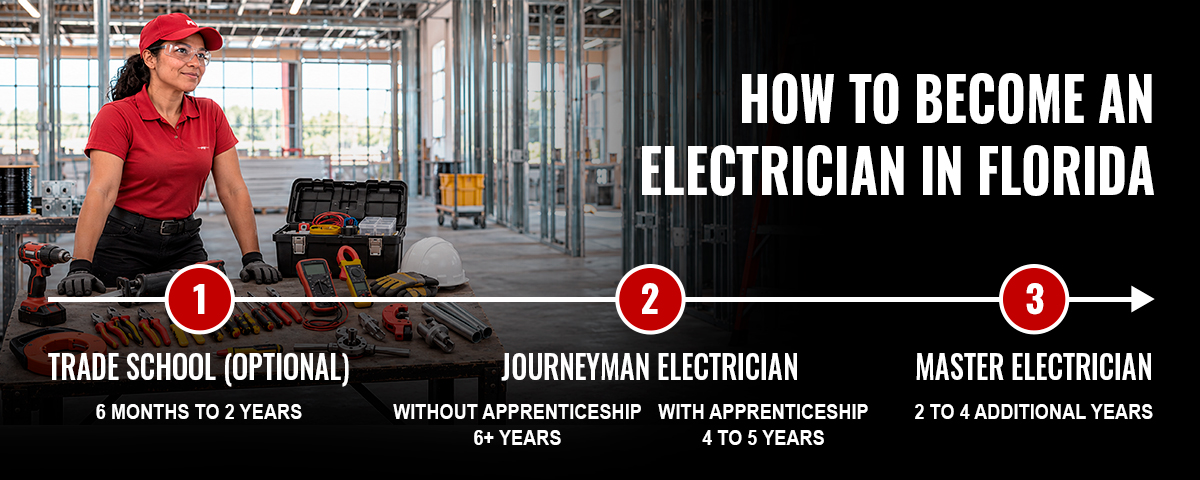
It takes approximately 4 to 5 years to become a licensed journeyman electrician in Florida through a registered apprenticeship combining roughly 8,000 hours of on-the-job training with classroom instruction. Reaching the master electrician level adds 2 to 4 more years depending on your county. Reaching the statewide Certified Electrical Contractor (EC) license adds additional experience and exam requirements on top of that.
Journeyman and Master Electrician Timeline in Florida
| STAGE OR CREDENTIAL | TIME REQUIRED FOR STAGE | TOTAL TIME FROM ENTRY | REQUIREMENTS AND NOTES |
|---|---|---|---|
| Trade School (Optional) | 6 months to 2 years | 6 months to 2 years | Provides foundational training but is not required to begin an apprenticeship. |
| Journeyman Electrician (Apprenticeship Path) | 4 to 5 years | 4 to 5 years | Typically 8,000 hours of on-the-job training plus classroom instruction in most Florida counties. |
| Journeyman Electrician (Without Apprenticeship) | 6+ years | 6+ years | At least 12,000 hours of on-the-job training without a registered apprenticeship (Florida Statute 489.5335). |
| Master Electrician | 2 to 4 additional years | 6 to 9 years* | Requires additional journeyman-level work experience, typically 2 to 4 years, depending on local licensing requirements. |
*The estimated total timeline for becoming a master electrician assumes completion of a registered apprenticeship followed by the required journeyman-level work experience. Actual timelines vary by local licensing requirements, and optional trade school may extend the overall timeline.
PLEASE NOTE: Florida does not require a journeyman or master electrician license before applying for a state Certified Electrical Contractor (EC) license.
The Certified Electrical Contractor (EC) license follows a separate path. Florida does not require a journeyman or master license before you apply, and the timeline depends on which experience pathway you qualify under.
Certified Electrical Contractor (EC) Timeline in Florida
| EXPERIENCE PATHWAY | YEARS OF EXPERIENCE NEEDED | COUNTED ONLY IF EARNED IN THE LAST |
|---|---|---|
| Management experience in the electrical trade | 3 years | 6 years before you apply |
| Foreman, supervisor, or contractor in the trade (including supervisory electrical work in the U.S. Armed Forces) | 4 years | 8 years before you apply |
| Comprehensive training, technical education, or broad experience with an electrical contracting business (or technical electrical work with the Armed Forces or a government entity) | 6 years | 12 years before you apply |
Requirements that apply to every pathway, according to the Florida DBPR:
- Experience must be recent. For example, the 4 years of foreman experience must fall within the 8 years before applying.
- At least 40 percent must be three-phase work. Three-phase power is the type used in most commercial and industrial buildings.
- Both state exams are required. Applicants must pass the technical exam and the business and finance exam.
This table shows the most common pathways. All seven are listed in Step 4.
Do You Need a License to Be an Electrician in Florida?
Not every electrician in Florida needs an individual state license. Employees and apprentices may perform electrical work within the scope of a properly licensed contractor’s work, subject to applicable supervision and local requirements. Journeyman credentials are issued locally, while anyone contracting directly with customers must hold the appropriate DBPR electrical contractor credential.
Certified Electrical Contractor (EC): Required to contract directly with property owners and pull permits statewide
Registered Electrical Contractor (ER): Required to contract within specific local jurisdictions
Journeyman and master credentials: Issued locally by counties and municipalities for electricians performing hands-on installation work
Apprentices and employees: If you are working as an apprentice or employee under the direct supervision of a licensed electrical contractor, you do not need your own individual license. The contractor’s license covers the work performed under their supervision.
One important clarification: journeyman and master electrician credentials in Florida do not authorize the holder to contract directly with property owners or pull permits independently. Those activities require a Certified or Registered Electrical Contractor license from the DBPR.
Florida Electrician License Renewal
Florida electrical contractor licenses expire on August 31 of every even-numbered year. Both Certified and Registered Electrical Contractors renew on the same cycle through the Florida DBPR.
Per the Florida DBPR Electrical Contractors’ Licensing Board, the continuing education requirements per renewal cycle are:
Certified Electrical Contractors (EC): 11 hours, including workers’ compensation, workplace safety, business practices, Florida Laws and Rules, Florida Building Code advanced module, and technical hours. Certified EC contractors who perform alarm work must also complete 2 hours of false alarm prevention
Registered Electrical Contractors (ER): 11 hours, same categories as EC contractors
Certified and Registered Alarm Contractors: 7 hours
Certified and Registered Specialty Contractors: 7 hours
Licenses cannot be renewed without completing the required continuing education hours. According to the Florida DBPR, the renewal fee for an active Certified Electrical Contractor license is $296, and the fee for an active Registered Electrical Contractor license is $121.
At Palmer Electric, staying current with Florida’s licensing and continuing education requirements is part of how we maintain our standing as a licensed and insured electrical contractor in Central Florida.
Common Florida Electrician Licensing Mistakes
Most licensing delays in Florida come from a few avoidable misunderstandings:
Treating a journeyman card like a contractor license
A journeyman card covers doing the work, not running the business. Starting an electrical business, bidding jobs, signing contracts, pulling permits, and advertising electrical services all require a state EC or ER license.
Contracting right after passing the exam
Passing both exams makes you eligible to apply for the license, not to start contracting. The initial license application, with its experience, financial, and insurance documents, still has to be approved and the license issued first.
Working outside a registered license’s area
An ER license only covers the counties or cities where its local card is valid. Working in another county may mean adding that county to the license, if the card qualifies there, or holding a statewide EC license.
Not keeping a job list as you go
The EC application asks for proof of experience, including each job’s description, location, and owner. Electricians who keep a running list and stay in touch with the contractors who can verify it have a much easier time applying.
Florida Electrician Career Outlook
Florida is one of the strongest markets for electricians in the country, driven by population growth, year-round construction activity, hurricane recovery and preparedness cycles, and a climate that creates consistent demand for electrical services across residential and commercial sectors.
According to O*NET OnLine, which is sponsored by the U.S. Department of Labor, electrician employment in Florida is projected to grow 19 percent from 2024 to 2034. O*NET OnLine’s national projection shows 9 percent growth from 2025 to 2035. While the projection periods differ, Florida’s projected growth rate is notably higher.
At Palmer Electric, we have been serving Orlando and Central Florida since 1951. The demand for qualified, licensed electricians in this market has never been stronger. Central Florida’s ongoing residential and commercial development, combined with the consistent need for storm preparation, generator installations, and electrical upgrades across aging properties, keeps our team consistently busy throughout the year.
How to Become an Electrician in Florida FAQs
Here are the most common questions people ask when researching how to become an electrician in Florida.
How to Become an Electrician in Florida?
To become an electrician in Florida, complete a high school diploma or GED, finish a registered apprenticeship combining approximately 8,000 hours of on-the-job training with classroom instruction, earn a local journeyman credential if your county requires one, and pass the Florida state contractor exam if your goal is to operate independently. Florida does not issue a statewide journeyman license. Journey-level credentials are handled at the county or municipal level.
How to Get an Electrician License in Florida?
To get an electrician license in Florida, apply through your local county or municipality for a journeyman credential, or apply to the Florida DBPR for a Certified Electrical Contractor (EC) or Registered Electrical Contractor (ER) license. Requirements vary depending on the credential. The EC license requires passing two state exams through Pearson VUE and meeting one of seven ECLB experience pathways, including at least 40 percent three-phase experience.
How Long Does It Take to Become an Electrician in Florida?
It typically takes 4 to 5 years to become a licensed journeyman electrician in Florida through a registered apprenticeship. Reaching master electrician status adds 2 to 4 years depending on your county. Obtaining a statewide Certified Electrical Contractor license adds additional experience and exam requirements. The total time depends on which of the seven ECLB experience pathways you qualify under.
Does Florida Have a Statewide Journeyman License?
No. Florida does not issue a statewide journeyman electrician license through the DBPR or the Electrical Contractors’ Licensing Board. Journey-level credentials are issued by individual counties and municipalities. Requirements, exams, and renewal processes vary by jurisdiction. Per Florida Statute 489.5335, counties and municipalities must recognize a journeyman license issued by any other Florida county or municipality.
Can a Felon Get an Electrician License in Florida?
Yes. A felony conviction does not automatically prevent you from getting an electrical contractor license in Florida. You must disclose your criminal history, and the Florida DBPR and Electrical Contractors’ Licensing Board review whether the offense relates to electrical contracting and whether you meet the state’s good moral character requirement.
Does a Puerto Rico Electrician License Work in Florida?
No, not automatically. However, Florida recognizes Puerto Rico’s Expert Electrician license for its 10-year endorsement pathway. If you have held the license for at least 10 years and meet Florida’s other requirements, you may apply for a Florida Certified Electrical Contractor license through DBPR without taking the Florida certification exam.
Can an Out-of-State Electrician License Transfer to Florida?
Sometimes, but only at the contractor level, and not automatically. Florida’s Electrical Contractors’ Licensing Board can grant a certified contractor license by endorsement to someone licensed in another state. Local journeyman and master electrician cards from other states don’t transfer. Those are handled by each Florida county or city.
There are two endorsement paths for contractors:
• Similar exam: you hold an out-of-state license and passed an exam the state considers substantially similar to Florida’s for that category. The ECLB keeps an Endorsement List of approved exams.
• 10 years licensed: you’ve held an out-of-state electrical contractor license for at least 10 years, in a similar scope, and it was active within the last 2 years. This path also requires a 2-hour Florida Building Code course.
Either way, you still have to meet Florida’s experience and financial requirements, and the endorsement application fee is $492. If your state or exam isn’t on the list, the review can take several months.
For journeyman and master cards, contact the licensing office where you plan to work. Some counties issue a temporary card while you take the local exam.
How Long Is Trade School for an Electrician in Florida?
Electrician trade school programs in Florida typically run 6 months to 2 years depending on the program and credential offered. Certificate programs run 6 to 12 months. Associate degree programs in electrical technology run approximately 2 years. Trade school is not required to begin an apprenticeship in Florida, but it can provide foundational knowledge and may count toward classroom instruction requirements in some registered apprenticeship programs.
Can I Become an Electrician in Florida Online?
No, not entirely online. You can complete some electrical theory, NEC, and safety coursework online, but Florida electrician credentials require verified hands-on training or work experience that cannot be completed online. The exact experience and licensing requirements depend on whether you pursue a local journeyman credential or a state electrical contractor license.
Conclusion
Becoming an electrician in Florida takes commitment, but the path is clear. The training is structured, the licensing requirements are well-defined, and the demand for qualified electricians in this state is strong and growing.
Florida’s licensing structure is more complex than most states because it splits licensing between local governments and the state. Understanding that split before you start, knowing which credential applies to your goals, and finding the right apprenticeship program for your county are the steps that set you up for success.
At Palmer Electric, we have seen what it looks like when electricians get the credentials right from the start. The ones who thrive in this market understand Florida’s licensing structure, stay current with code updates, and build their skills consistently over time.
We are always looking for motivated individuals who want to build a career in the electrical trade. If you’re ready to put your skills to work or take the first step toward becoming an electrician in Central Florida, explore career opportunities at Palmer Electric.
Looking for a Licensed Electrician in Central Florida?
Need a licensed and insured electrician for your home or business? Palmer Electric has been providing safe, reliable electrical services in Orlando and Central Florida since 1951. Contact Palmer Electric today or call 407.646.8700 for a free estimate.
References
- Florida Legislature, Florida Statute 489.5335, Journeyman Reciprocity and Standards, 2026: https://www.leg.state.fl.us/statutes/index.cfm?App_mode=Display_Statute&URL=0400-0499%2F0489%2FSections%2F0489.5335.html
- Florida Legislature, Florida Statute 489.511, Certification, Application and Examinations, 2026: https://www.flsenate.gov/Laws/Statutes/2026/489.511
- Florida DBPR, Electrical Contractors’ Licensing Board: https://www2.myfloridalicense.com/electrical-contractors/
- Florida DBPR, Electrical Contractors’ Licensing Board FAQs: https://www2.myfloridalicense.com/electrical-contractors/faqs/
- Florida DBPR, Certified Electrical Contractor Initial Application Checklist (ECLB 1): https://www.myfloridalicense.com/CheckListDetail.asp?SID=&xactCode=1030&clientCode=0801&XACT_DEFN_ID=3657
- Florida ECLB, 10-Year Endorsement List, updated March 2026: https://www2.myfloridalicense.com/pro/elboard/documents/10-year_endorsement.pdf
- Florida Administrative Code, Rule 61G6-5.003, Requirements for Certification: https://flrules.org/gateway/ruleNo.asp?id=61G6-5.003
- Florida Administrative Code, Rule 61G6-5.004, Requirement for Business Organizations: https://flrules.org/gateway/ruleNo.asp?id=61G6-5.004
- Florida Administrative Code, Rule 61G6-6.017, Examination Scores: https://flrules.org/gateway/ruleno.asp?id=61G6-6.017
- O*NET OnLine, U.S. Department of Labor, Florida Employment Trends: Electricians (47-2111.00), updated October 2026: https://www.onetonline.org/link/localtrends/47-2111.00?st=FL
- Orange Technical College, Electrical Apprenticeship (FEAT): https://www.orangetechcollege.net/electrical-apprenticeship
- Daytona State College, Electrical Apprentice – Non-Union, 2026–2027 Catalog: https://daytonastate.smartcatalogiq.com/en/2026-2027/college-catalog/program-guides/apprenticeship/electrical-apprentice-non-union
- Electrical Training Alliance of Central Florida, Programs: https://www.etacfl.org/programs
- Florida Department of Education, Registered Apprenticeship Participating Employers by Company: https://www.fldoe.org/core/fileparse.php/5626/urlt/business-by-company.pdf
- Orange Technical College, Electricity Program: https://orangetechcollege.net/electricity-program-brochure
- Erwin Technical College, Career Certificate Programs: https://erwin.edu/career-certificate-programs
- Orange County, Florida, Code of Ordinances, Ch. 9, Sec. 9-116 to 9-118 (Municode): https://library.municode.com/
- Volusia County Contractor Licensing, Application for Examination: Master Electrician / Local Specialty: https://www.volusia.org/file/6093/Specialty-Master-Elec-App-2022.pdf
- Seminole County, License Administration Form: https://www.seminolecountyfl.gov/docs/default-source/pdf/licenseadministration04052024ada.pdf
- City of Jacksonville, Ordinance Code, Ch. 342, Sec. 342.101 and 342.112 (Municode): https://library.municode.com/
- Miami-Dade County, Code of Ordinances, Ch. 10, Sec. 10-2 and 10-3 (Municode): https://library.municode.com/
- Miami-Dade County Construction Trades Qualifying Board, Certification Categories: https://www.miamidade.gov/resources/economy/board-and-code/ctqb/certification-categories.pdf
- Hillsborough County, Application Instructions for Local Specialty and State Registered (Certificate of Competency), rev. 01/2026: https://assets.contentstack.io/v3/assets/blteea73b27b731f985/blt53467c8970ba3203/Local%20Specialty%20State%20Registered%20Fillable.pdf
- Hillsborough County, Journeyman Electrician or Plumber Certificate of Competency: https://hcfl.gov/businesses/hillsgovhub/contractor-licensing/journeyman-electrician-or-plumber-certificate-of-competency
- Palm Beach County, Special Act, Chapter 67-1876, Laws of Florida, as amended: https://discover.pbc.gov/Pages/default.aspx
- Broward County, Code of Ordinances, Ch. 9, Sec. 9-1 and 9-11 (Municode): https://library.municode.com/
- Pinellas County, Code of Ordinances, Ch. 26, Sec. 26-91, 26-93, and 26-109 (Municode): https://library.municode.com/
- Pinellas County Construction Licensing Board: https://pinellas.gov/construction-licensing-board/
- City of Orlando, Code of Ordinances, Ch. 22, as amended by Ord. No. 2015-55 (Municode): https://library.municode.com/
- City of Port St. Lucie, Contractor Licensing: https://www.cityofpsl.com/Business/Building-Commercial/Contractor-Licensing
- City of Tallahassee, Certificate of Competency Application Packet: https://2ndcircuit.talgov.com/Uploads/Public/Documents/growth/forms/competency_cert_app_packet.pdf
- Lake County Code of Ordinances, Chapter 6, Article VI, Section 6-83: Requirements for Local Licensure
https://library.municode.com/fl/lake_county/codes/code_of_ordinances?nodeId=LACOCO_CH6BUCO_ARTVILORELOLICO - Osceola County Code of Ordinances, Chapter 5, Article V, Division 2, Section 5-189(3)(p): Qualifications and Eligibility Requirements
https://library.municode.com/fl/osceola_county/codes/code_of_ordinances?nodeId=PTIIOSCOCOOR_CH5BUBURE_ARTVCOCO_DIV2CEEX